

Powder coating generally offers better durability, scratch resistance, and cost efficiency for high-volume metal parts. Painting is more flexible for custom colors, thinner coatings, small batches, and easy repairs.
Both finishes protect metal surfaces, but the best choice depends on your part’s material, operating environment, production volume, and dimensional requirements. This guide compares their key differences to help you choose the right finish.
Powder Coating vs Painting: Quick Comparison
| Feature | Powder Coating | Painting |
|---|---|---|
| Application | Electrostatic dry powder | Liquid coating |
| Typical Thickness | 50–120 μm | 20–60 μm for many conventional systems |
| Durability | Generally high | Depends on paint system |
| Scratch Resistance | Generally better | Varies by formulation |
| Corrosion Resistance | Excellent with proper pretreatment | Excellent with suitable primer and topcoat |
| Color Options | Wide range | Greater customization flexibility |
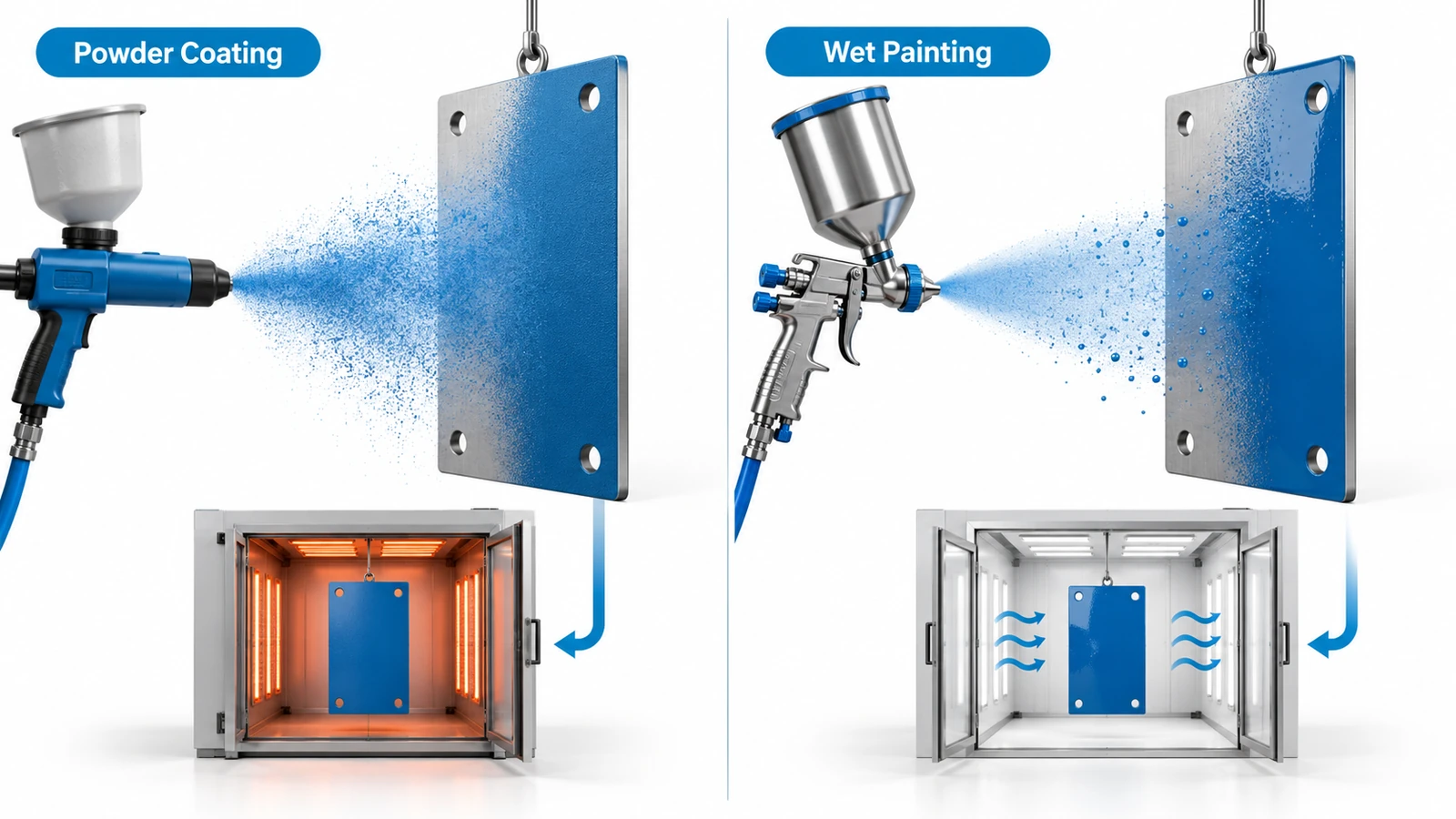
| Curing | Usually requires oven heating | Air-dried or heat-cured |
| Tight Tolerances | Careful masking required | Thinner systems offer more flexibility |
| Repairability | More difficult | Easier to touch up |
| Small Batches | Setup can increase cost | Often more economical |
| Large Batches | Often cost-effective | Depends on coating system |
| VOC Emissions | Very low | Depends on formulation |
These thickness ranges are typical examples, not fixed specifications. Multi-layer painting systems can be thicker than powder coatings.
What Is Powder Coating?
Powder coating is a dry finishing process that applies electrically charged powder particles to a grounded metal surface. The coated part is then heated, allowing the powder to melt and form a continuous protective layer.
The process typically involves surface preparation, electrostatic powder application, oven curing, and inspection.
Powder coating is commonly used on aluminum and steel components, including equipment housings, mounting brackets, machine guards, and automotive parts.
Its main advantages include:
- Good scratch and abrasion resistance
- Consistent appearance across production batches
- Excellent corrosion protection with proper pretreatment
- Low VOC emissions during application
However, powder coating usually produces a relatively thick film and requires heat curing. These factors can limit its suitability for precision features and temperature-sensitive assemblies.
What Is Painting?
Painting, also called wet painting or liquid coating, involves applying liquid paint through spraying, dipping, or other methods. The coating then dries or cures to form a protective film.
Industrial painting may use acrylic, epoxy, or polyurethane coatings, depending on the required appearance and performance.
Painting offers several advantages:
- Flexible color matching and decorative finishes
- Thinner coating options
- Easier local repairs and touch-ups
- Greater flexibility for prototypes and small batches
Many liquid coatings can cure at room temperature, making them suitable for components that cannot withstand conventional powder coating temperatures.
However, conventional painting may require multiple layers to achieve the desired protection, and some solvent-based formulations produce VOC emissions.
Powder Coating vs Painting: 8 Key Differences
1. Durability and Scratch Resistance
Powder coating generally offers better resistance to scratching, chipping, and everyday abrasion than conventional single-layer paint. Its continuous film makes it suitable for frequently handled industrial components.
However, high-performance epoxy and polyurethane paint systems can also provide excellent durability.
Choose powder coating for general-purpose industrial parts requiring a robust finish. Consider specialized painting systems when the operating environment demands particular chemical or protective properties.
2. Coating Thickness
Powder coating commonly produces a dry film thickness of approximately 50–120 μm. Many conventional liquid coatings are thinner, although multi-layer paint systems may be considerably thicker.
This difference matters for precision components.
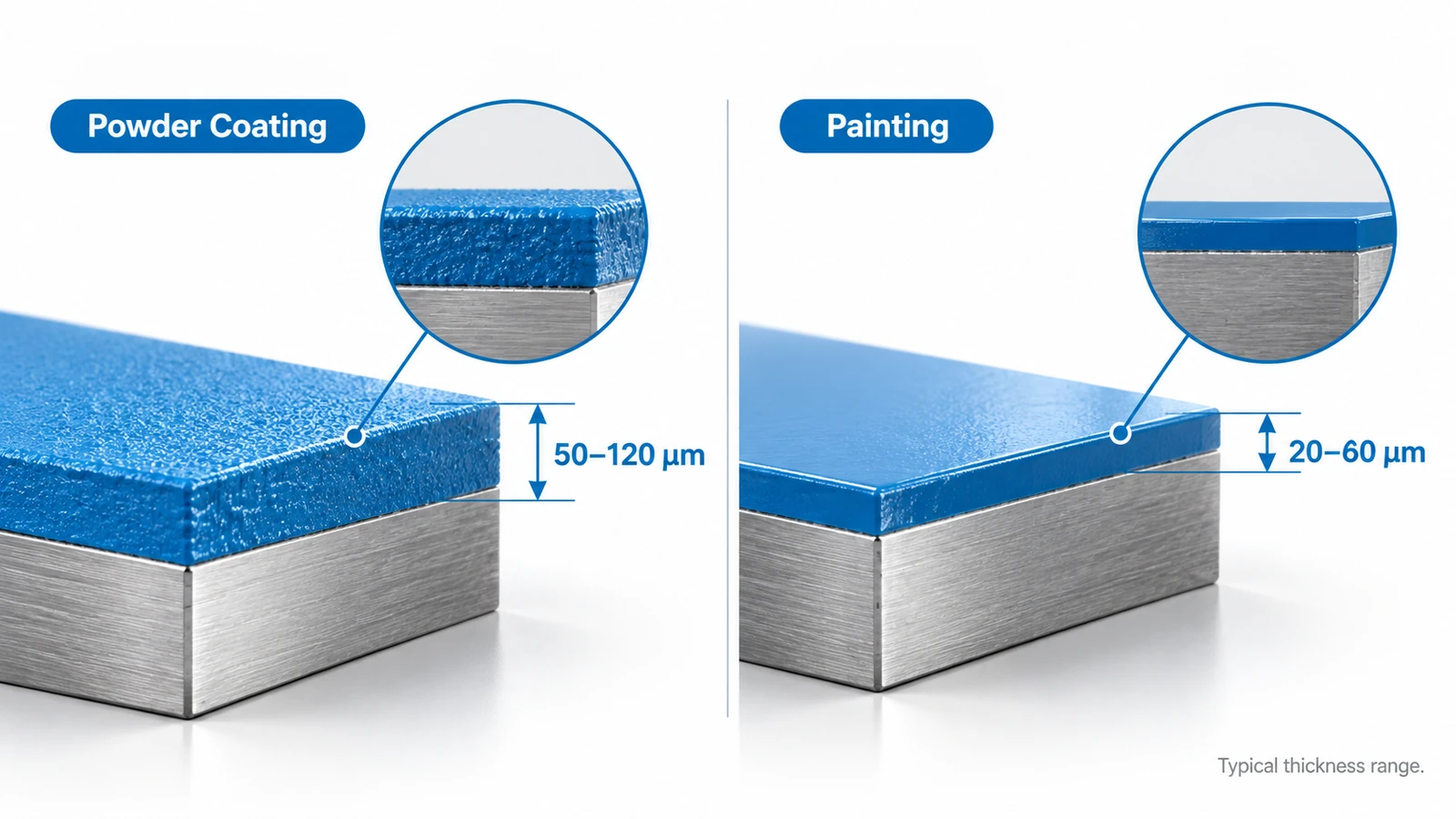
For example, a 10.00 mm bore receiving a uniform 70 μm coating on its internal surface would have a finished diameter of approximately:
10.00 − (0.07 × 2) = 9.86 mm
That 0.14 mm reduction could prevent a bearing or closely fitted component from assembling correctly.
Actual coverage inside holes may vary, so this calculation illustrates dimensional impact rather than predicting the exact finished diameter.
For tight-tolerance CNC parts, specify the required dimensions after finishing and mask critical surfaces when necessary.
3. Surface Appearance and Color
Both finishes are available in matte, satin, gloss, and textured options.
Powder coating provides a consistent appearance for production parts, while painting offers greater flexibility for precise color matching, decorative effects, and multi-color finishes.
Choose painting when brand colors or complex cosmetic requirements are critical. Powder coating is often sufficient for standard industrial colors.
4. Corrosion and Weather Resistance
Both processes can provide excellent corrosion protection when properly specified.
Exterior-grade polyester powder coatings are commonly used for outdoor aluminum components. Industrial paint systems with appropriate primers and topcoats can also perform well in demanding environments.
Surface preparation, pretreatment, coating chemistry, and film thickness all affect protection.
For marine, chemical, or highly corrosive conditions, evaluate the complete coating system rather than assuming powder coating is always superior.
5. Cost and Production Volume
Painting is often economical for prototypes and small batches because it offers flexible setup and color changes.
Powder coating may become more cost-effective for larger production runs due to repeatable application and efficient material use.
| Production Requirement | Usually More Practical |
|---|---|
| Single prototype | Painting |
| Small custom batch | Painting |
| Large batch of identical brackets | Powder coating |
| High-volume metal enclosures | Powder coating |
| Frequent custom color changes | Painting |
These are general recommendations, not fixed rules. Actual costs depend on part size, quantity, masking, material, coating specifications, and supplier setup charges.
6. Environmental Impact
Powder coating is typically applied without solvents, resulting in very low VOC emissions. Some application systems can also recover unused powder.
Liquid painting varies by formulation. Solvent-based paints may release VOCs, while water-based and high-solids systems can reduce emissions.
Powder coating generally offers an advantage in application-stage VOC emissions, although curing energy and pretreatment must also be considered.
7. Material Compatibility
Conventional powder coating usually requires oven curing, often around 180–200°C at the metal surface, depending on the formulation.
This can be unsuitable for assemblies containing heat-sensitive seals, adhesives, plastics, or electronics.
Many liquid paint systems cure at lower temperatures and offer greater flexibility for these components.
When possible, coat metal housings before installing temperature-sensitive parts.
8. Repair and Maintenance
Painting is generally easier to repair. Damaged areas can often be prepared and repainted locally.
Powder coating is more difficult to restore invisibly because matching the original texture and appearance can be challenging. Severe damage may require complete recoating.
For equipment requiring frequent field repairs, painting may reduce maintenance complexity.
Which Finish Is Better for CNC Machined Parts?
For CNC machined components, choosing between powder coating and painting requires careful consideration of part geometry and dimensional tolerances.
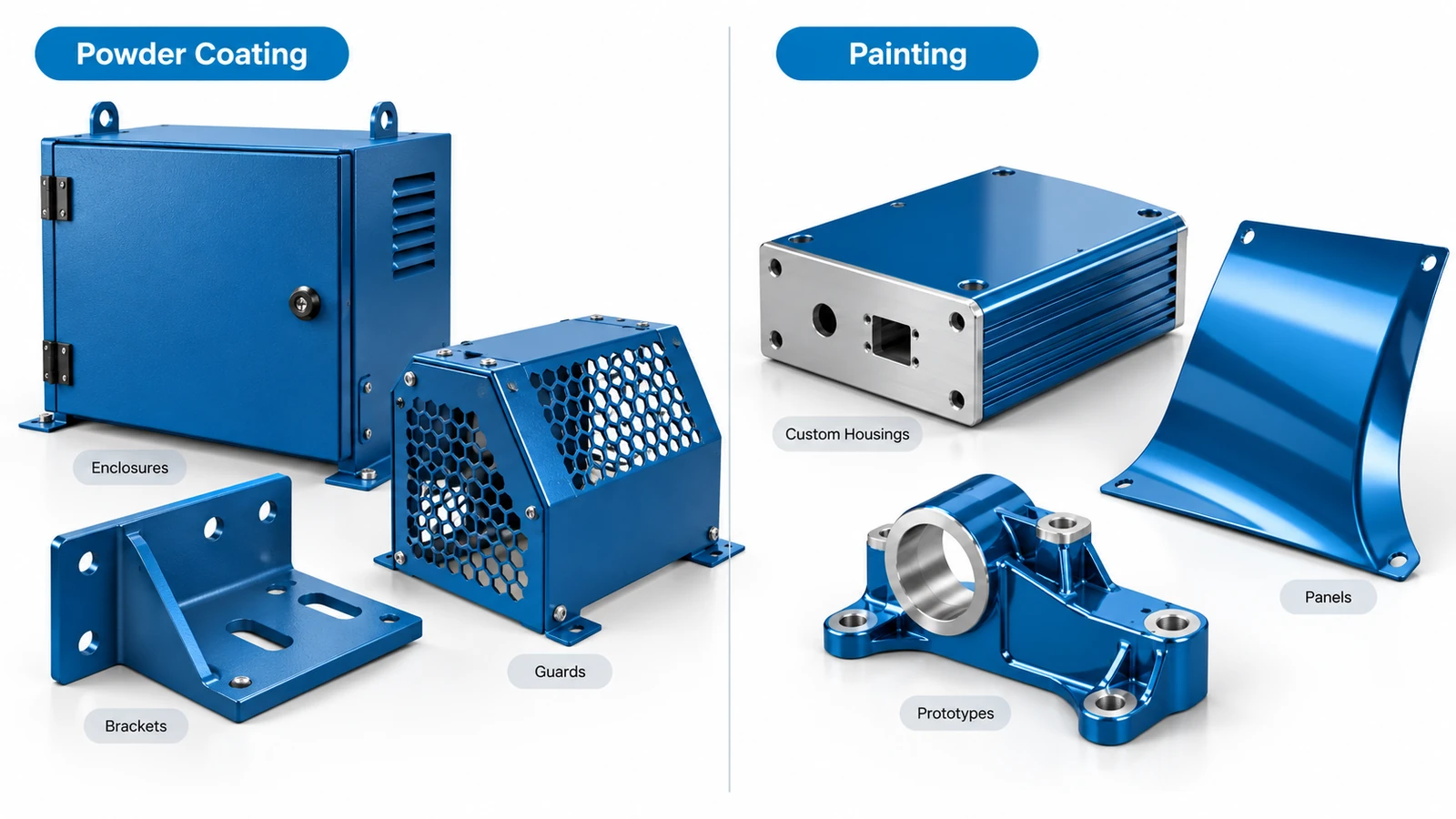
Powder coating works well for aluminum housings, steel brackets, machine guards, and equipment enclosures where thicker coatings are acceptable.
However, coating buildup can interfere with precision features.
Which Features Should Be Masked?
| CNC Feature | Reason for Masking |
|---|---|
| Threaded holes | Prevents interference with fasteners |
| Bearing seats | Preserves required fits |
| Precision bores | Prevents diameter reduction |
| Mating surfaces | Maintains assembly clearances |
| Locating faces | Preserves positioning accuracy |
| Electrical contacts | Maintains electrical continuity |
| Sealing surfaces | Protects functional sealing geometry |
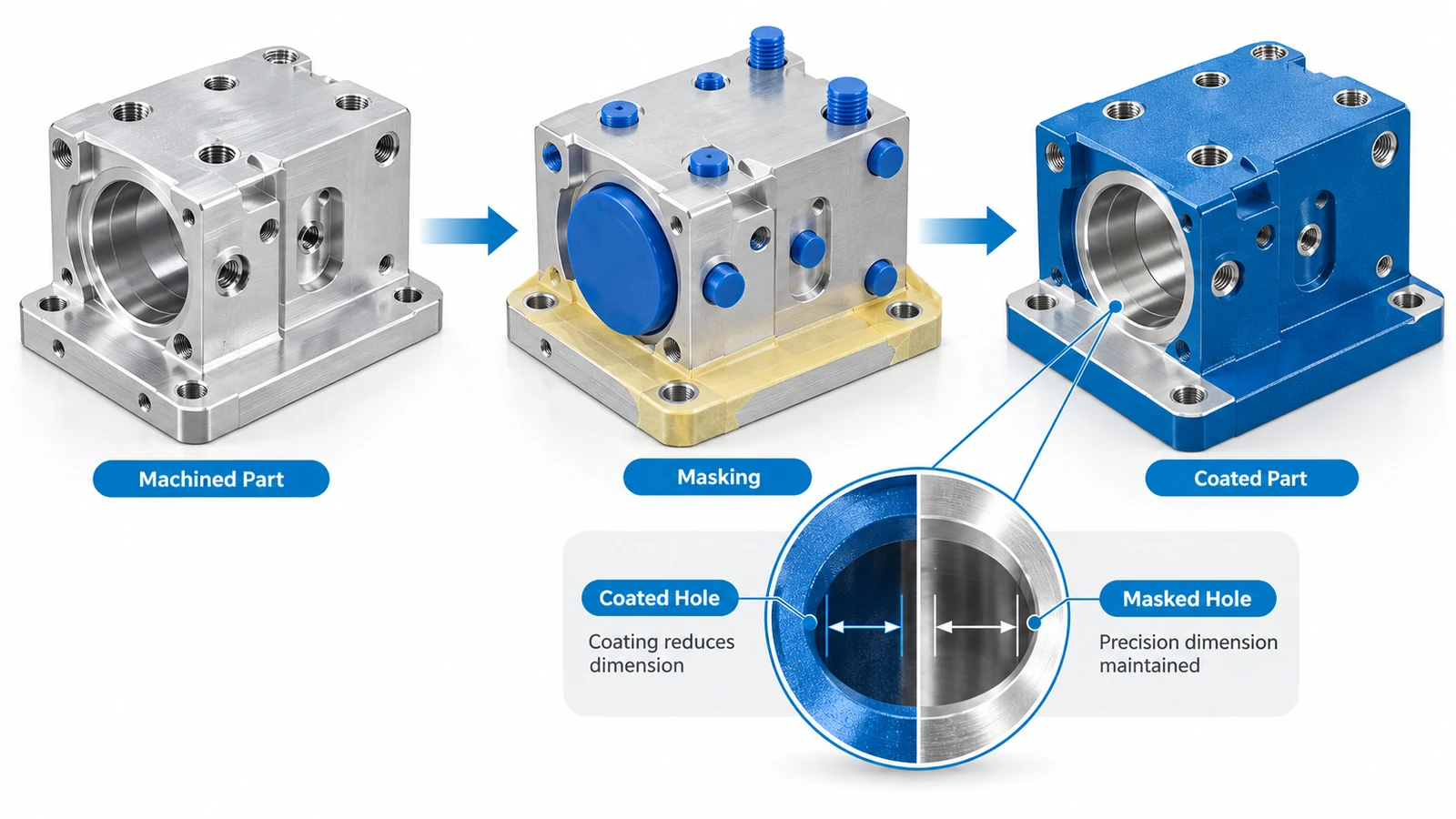
For most parts, the preferred production sequence is:
CNC Machining → Deburring → Surface Preparation → Masking → Coating → Inspection
Critical features should be identified on engineering drawings before finishing.
Powder Coating vs Painting Aluminum Parts
For outdoor aluminum enclosures and industrial brackets, powder coating often provides a durable and consistent finish.
Painting may be more practical for aluminum prototypes, custom cosmetic finishes, or components requiring thinner coatings.
For precision aluminum parts, anodizing is another option worth considering. It creates an oxide layer rather than depositing a thick external coating, although dimensional changes must still be accounted for.
Engineering tip: Always specify whether dimensional tolerances apply before or after finishing. This helps prevent costly assembly problems.
How to Choose Between Powder Coating and Painting
The best finishing method depends on how the component will be used.
| Your Priority | Recommended Starting Point |
|---|---|
| Durability for general industrial use | Powder coating |
| High-volume production | Powder coating |
| Low-VOC application | Powder coating |
| Thin protective finish | Painting |
| Exact custom color | Painting |
| Small-batch prototypes | Painting |
| Easy field repairs | Painting |
| Heat-sensitive assemblies | Suitable low-temperature painting |
| Tight-tolerance features | Evaluate masking or alternative finishes |
| Severe corrosion exposure | Compare qualified coating systems |
Before making your final decision, confirm the required coating thickness, operating environment, production quantity, cosmetic requirements, and dimensional tolerances.
For precision components, these factors are more important than choosing a finish based on appearance alone.
Powder Coating vs Painting: Final Verdict
Neither powder coating nor painting is universally better.
Powder coating is usually preferable for durable, repeatable finishes on production metal parts. Painting offers more flexibility for thin coatings, prototypes, special colors, and repairs.
For CNC machined parts, the best finish must also preserve critical dimensions and assembly functions.
At YuanYi Precision Manufacturing, we help customers evaluate CNC machining requirements and suitable surface finishes before production, including coating thickness and masking considerations.
Need precision CNC machined parts with custom surface finishing? Send us your drawings and project requirements for a quotation and DFM review.
Frequently Asked Questions
Powder coating generally provides a durable finish for industrial metal parts. Painting is often better when thin coatings, custom colors, or easy repairs are required.
Powder coating often outlasts conventional single-layer paint, but high-performance industrial paint systems can provide comparable or better protection in certain environments.
Powder coating may cost more for small batches because of setup requirements, but it can be economical for larger production runs. Actual prices depend on coating specifications and production volume.
Yes. Aluminum is commonly powder coated for housings, brackets, panels, and outdoor equipment. Proper pretreatment helps ensure good coating adhesion and corrosion resistance.
Yes. Powder coating adds thickness to exposed surfaces and can change hole diameters, fits, and assembly clearances. Critical machined features should be masked or designed to accommodate the finished coating.



