

Cast iron and steel are both iron-based materials, but they behave very differently in manufacturing and service. Cast iron generally contains more carbon and offers excellent vibration damping, castability, and compressive performance, while steel usually provides higher tensile strength, toughness, and impact resistance.
For CNC machined parts, neither material is universally better. Cast iron is commonly used for machine bases, housings, pump bodies, and other rigid components, while steel is often preferred for shafts, gears, brackets, and parts exposed to tension, bending, or impact.
The right choice depends on the required strength, machinability, wear resistance, operating environment, manufacturing process, and total part cost.
Cast Iron vs Steel at a Glance
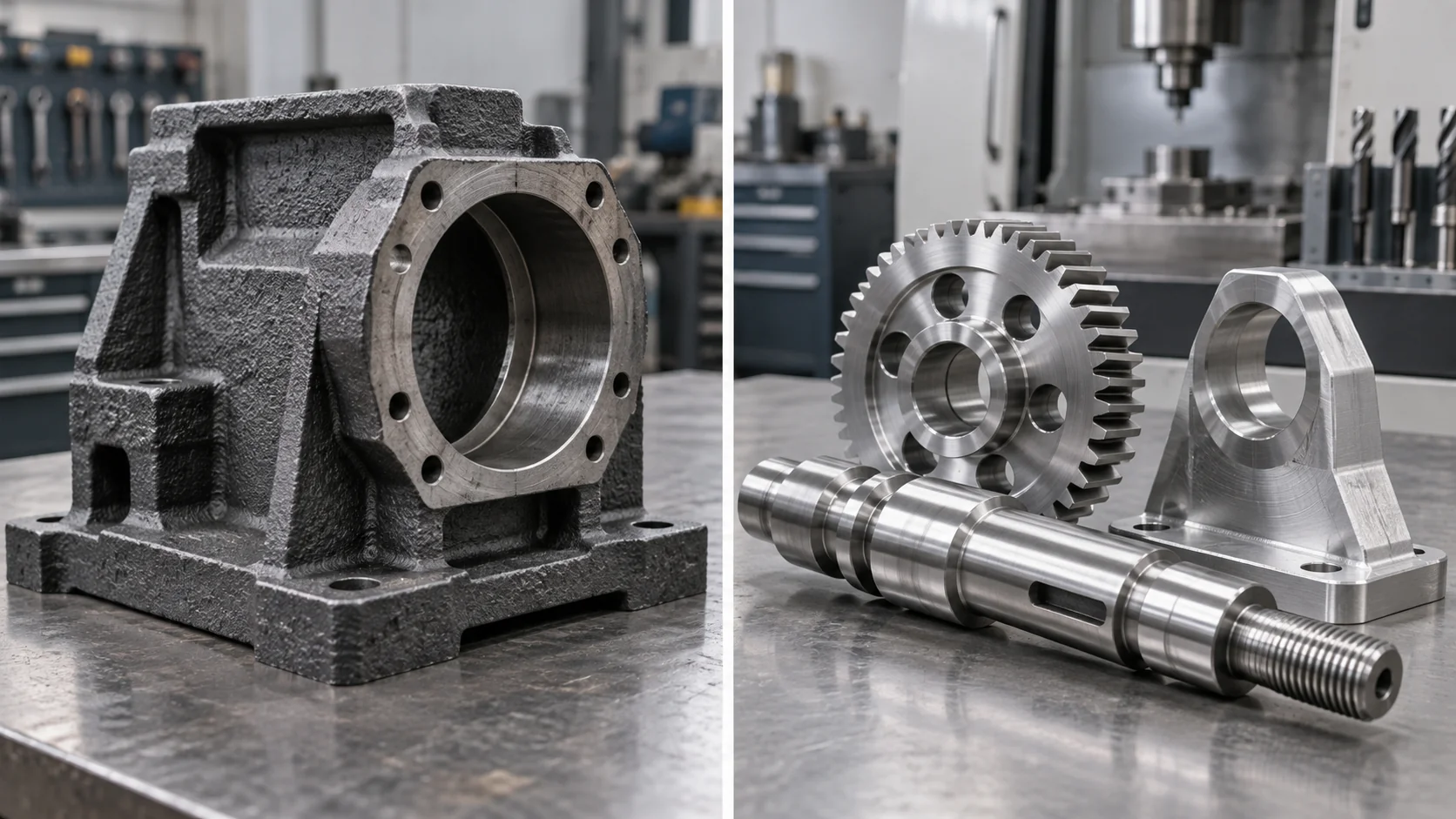
The table below summarizes the main differences between cast iron and steel for manufactured and CNC machined parts.
| Property | Cast Iron | Steel |
|---|---|---|
| Carbon Content | Typically about 2–4% | Generally below 2% |
| Tensile Strength | Usually lower | Usually higher |
| Compressive Performance | Excellent | Excellent |
| Toughness | Lower for many grades | Generally higher |
| Impact Resistance | Lower | Higher |
| Vibration Damping | Excellent | Lower |
| Castability | Excellent | Moderate to good |
| Weldability | Usually more difficult | Generally better |
| Machinability | Good for many gray iron grades | Highly dependent on grade and hardness |
| Brittleness | Higher | Lower |
| Heat Treatment Options | Grade dependent | Extensive |
| Typical Parts | Machine bases, housings, pump bodies | Shafts, gears, brackets, structural parts |
These are general comparisons. Actual performance can vary significantly between specific cast iron and steel grades.
What Is Cast Iron?
Cast iron is a group of iron-carbon alloys containing a relatively high percentage of carbon. Its composition and microstructure give it excellent castability and make it suitable for producing complex or heavy components.
Common types of cast iron include:
- Gray Cast Iron: Widely used for machine bases, engine components, housings, and industrial equipment because of its good machinability and vibration damping.
- Ductile Iron: Provides greater ductility and impact resistance than gray iron and is commonly used in automotive and heavy equipment parts.
- White Cast Iron: Hard and wear-resistant but relatively brittle, making it useful for abrasive environments.
- Malleable Iron: Heat-treated to improve toughness and ductility.
- Compacted Graphite Iron: Offers properties between gray and ductile iron and is often used in demanding automotive applications.
For CNC machining, gray cast iron is particularly common because its graphite structure can promote chip breaking and relatively stable cutting behavior.
What Is Steel?
Steel is also an iron-carbon alloy, but it normally contains less carbon than cast iron. Its properties can be adjusted significantly through alloying and heat treatment.
Major steel categories include:
- Carbon Steel: Includes low-, medium-, and high-carbon steels used for general mechanical parts.
- Alloy Steel: Contains elements such as chromium, molybdenum, or nickel to improve strength, hardenability, or wear resistance.
- Stainless Steel: Contains chromium for improved corrosion resistance.
- Tool Steel: Designed for high hardness, wear resistance, and dimensional stability.
Steel offers a wider range of mechanical properties than cast iron, which is one reason it is used for shafts, gears, fasteners, structural components, tooling, and precision CNC machined parts.
Cast Iron vs Steel: What Are the Main Differences?
Carbon Content
Carbon content is one of the most important differences between cast iron and steel.
Cast iron generally contains approximately 2–4% carbon, while most steels contain less than 2% carbon.
The higher carbon content of cast iron contributes to its excellent castability and hardness, but it also tends to make many cast iron grades more brittle.
Steel’s lower carbon content generally allows better ductility and toughness, although high-carbon and hardened steels can also become significantly harder and less ductile.
Strength
The question “Is steel stronger than cast iron?” depends on what type of strength is being considered.
Steel usually performs better under tensile, bending, and impact loads. This makes it suitable for shafts, structural components, gears, and other parts that experience dynamic loading.
Cast iron performs very well under compression and provides excellent rigidity, making it suitable for machine frames, bases, and heavy housings.
Therefore, simply comparing one “strength” value can be misleading.
Toughness and Impact Resistance
Steel generally has better toughness and can absorb more energy before fracture.
Many cast irons, particularly gray cast iron, are more brittle and are less suitable for components exposed to sudden impact or heavy shock loads.
Ductile iron improves significantly on this limitation and can offer much better impact performance than gray iron, although material selection should still be based on the actual grade and application.
Hardness and Wear Resistance
Both steel and cast iron can provide excellent wear resistance.
Certain white cast irons are particularly resistant to abrasive wear because of their hard microstructure.
Steel, however, provides much greater flexibility through heat treatment. Grades such as 4140, tool steels, and other alloy steels can be hardened to achieve high surface hardness and wear resistance while maintaining suitable core properties.
This makes steel especially useful for gears, shafts, tooling, and heavily loaded mechanical parts.
Which Has Better Vibration Damping?
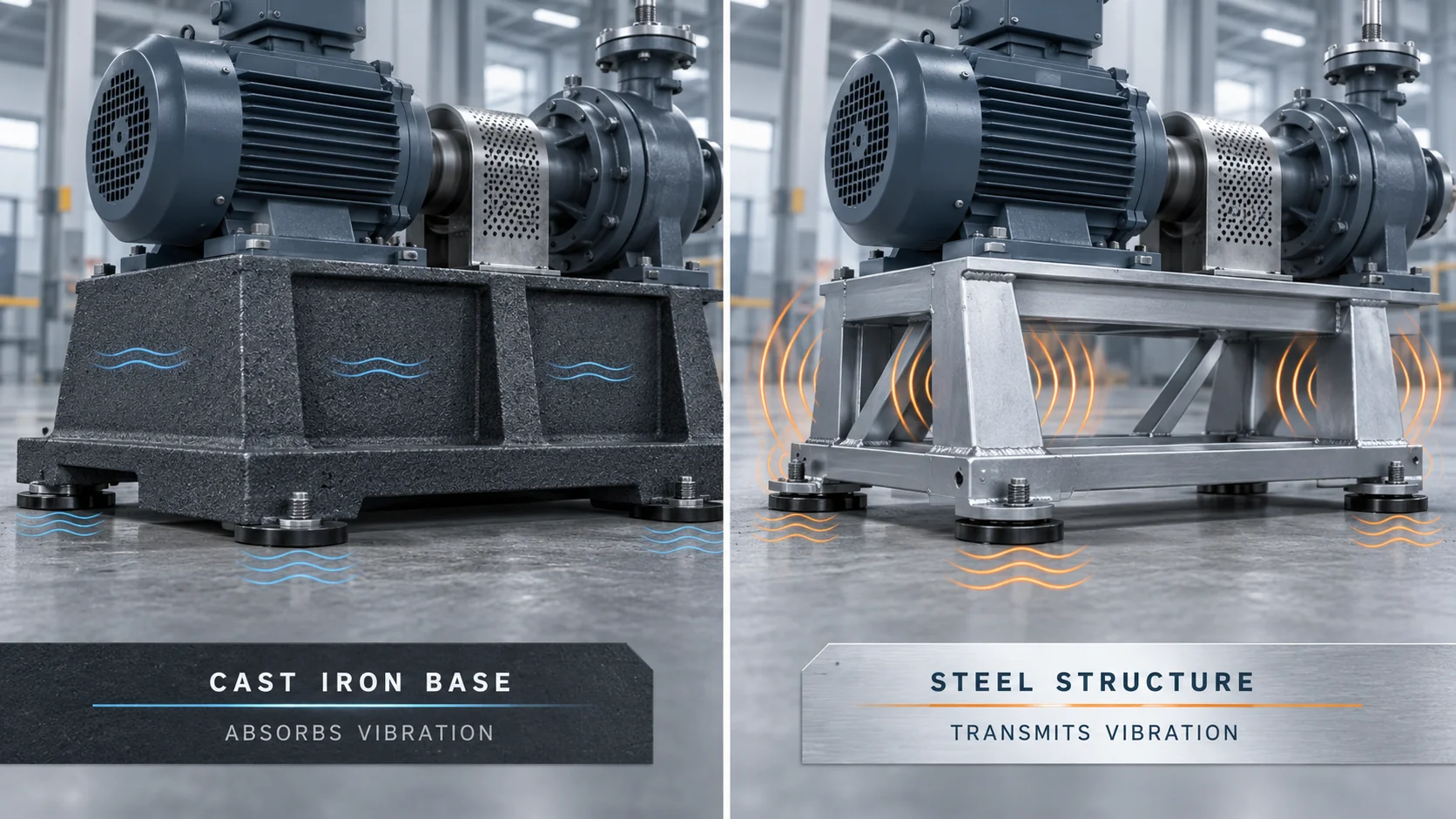
One of cast iron’s most important engineering advantages is its ability to absorb vibration.
Gray cast iron is especially effective at damping vibration due to its graphite microstructure. This is why it has traditionally been used for:
- CNC machine beds
- Lathe bases
- Milling machine frames
- Gearbox housings
- Industrial equipment bases
Steel structures can provide high strength and rigidity, but they generally transmit more vibration.
For equipment where vibration control and dimensional stability are important, cast iron can therefore offer a significant advantage.
Which Material Is Easier to Cast?
Cast iron normally has better castability.
Its relatively low melting characteristics and good fluidity make it suitable for producing complicated shapes, thick sections, ribs, internal cavities, and large components.
This is one reason cast iron is commonly used for pump housings, machine bases, valve bodies, and engine blocks.
Steel can also be cast, but steel casting generally requires higher processing temperatures and more demanding process control.
However, steel is also widely available as bar, plate, tube, forging, and other wrought forms, so many CNC machined steel components do not require casting at all.
Cast Iron vs Steel: Which Is Easier to Weld?
Steel is generally easier to weld than cast iron.
Many low-carbon steels offer good weldability and can be welded using conventional industrial processes with relatively straightforward preparation.
Cast iron requires more care because of its carbon content and brittle structure. Improper heating or cooling can lead to cracking.
Depending on the cast iron grade, successful welding may require:
- Preheating
- Controlled heat input
- Special filler materials
- Slow cooling
- Post-weld treatment
If a component requires extensive welded fabrication, steel is usually the more practical starting material.
Cast Iron vs Steel Corrosion Resistance
Neither standard cast iron nor carbon steel is naturally highly resistant to corrosion.
Both materials can rust when exposed to moisture, chemicals, or aggressive environments.
Their corrosion performance depends heavily on:
- Alloy composition
- Surface condition
- Coating
- Operating environment
- Maintenance
Steel offers more corrosion-resistant options, particularly stainless steels such as 304 and 316.
Cast iron parts can also be protected using paint, plating, coating, oil, or other surface treatments.
For outdoor or chemically aggressive applications, corrosion requirements should be considered separately from mechanical strength.
Cast Iron vs Steel for CNC Machining
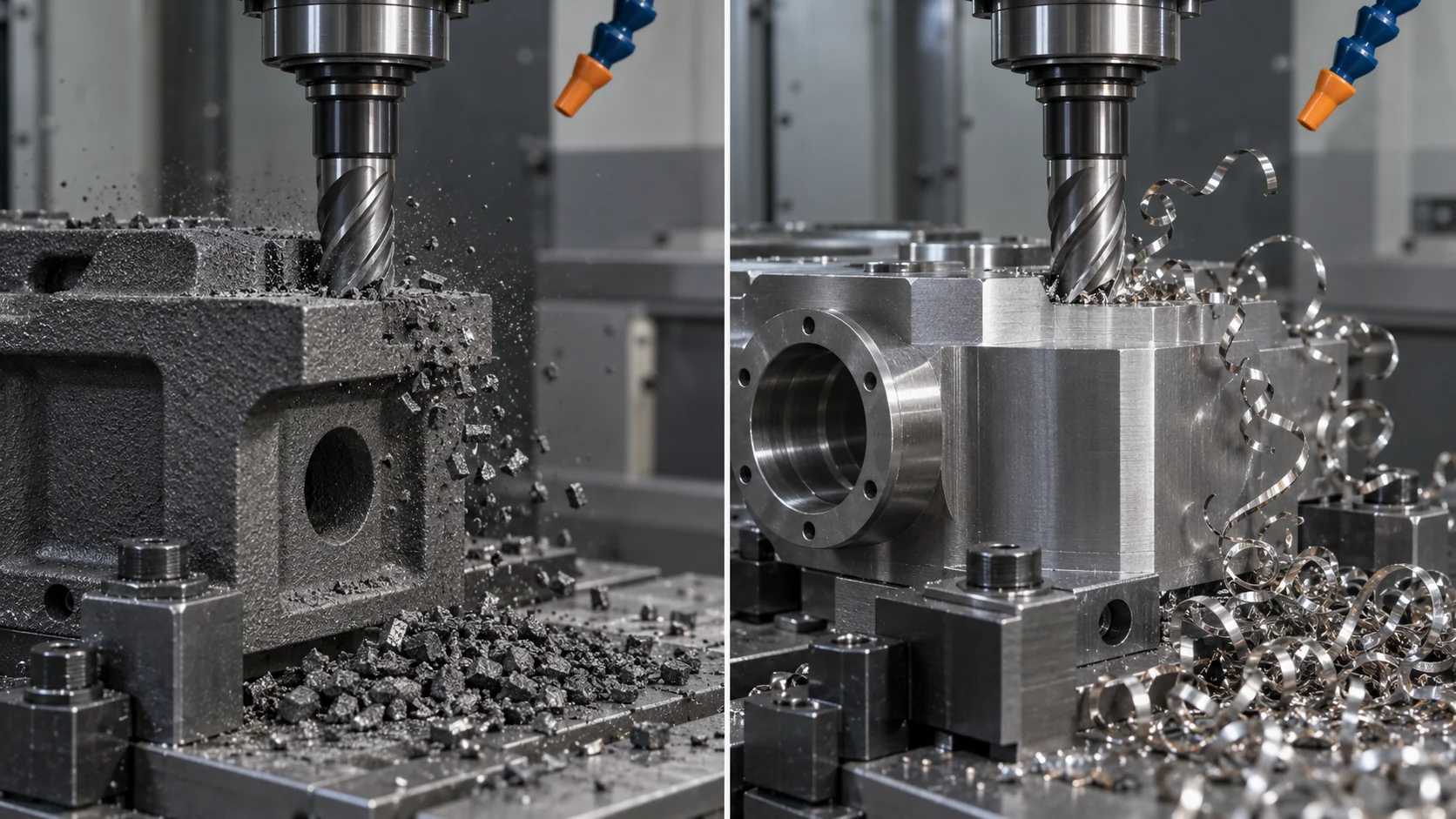
Machinability is where the comparison becomes more complicated.
It is not accurate to say that either all cast irons or all steels are easier to CNC machine. Machining behavior depends heavily on material grade, hardness, microstructure, heat treatment, and part geometry.
Cast Iron Machinability
Gray cast iron often offers good machinability.
Its graphite structure helps promote short chips and can reduce friction during cutting. This makes many gray iron grades relatively efficient for turning, milling, drilling, and boring.
However, cast iron machining also presents challenges.
Its chips can break into fine particles and dust, and harder phases in some grades may cause abrasive tool wear.
Machine protection, chip control, tooling selection, and effective dust management are therefore important.
Ductile iron can also be machined effectively, but its tougher structure may produce different cutting behavior from gray iron.
White cast iron is significantly more difficult to machine because of its high hardness and wear resistance.
Steel Machinability
Steel machinability varies much more widely.
Low-carbon steels can generally be CNC machined efficiently, while high-carbon, alloyed, hardened, or stainless grades may require lower cutting speeds and more wear-resistant tooling.
For example:
- Mild steel is generally straightforward to machine.
- 1045 steel is stronger but can require more cutting force.
- 4140 steel becomes more demanding as hardness increases.
- Hardened alloy steel can significantly increase tool wear and machining time.
- Stainless steel may generate heat and work harden during machining.
For this reason, engineers should compare specific grades rather than treating “steel” as a single material.
How Do Cast Iron and Steel Affect Tool Wear?
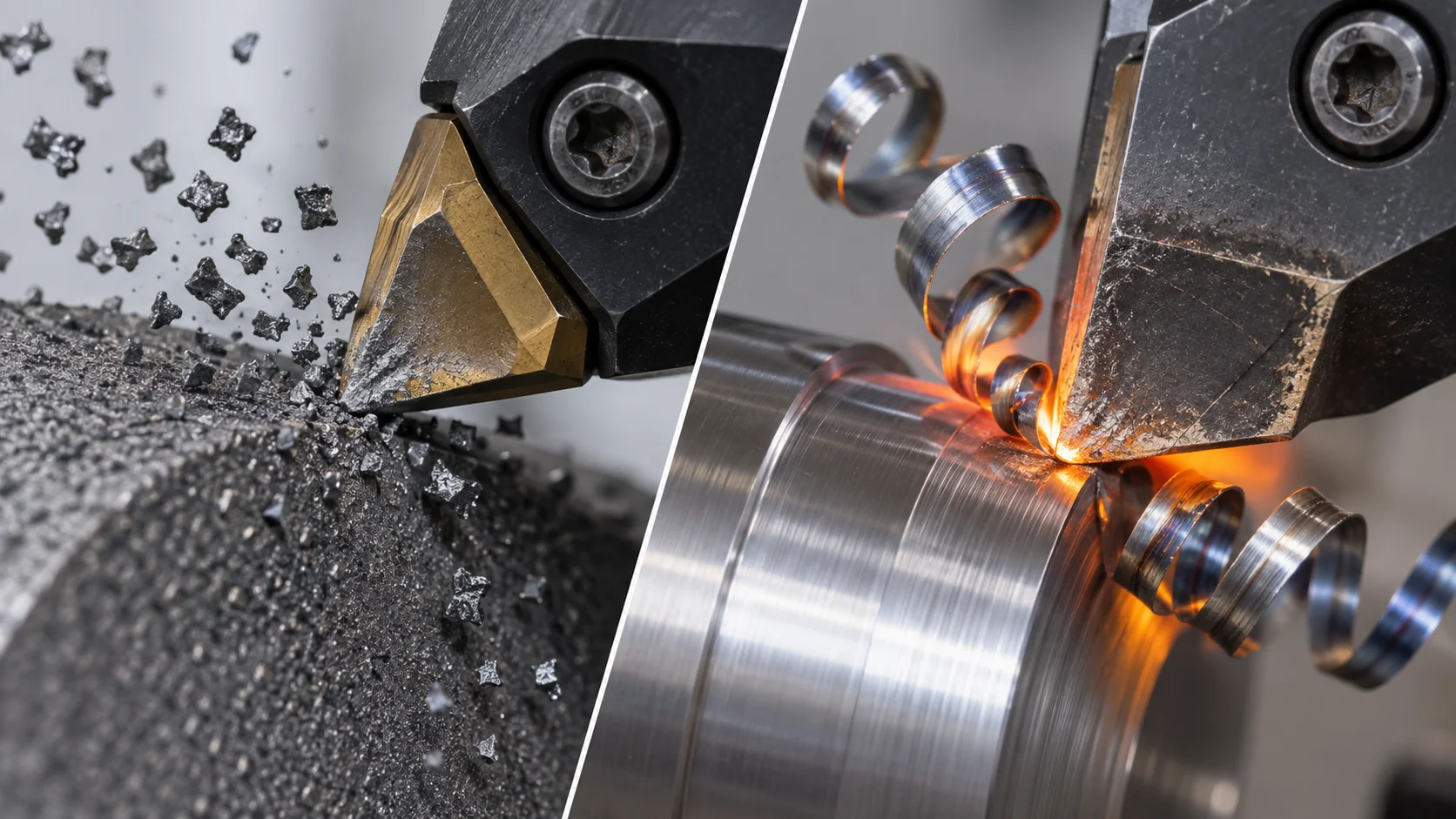
Tool life depends on both the workpiece material and the machining strategy.
Cast iron often produces short chips, which is beneficial for chip control. However, abrasive particles and hard inclusions may accelerate cutting-edge wear.
Steel can create different problems depending on the grade. Tough alloy steels may increase cutting forces, while hardened materials can produce substantial abrasive and thermal wear.
Important machining variables include:
- Cutting tool material
- Coating
- Cutting speed
- Feed rate
- Depth of cut
- Coolant strategy
- Material hardness
- Interrupted cutting conditions
A material that appears cheaper initially may therefore produce higher machining costs if it requires significantly slower cutting or more frequent tool changes.
Surface Finish: Cast Iron vs Steel
Both materials can achieve functional precision-machined surfaces, but the finished appearance and achievable surface quality depend on material structure.
Steel can often achieve very smooth machined and polished surfaces, especially when the grade and hardness are appropriate.
Cast iron contains graphite and other structural features that can influence the appearance of the machined surface. Gray iron surfaces may appear different from machined steel even when dimensional accuracy is similar.
For sealing surfaces, bearing fits, precision bores, or cosmetic requirements, surface finish should be specified directly on the engineering drawing rather than assumed from the material.
Is Cast Iron Cheaper Than Steel?
Cast iron is often considered economical for large, heavy, cast components, but the lowest material price does not always mean the lowest finished-part cost.
A realistic cost comparison should include:
Raw Material + Casting or Forging + CNC Machining + Tool Wear + Heat Treatment + Surface Treatment + Inspection
Cast iron may be highly economical for complex housings or machine bases that can be cast close to final shape.
Steel may be more economical for parts produced directly from standard bar or plate, particularly when only a moderate amount of material needs to be removed.
Production quantity also matters. Casting requires tooling and process preparation, so CNC machining from stock may be more economical for prototypes and small production runs.
Cast Iron vs Steel for Common CNC Parts
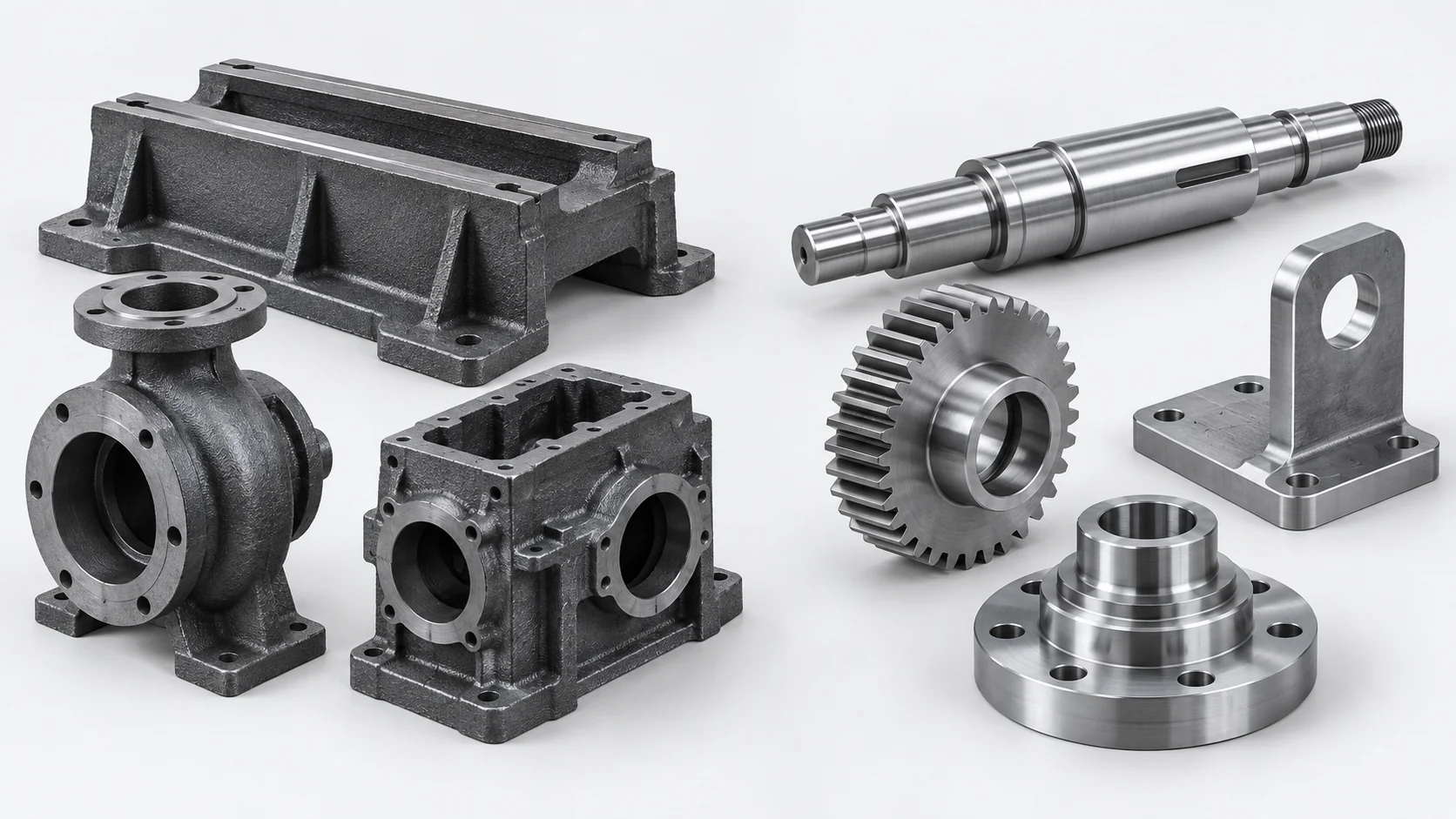
The following table provides a practical starting point for material selection.
| Part Type | Common Starting Choice | Main Reason |
|---|---|---|
| Machine Base | Cast Iron | Vibration damping and rigidity |
| CNC Machine Bed | Cast Iron | Stability and damping |
| Gearbox Housing | Cast Iron | Rigidity and casting flexibility |
| Pump Housing | Cast Iron or Steel | Depends on pressure and environment |
| Shaft | Steel | Tensile strength and toughness |
| Gear | Steel | Strength, fatigue resistance, heat treatment |
| Structural Bracket | Steel | Better tension and impact performance |
| Automotive Housing | Cast Iron / Ductile Iron | Castability and stiffness |
| High-Impact Part | Steel | Toughness |
| Wear Component | Grade dependent | Requires specific wear analysis |
These are not absolute rules. Load direction, temperature, corrosion, weight, geometry, heat treatment, production volume, and manufacturing method can all change the best material choice.
Cast Iron vs Mild Steel
Mild steel is a low-carbon steel commonly used for general-purpose mechanical and structural components.
Compared with cast iron, mild steel generally offers:
- Better ductility
- Better weldability
- Higher impact resistance
- Easier fabrication
Cast iron generally offers:
- Better vibration damping
- Excellent castability
- Good compressive performance
- Greater suitability for large rigid machine structures
Mild steel is usually preferred for welded frames, brackets, plates, and structural parts, while cast iron remains common for machine bases and cast housings.
Cast Iron vs Carbon Steel
Carbon steel covers a much wider range than mild steel.
As carbon content increases, steel generally becomes stronger and harder but less ductile and more difficult to weld.
Compared with cast iron, carbon steel normally provides better tensile strength and toughness. It is widely used for shafts, fasteners, gears, machine components, and structural parts.
Cast iron remains advantageous where vibration damping, casting complexity, rigidity, and compressive loading are more important.
The correct choice depends strongly on the carbon steel grade and heat-treatment condition.
Cast Iron vs Stainless Steel
Stainless steel differs from ordinary carbon steel because its chromium content provides significantly better corrosion resistance.
Stainless steel is usually preferred for components exposed to:
- Moisture
- Chemicals
- Food processing environments
- Medical environments
- Marine conditions
Cast iron is generally more economical for heavy industrial housings and structures but normally requires additional protection against corrosion.
Stainless steel can also be more difficult and expensive to machine, particularly in grades that work harden easily.
How to Choose Between Cast Iron and Steel
Instead of asking only which material is “better,” evaluate the actual operating requirements.
Choose cast iron when the application prioritizes:
- Vibration damping
- High rigidity
- Complex cast geometry
- Heavy static loading
- Large housings or machine structures
- Cost-effective near-net-shape casting
Choose steel when the application prioritizes:
- Tensile strength
- Impact resistance
- Fatigue performance
- Weldability
- Heat treatment
- Shafts, gears, brackets, or structural components
For CNC parts, the specific grade should always be considered alongside material family.
Gray iron and ductile iron behave differently, just as mild steel, 4140 alloy steel, and hardened tool steel behave differently.
CNC Machining Cast Iron and Steel Parts
CNC machining can be used to produce precision features in both cast iron and steel components, including bores, mounting surfaces, threads, pockets, sealing faces, shafts, and complex multi-axis geometries.
The machining strategy should be selected according to material grade, hardness, dimensional tolerance, surface finish, and production quantity.
At YUANYI Precision Manufacturing, we support CNC milling, CNC turning, multi-axis machining, mill-turn machining, and other precision machining processes for a wide range of metal parts.
For projects involving steel or other engineering metals, reviewing the drawing, material grade, tolerance requirements, and surface finish before production can help identify machining risks and control manufacturing cost.
Need help selecting a material for your CNC part? Send us your drawing and material requirements for a machining review and quotation.
Frequently Asked Questions
Steel generally provides higher tensile strength, toughness, and impact resistance. Cast iron can perform extremely well under compression and offers excellent rigidity, so the better material depends on the type of load.
Their densities are relatively close, but steel is generally slightly denser than many common cast irons. For most mechanical components, geometry has a greater effect on final part weight than the small density difference alone.
Gray cast iron offers excellent vibration damping, rigidity, dimensional stability, and castability. These properties make it well suited for machine beds and equipment bases where vibration can affect machining accuracy.
Yes. Many grades, particularly gray cast iron and ductile iron, can be CNC milled, turned, drilled, and bored. Tooling and cutting parameters should be matched to the specific grade and hardness.
Sometimes, but not always. Steel may provide better tensile strength and toughness, while cast iron can provide better damping and casting efficiency. Changing materials may also require redesigning wall thickness, geometry, joining methods, and manufacturing processes.
For prototypes, steel bar or plate can often be easier to source and machine directly without casting tooling. However, the correct choice depends on whether the prototype must accurately reproduce the behavior of a final cast iron component.



