

Use the sheet metal gauge charts below to convert common gauge numbers into thickness in inches and millimeters for mild steel, stainless steel, galvanized steel, aluminum, copper, and brass.
The most important rule is simple: a higher gauge number means thinner sheet, but the same gauge does not represent the same thickness for every material.
How Does Sheet Metal Gauge Work?
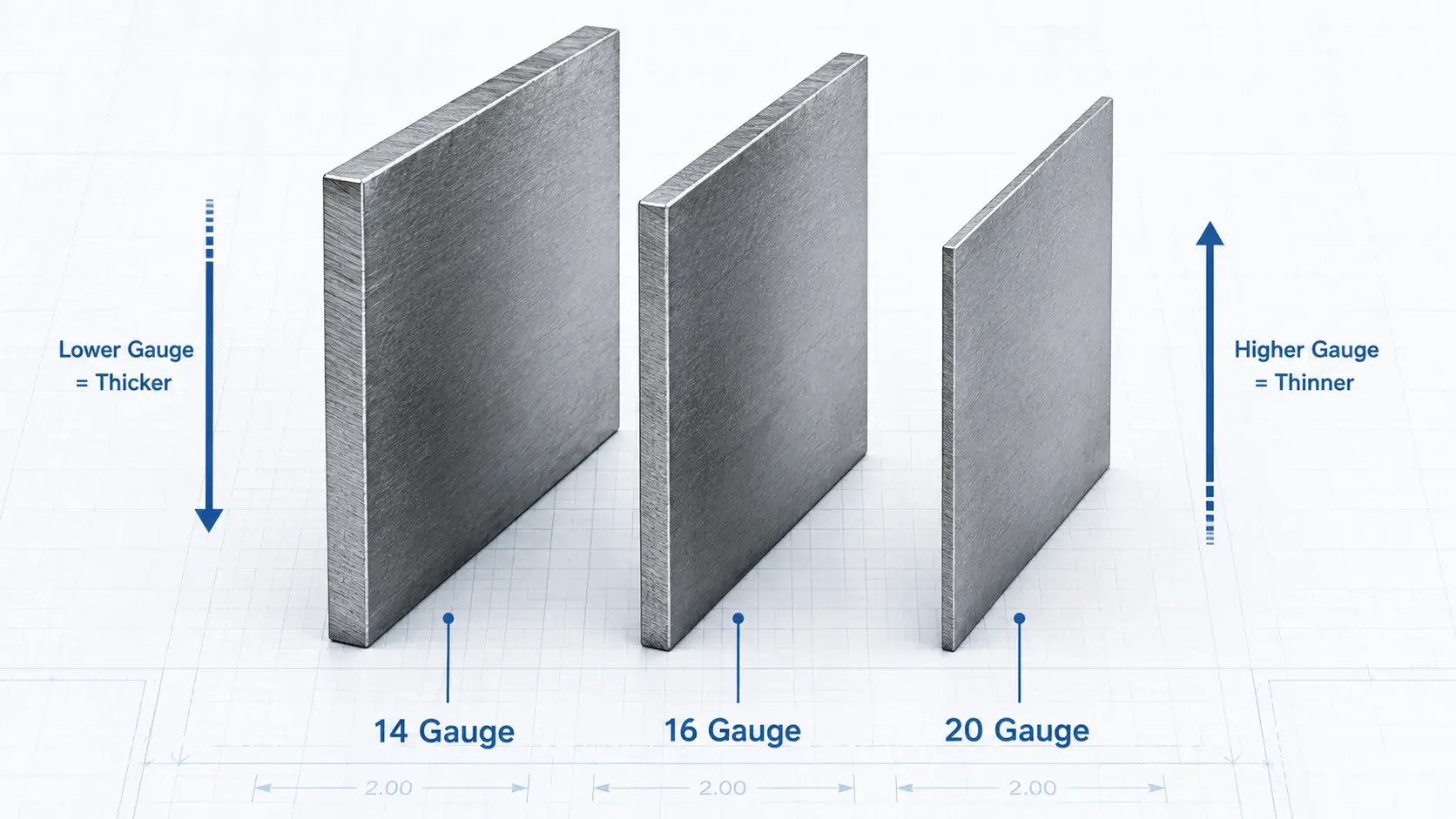
Sheet metal gauge is a traditional system used to describe material thickness. Unlike millimeters or inches, gauge numbers are not a direct linear measurement.
For most sheet metals:
Lower gauge = thicker material
Higher gauge = thinner material
For example, 14 gauge steel is thicker than 16 gauge steel.
However, gauge values also depend on the material. A 16 gauge mild steel sheet is not the same thickness as 16 gauge stainless steel, aluminum, or copper.
That is why engineering drawings should ideally include the actual thickness in mm or inches, especially when parts will be laser cut, bent, welded, or assembled with tight tolerances.
Sheet Metal Gauge Thickness Chart
The following chart covers common sheet metal gauges used in manufacturing.
| Gauge | Mild Steel | Stainless Steel | Galvanized Steel | Aluminum | Copper | Brass |
|---|---|---|---|---|---|---|
| 7 | 0.1793 in / 4.554 mm | — | — | 0.1443 in / 3.665 mm | 0.180 in / 4.572 mm | 0.1443 in / 3.665 mm |
| 8 | 0.1644 in / 4.175 mm | 0.1719 in / 4.365 mm | 0.1681 in / 4.269 mm | 0.1285 in / 3.264 mm | 0.165 in / 4.191 mm | 0.1285 in / 3.264 mm |
| 9 | 0.1495 in / 3.797 mm | 0.1563 in / 3.968 mm | 0.1532 in / 3.891 mm | 0.1144 in / 2.906 mm | 0.148 in / 3.759 mm | 0.1144 in / 2.906 mm |
| 10 | 0.1345 in / 3.416 mm | 0.1406 in / 3.571 mm | 0.1382 in / 3.510 mm | 0.1019 in / 2.588 mm | 0.134 in / 3.404 mm | 0.1019 in / 2.588 mm |
| 11 | 0.1196 in / 3.038 mm | 0.1250 in / 3.175 mm | 0.1233 in / 3.132 mm | 0.0907 in / 2.305 mm | 0.120 in / 3.048 mm | 0.0907 in / 2.305 mm |
| 12 | 0.1046 in / 2.656 mm | 0.1094 in / 2.778 mm | 0.1084 in / 2.753 mm | 0.0808 in / 2.053 mm | 0.109 in / 2.769 mm | 0.0808 in / 2.053 mm |
| 14 | 0.0747 in / 1.897 mm | 0.0781 in / 1.984 mm | 0.0785 in / 1.994 mm | 0.0641 in / 1.628 mm | 0.083 in / 2.108 mm | 0.0641 in / 1.628 mm |
| 16 | 0.0598 in / 1.518 mm | 0.0625 in / 1.587 mm | 0.0635 in / 1.613 mm | 0.0508 in / 1.291 mm | 0.065 in / 1.651 mm | 0.0508 in / 1.291 mm |
| 18 | 0.0478 in / 1.214 mm | 0.0500 in / 1.270 mm | 0.0516 in / 1.310 mm | 0.0403 in / 1.024 mm | 0.049 in / 1.245 mm | 0.0403 in / 1.024 mm |
| 20 | 0.0359 in / 0.911 mm | 0.0375 in / 0.953 mm | 0.0396 in / 1.005 mm | 0.0320 in / 0.812 mm | 0.035 in / 0.889 mm | 0.0320 in / 0.812 mm |
| 22 | 0.0299 in / 0.759 mm | 0.0313 in / 0.794 mm | 0.0336 in / 0.853 mm | 0.0254 in / 0.644 mm | 0.028 in / 0.711 mm | 0.0254 in / 0.644 mm |
| 24 | 0.0239 in / 0.607 mm | 0.0250 in / 0.635 mm | 0.0276 in / 0.701 mm | 0.0201 in / 0.511 mm | 0.022 in / 0.559 mm | 0.0201 in / 0.511 mm |
| 26 | 0.0179 in / 0.454 mm | 0.0188 in / 0.476 mm | 0.0217 in / 0.551 mm | 0.0159 in / 0.405 mm | 0.018 in / 0.457 mm | 0.0159 in / 0.405 mm |
| 28 | 0.0149 in / 0.378 mm | 0.0156 in / 0.396 mm | 0.0187 in / 0.474 mm | 0.0126 in / 0.321 mm | 0.014 in / 0.356 mm | 0.0126 in / 0.321 mm |
| 30 | 0.0120 in / 0.305 mm | 0.0125 in / 0.318 mm | 0.0157 in / 0.398 mm | 0.0100 in / 0.255 mm | 0.012 in / 0.305 mm | 0.0100 in / 0.255 mm |
Note: Gauge values are nominal. Actual material thickness can vary within the tolerance allowed by the relevant material specification.
Steel Sheet Metal Gauge Chart
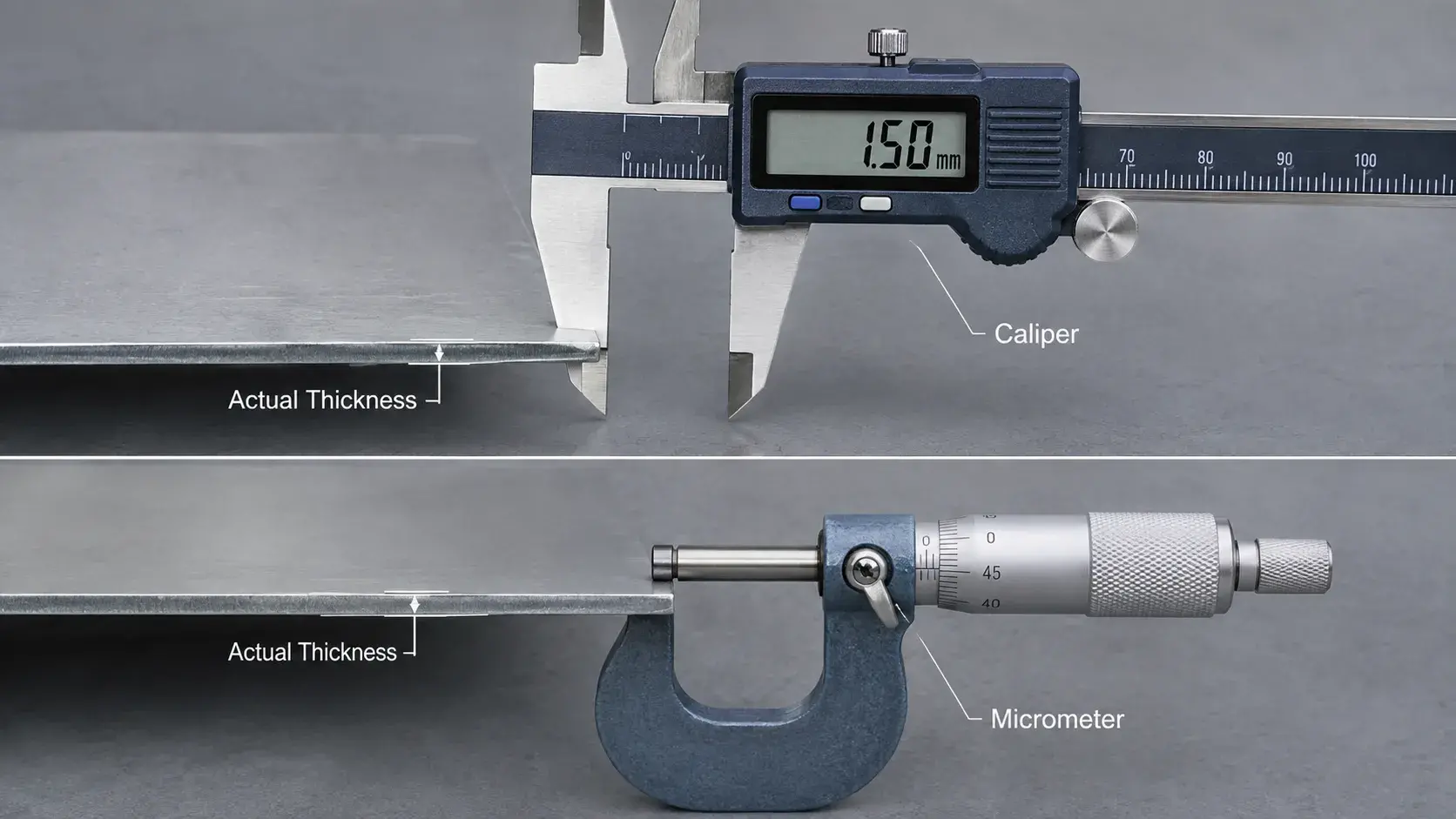
Mild steel is one of the most common materials specified by gauge.
Some frequently used sizes are:
| Steel Gauge | Thickness (in) | Thickness (mm) |
|---|---|---|
| 10 gauge | 0.1345 | 3.416 |
| 12 gauge | 0.1046 | 2.656 |
| 14 gauge | 0.0747 | 1.897 |
| 16 gauge | 0.0598 | 1.518 |
| 18 gauge | 0.0478 | 1.214 |
| 20 gauge | 0.0359 | 0.911 |
| 22 gauge | 0.0299 | 0.759 |
| 24 gauge | 0.0239 | 0.607 |
For example, 14 gauge mild steel is approximately 1.897 mm or 0.0747 inch thick.
If you specifically need this size, see our complete guide to 14 gauge steel thickness, including measurement, applications, weight, and comparisons with nearby gauges.
Stainless Steel Gauge Chart
Stainless steel uses a different gauge-to-thickness relationship than mild steel.
| Stainless Gauge | Thickness (in) | Thickness (mm) |
|---|---|---|
| 10 gauge | 0.1406 | 3.571 |
| 12 gauge | 0.1094 | 2.778 |
| 14 gauge | 0.0781 | 1.984 |
| 16 gauge | 0.0625 | 1.587 |
| 18 gauge | 0.0500 | 1.270 |
| 20 gauge | 0.0375 | 0.953 |
| 22 gauge | 0.0313 | 0.794 |
| 24 gauge | 0.0250 | 0.635 |
This means that 16 gauge stainless steel is about 1.587 mm thick, while 16 gauge mild steel is about 1.518 mm.
They have the same gauge number but not the same actual thickness.
Aluminum Gauge Chart
Aluminum sheet is generally thinner than steel at the same gauge number.
| Aluminum Gauge | Thickness (in) | Thickness (mm) |
|---|---|---|
| 10 gauge | 0.1019 | 2.588 |
| 12 gauge | 0.0808 | 2.053 |
| 14 gauge | 0.0641 | 1.628 |
| 16 gauge | 0.0508 | 1.291 |
| 18 gauge | 0.0403 | 1.024 |
| 20 gauge | 0.0320 | 0.812 |
| 22 gauge | 0.0254 | 0.644 |
| 24 gauge | 0.0201 | 0.511 |
When manufacturing aluminum sheet parts, actual thickness affects laser-cutting parameters, bend allowance, minimum bend radius, stiffness, and final part dimensions.
For more information about cutting aluminum sheets, see our guide to laser cutting aluminum.
Galvanized Steel Gauge Chart
Galvanized steel also has its own gauge values.
| Galvanized Gauge | Thickness (in) | Thickness (mm) |
|---|---|---|
| 10 gauge | 0.1382 | 3.510 |
| 12 gauge | 0.1084 | 2.753 |
| 14 gauge | 0.0785 | 1.994 |
| 16 gauge | 0.0635 | 1.613 |
| 18 gauge | 0.0516 | 1.310 |
| 20 gauge | 0.0396 | 1.005 |
| 22 gauge | 0.0336 | 0.853 |
| 24 gauge | 0.0276 | 0.701 |
Do not assume that a galvanized sheet has the same thickness as mild steel simply because both are called 16 gauge or 18 gauge.
Copper and Brass Gauge Chart
Copper and brass also use material-specific gauge-to-thickness values.
| Gauge | Copper (in / mm) | Brass (in / mm) |
|---|---|---|
| 10 | 0.134 / 3.404 | 0.1019 / 2.588 |
| 12 | 0.109 / 2.769 | 0.0808 / 2.053 |
| 14 | 0.083 / 2.108 | 0.0641 / 1.628 |
| 16 | 0.065 / 1.651 | 0.0508 / 1.291 |
| 18 | 0.049 / 1.245 | 0.0403 / 1.024 |
| 20 | 0.035 / 0.889 | 0.0320 / 0.812 |
| 22 | 0.028 / 0.711 | 0.0254 / 0.644 |
| 24 | 0.022 / 0.559 | 0.0201 / 0.511 |
Copper sheet is noticeably thicker than brass at many equivalent gauge numbers.
Why Is the Same Gauge a Different Thickness?
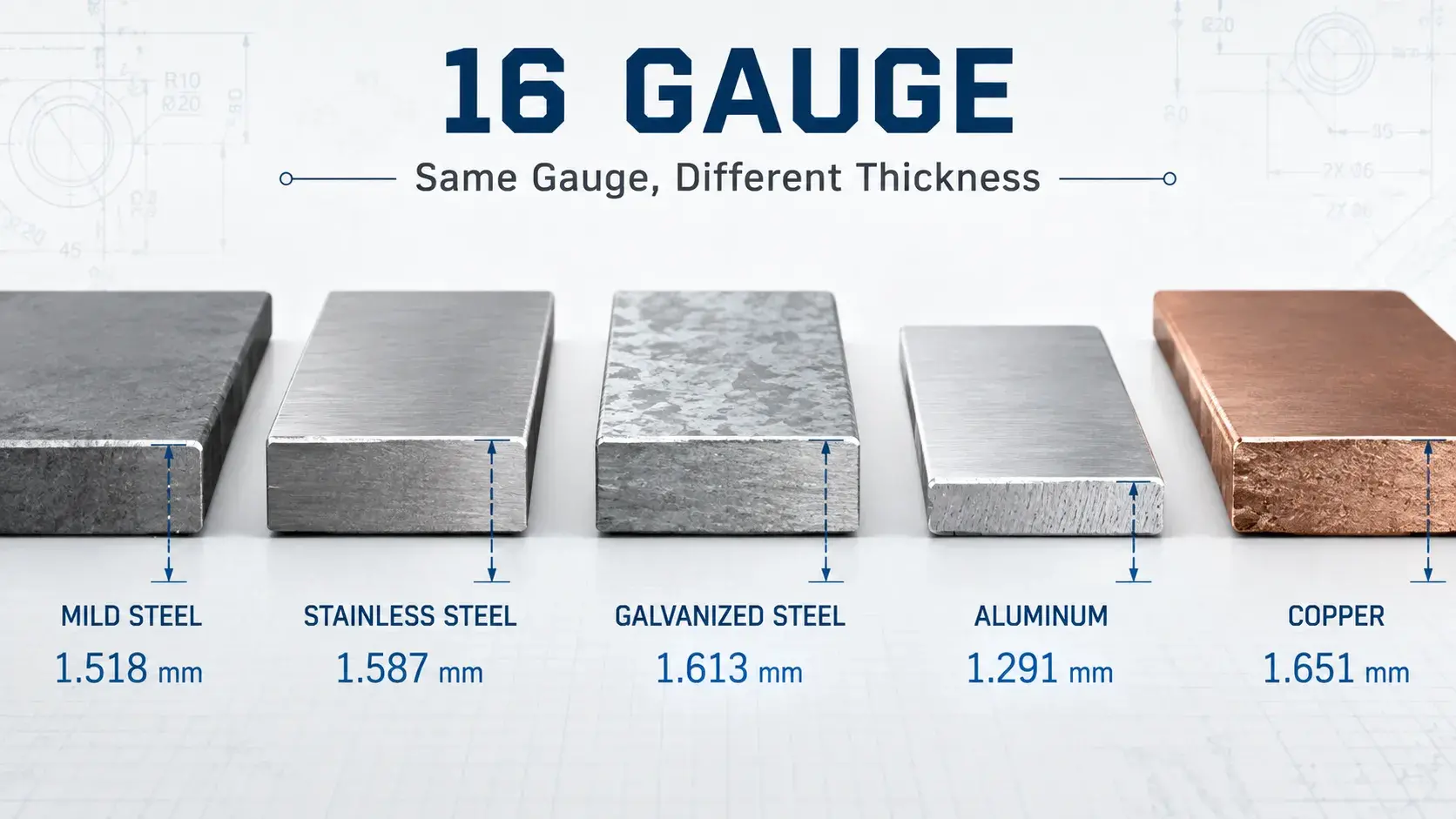
Gauge numbers developed from historical manufacturing systems rather than from a universal dimensional scale.
As a result, each material category can have its own gauge-to-thickness relationship.
Consider 16 gauge:
| Material | 16 Gauge Thickness |
|---|---|
| Mild Steel | 1.518 mm |
| Stainless Steel | 1.587 mm |
| Galvanized Steel | 1.613 mm |
| Aluminum | 1.291 mm |
| Copper | 1.651 mm |
| Brass | 1.291 mm |
This difference matters when designing parts.
If a CAD drawing only says “16 GA” without identifying the material, the intended thickness may not be clear.
How Should You Specify Sheet Metal Thickness on a Drawing?
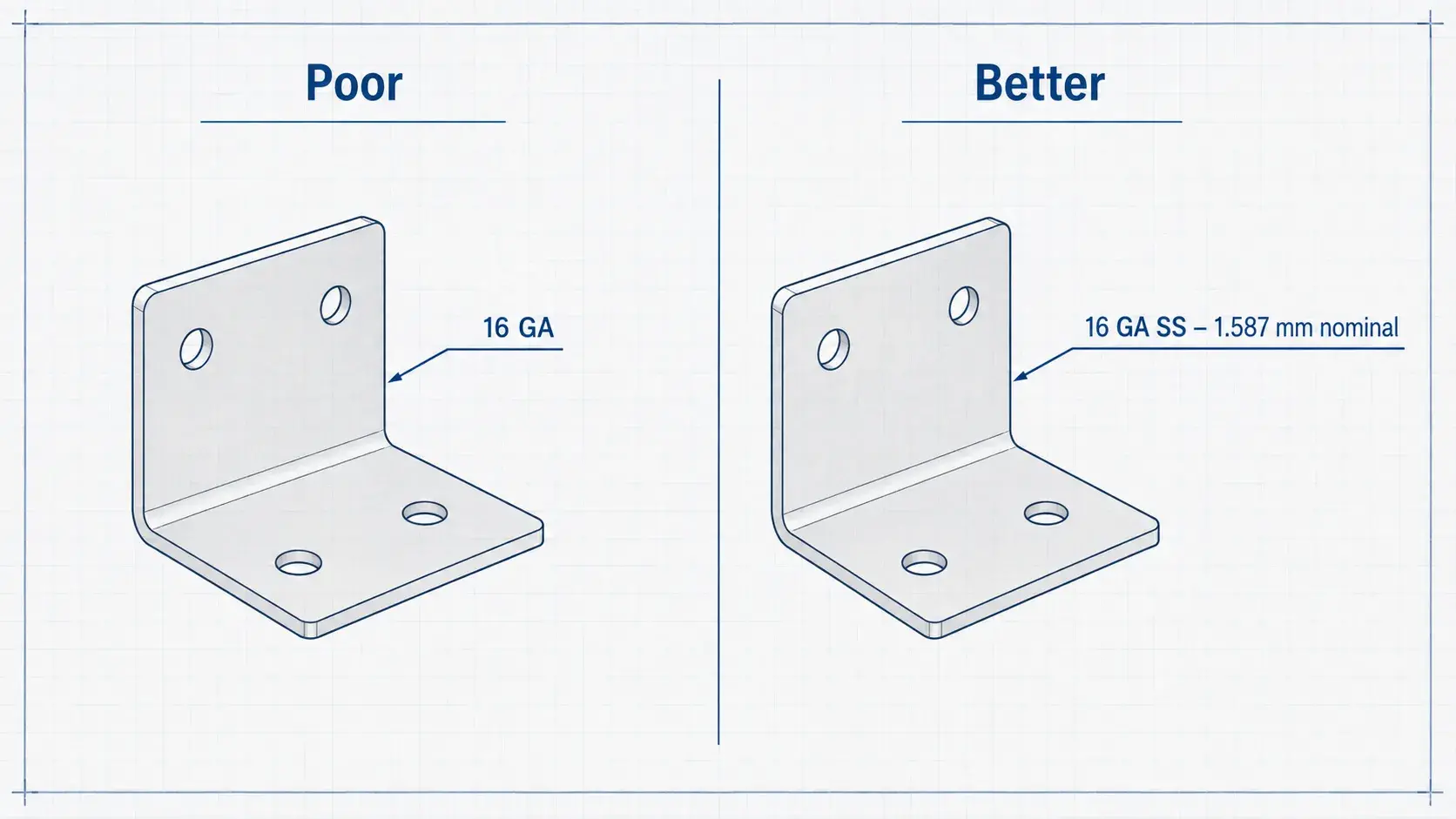
For manufacturing drawings, specifying the actual material and thickness is usually clearer than relying only on gauge.
Instead of:
16 GA
use something such as:
1.5 mm Mild Steel
or:
16 GA Stainless Steel – 1.587 mm nominal
This becomes especially important for parts involving:
- Tight dimensional tolerances
- Bending
- Laser cutting
- Welding
- Tabs and slots
- Press-fit features
- Enclosures and assemblies
Actual sheet thickness influences bend radius, bend deduction, kerf, stiffness, hole-to-edge distance, and final formed dimensions.
For CNC and sheet metal manufacturing, the CAD model should normally reflect the actual nominal sheet thickness that will be used for production.
Is Sheet Metal Gauge the Same as Wire Gauge?
No.
Although both systems use the word gauge, sheet metal gauge and wire gauge should not automatically be treated as the same system.
For example, American Wire Gauge (AWG) is mainly used to specify wire diameter.
Sheet metal thickness uses material-specific gauge charts.
Therefore, you should not convert an aluminum, steel, or stainless sheet thickness using an AWG wire chart.
Sheet Metal vs Plate: What Is the Difference?
There is no single thickness at which every material universally changes from “sheet” to “plate.”
The definition varies by:
- Material
- Product specification
- Industry
- Supplier
- Manufacturing standard
In practical engineering work, thicker flat stock is often specified directly by its actual thickness rather than by gauge.
If the material standard or supplier drawing specifies a particular classification, that definition should take priority.
FAQs
It depends on the material.
Common 16 gauge thicknesses include:
- Mild steel: 1.518 mm
- Stainless steel: 1.587 mm
- Galvanized steel: 1.613 mm
- Aluminum: 1.291 mm
Always identify the material before converting a gauge number.
Yes.
For the same material system, a lower gauge number represents thicker sheet.
For mild steel:
14 gauge = 1.897 mm
16 gauge = 1.518 mm
18 gauge mild steel is approximately:
0.0478 inch or 1.214 mm
18 gauge stainless steel is slightly thicker at approximately:
0.0500 inch or 1.270 mm
Gauge numbers are based on different historical thickness systems for different materials. They are not universal dimensional units, so the same gauge number can represent different actual thicknesses.
Using the actual thickness in millimeters or inches together with the material specification is usually clearer.
Gauge can be included as a reference, but actual thickness reduces ambiguity between engineering, purchasing, and manufacturing teams.



