

Springs are mechanical components used to store energy, resist force, control motion, absorb shock, or return parts to a defined position.
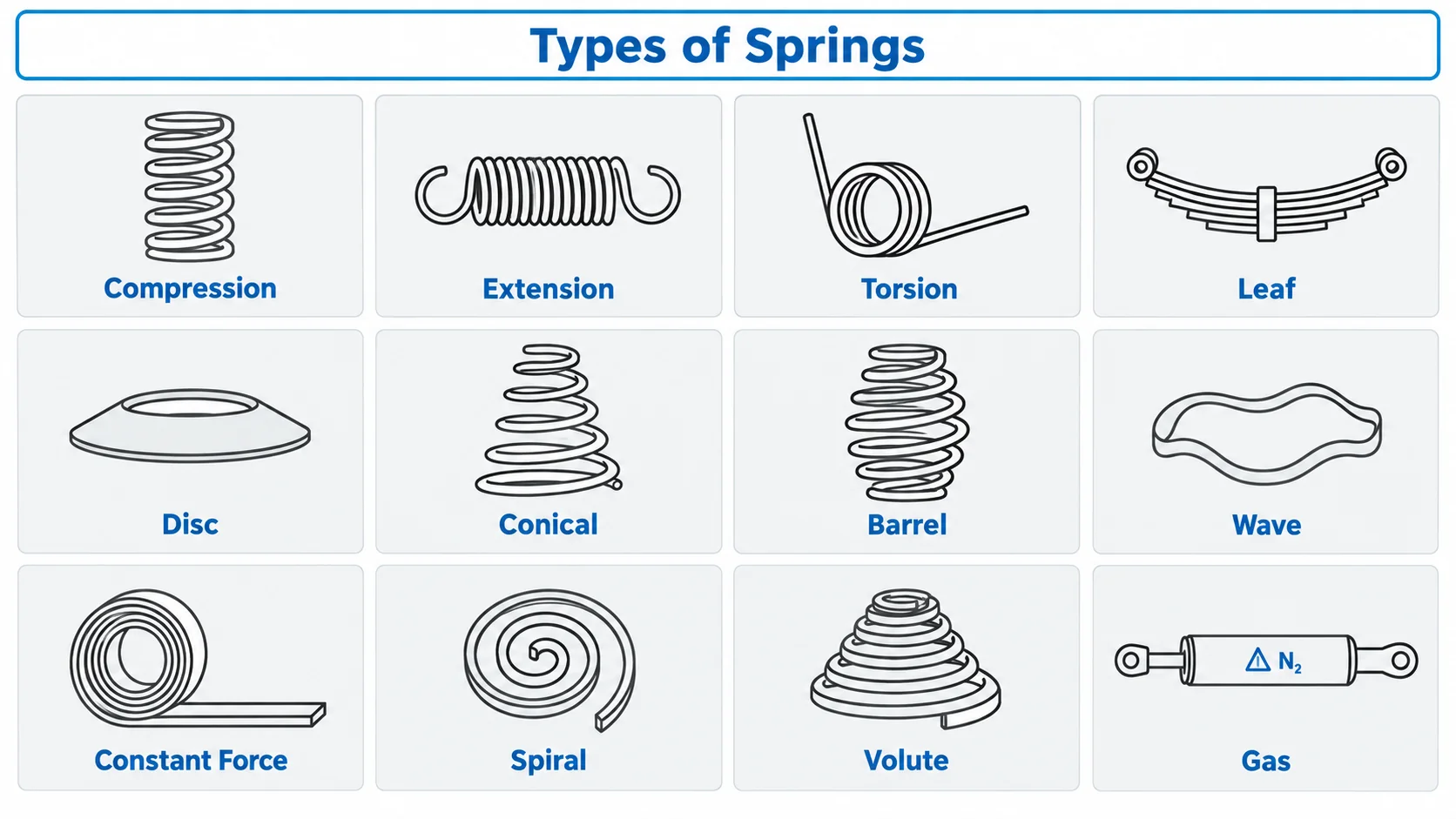
Common spring types include compression springs, extension springs, torsion springs, leaf springs, disc springs, wave springs, constant force springs, spiral springs, conical springs, barrel springs, volute springs, and gas springs.
The right spring mainly depends on load direction, required force, travel, available space, operating environment, and fatigue life.
What Is a Spring?
A spring is an elastic component that deforms under load and tends to return toward its original shape when the load is removed.
Springs are commonly used to:
- resist compression or tension
- provide rotational torque
- absorb shock and vibration
- maintain contact between parts
- store mechanical energy
- return moving components to position
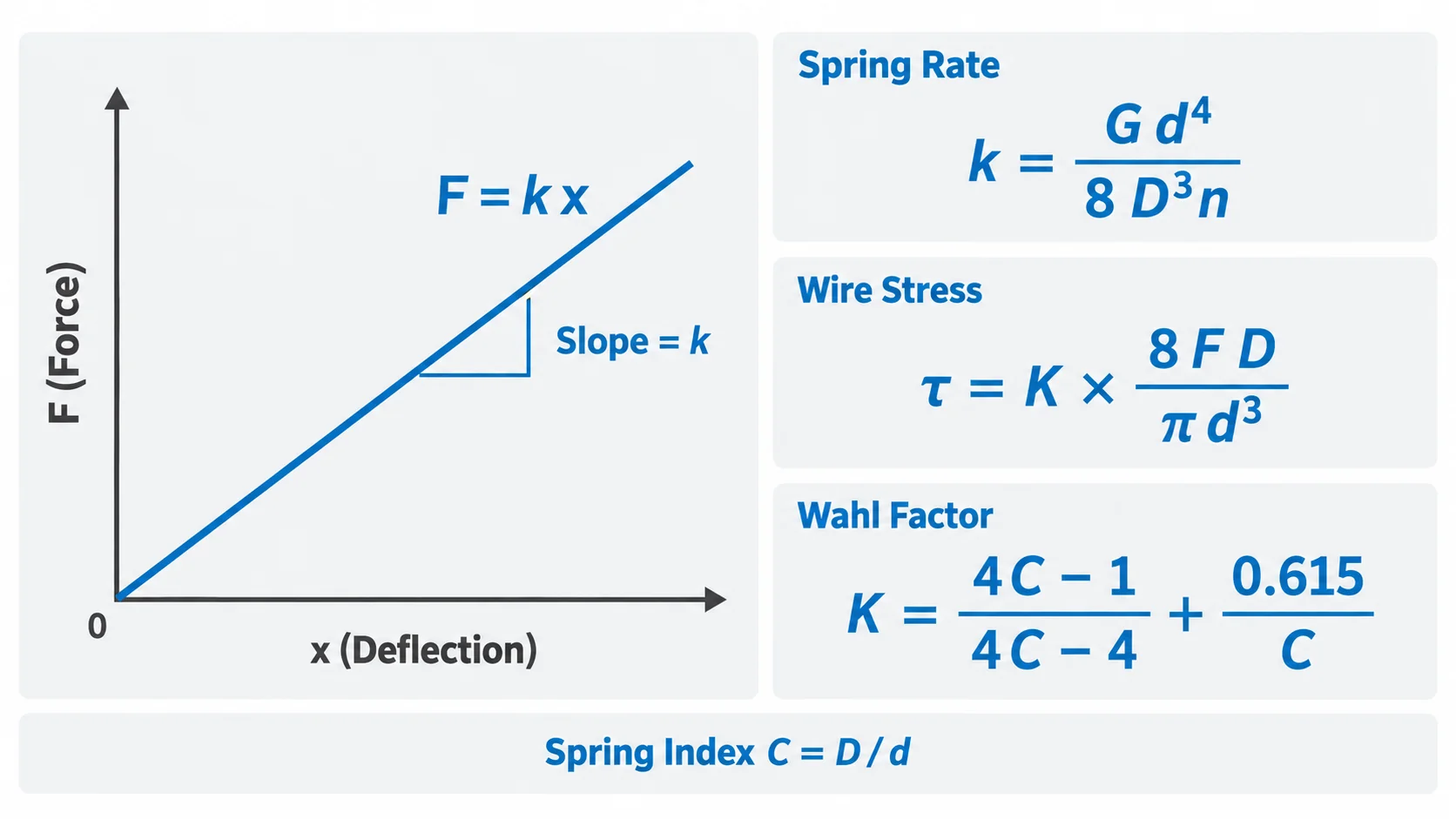
For many linear springs, force and deflection are approximately related by Hooke’s law:
F = k × x
Where F is force, k is spring rate, and x is deflection.
A higher spring rate means more force is required to produce the same movement.
Real springs are not perfectly linear over their whole range. Initial tension in extension springs, coil contact in compression springs near solid height, and the pressure curve of a gas spring all deviate from a straight line. Spring selection should therefore be based on the working range, not on a single rate value.
Spring Terminology
| Term | Meaning |
|---|---|
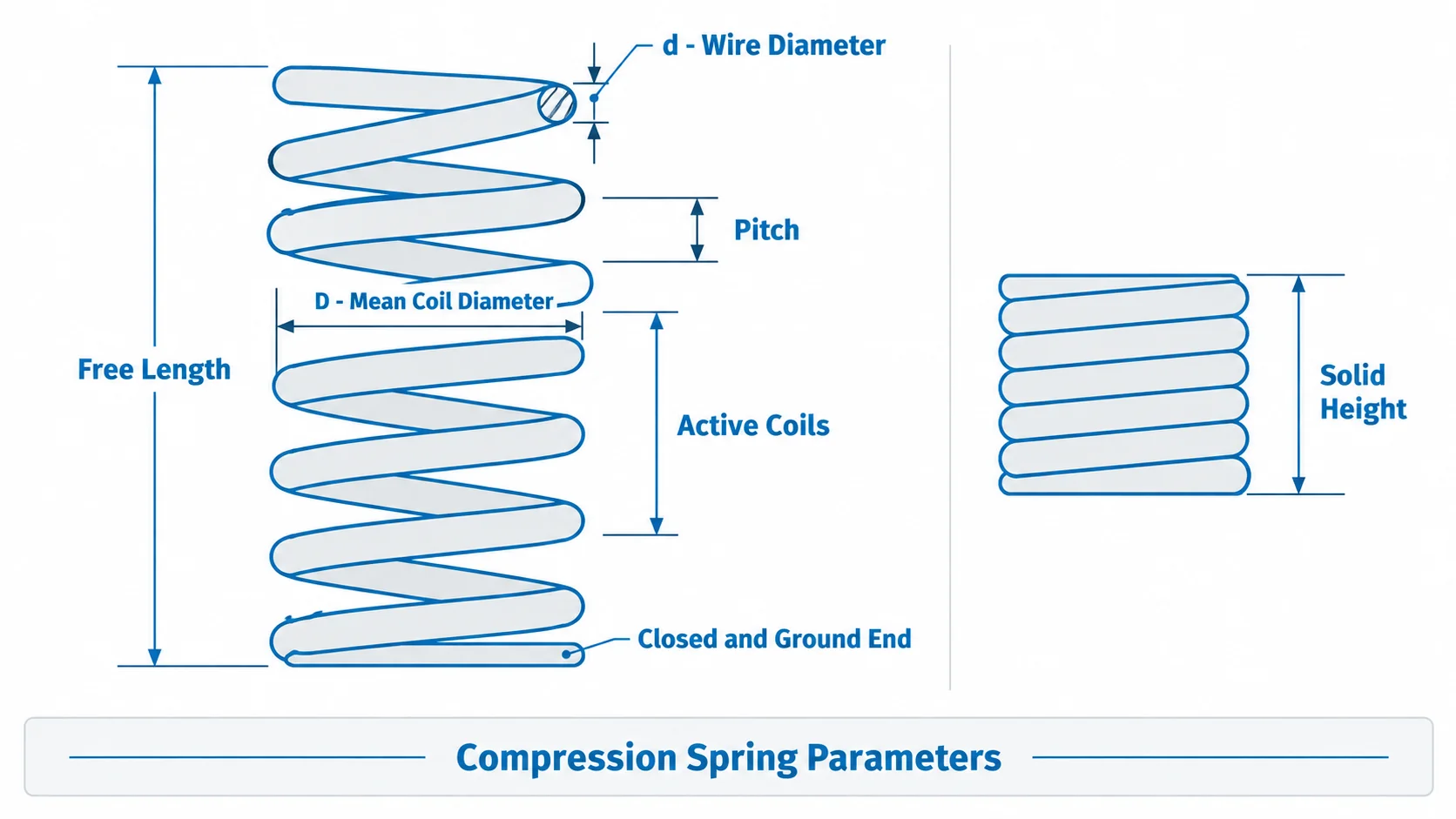
| Free length | Length of the spring with no load applied |
| Solid height | Length when the coils are fully stacked and touching |
| Spring rate | Force required per unit of deflection (N/mm or lbf/in) |
| Preload | Load already applied when the spring is installed in its working position |
| Initial tension | Force that must be overcome before an extension spring starts to extend |
| Active coils | Coils that contribute to deflection |
| Pitch | Axial distance between adjacent active coils |
| Clash allowance | Deflection remaining before the coils touch at solid height |
| Set (permanent set) | Length loss that remains after the first full compression |
| Spring index | Mean coil diameter divided by wire diameter |
How Are Springs Classified?
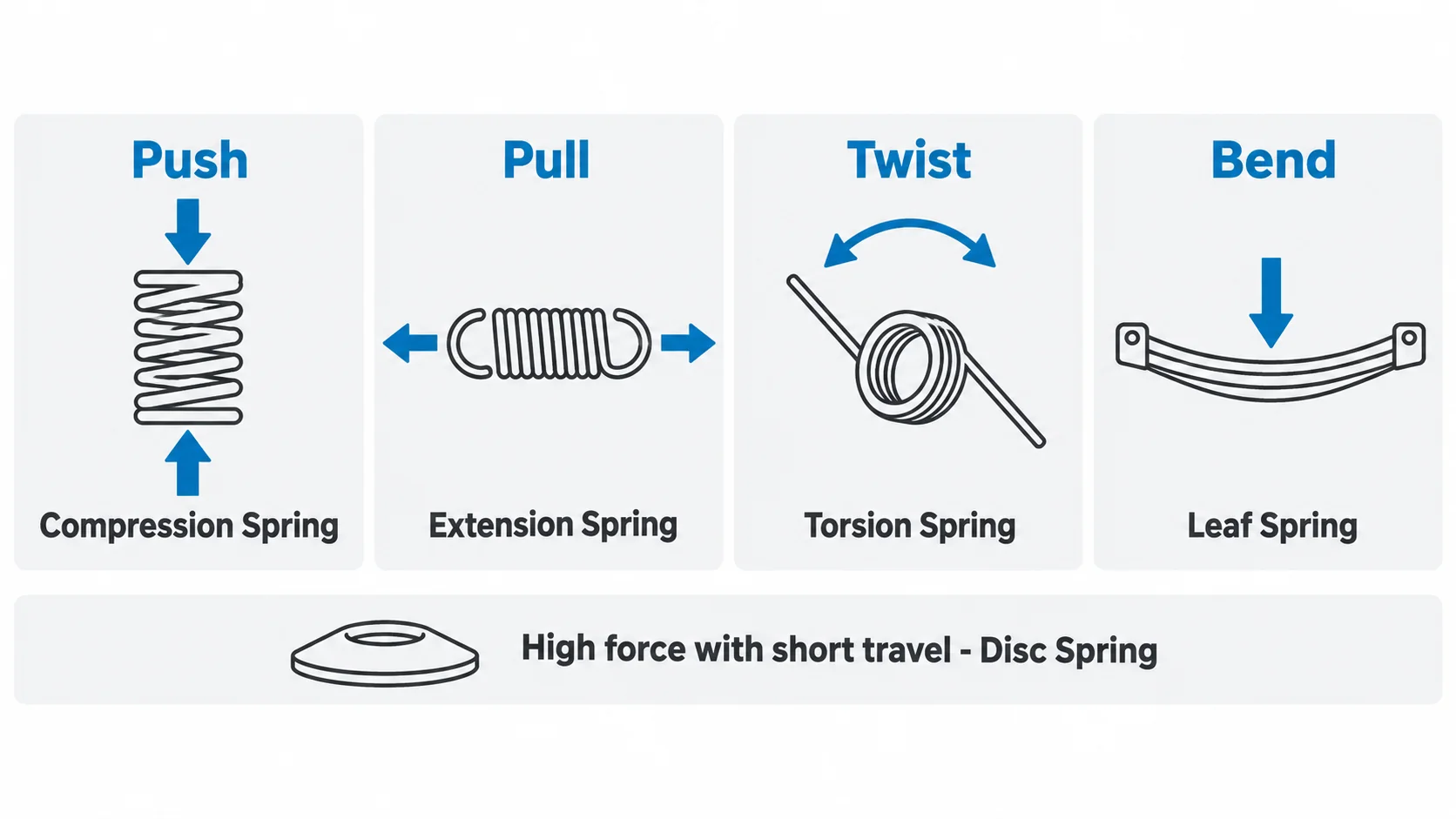
One of the easiest ways to understand spring types is by the load they resist.
| Load Requirement | Typical Spring Type | Motion |
|---|---|---|
| Push | Compression spring | Linear compression |
| Pull | Extension spring | Linear extension |
| Twist | Torsion spring | Rotation |
| Bend | Leaf spring | Flexure |
| High axial load | Disc spring | Short axial movement |
| Constant pull | Constant force spring | Linear travel |
| Compact axial preload | Wave spring | Short axial movement |
| Rotational energy | Spiral spring | Rotation |
This load-based classification is often more useful than choosing a spring by appearance alone. Springs can also be grouped by construction form (coil, flat, tapered, gas), by material, or by the standard they are manufactured to.
Main Types of Springs
Compression Springs
Compression springs shorten when axial force is applied and return toward their free length after the load is removed.
Best for: cushioning, return force, and resistance to compression.
Common applications: valves, pens, switches, industrial fixtures, automotive systems, pumps, and medical devices.
Design notes: closed and ground ends improve squareness and load alignment, and a spring index between roughly 4 and 12 keeps both stress and manufacturing difficulty reasonable.
Extension Springs
Extension springs resist pulling forces. They are stretched under load and usually use hooks, loops, or other formed ends for attachment.
Best for: maintaining tension or pulling two components together.
Common applications: garage doors, latches, trampolines, brake mechanisms, and industrial equipment.
Design notes: many extension springs are wound with initial tension, which keeps the coils closed and delays the start of extension. The hook is usually the weakest point of the spring, so end form and bend radius deserve attention.
Torsion Springs
Torsion springs provide rotational resistance. They normally have arms or legs that rotate relative to the spring coil.
Best for: hinges, levers, covers, and mechanisms requiring return torque.
Common applications: clips, doors, clothespins, lids, and mechanical assemblies.
Design notes: torsion springs work in bending rather than torsion of the wire, and the spring diameter shrinks as the spring is wound tighter, so a mandrel or clearance must allow for that change.
Leaf Springs
Leaf springs are made from flat strips that bend under load.
Best for: carrying heavier loads while allowing controlled flexure.
Common applications: vehicle suspension, agricultural equipment, clamps, and electrical contacts.
Disc Springs
Disc springs, also called Belleville springs, are conical washers that flatten under axial load.
They can generate high force with relatively little deflection.
Best for: high axial force in limited space.
Common applications: clutches, valves, bolted joints, bearings, and preload systems.
Design notes: disc springs can be stacked in parallel to increase force or in series to increase travel, and stacking also changes the effective rate. Preload on bolted joints is a very common use.
Conical Springs
Conical springs have a changing coil diameter from one end to the other.
Their coils can sometimes nest during compression, reducing solid height.
Best for: compact designs with limited compressed height.
Common applications: battery contacts, switches, compact mechanisms, and vibration systems.
Barrel Springs
Barrel springs are wider in the center and narrower at both ends.
Their shape can improve stability and reduce buckling compared with long cylindrical springs.
Best for: stable compression under axial load.
Common applications: industrial machinery, automotive systems, and vibration control.
Wave Springs
Wave springs are made from flat spring material formed into waves.
They can provide axial load while using less axial space than many conventional coil springs.
Best for: compact preload applications.
Common applications: bearings, seals, gear assemblies, pumps, and connectors.
Design notes: a wave spring often replaces a much taller compression spring at the same load, which is useful when the available cavity is shallow.
Constant Force Springs
Constant force springs are made from pre-stressed strip material wound into a coil.
They can provide relatively consistent force over a long travel distance.
Best for: applications requiring nearly constant tension.
Common applications: retractors, counterbalances, reels, display systems, and medical equipment.
Spiral Springs
Spiral springs use a flat strip wound into a spiral and store rotational energy.
Best for: rotational return and energy storage.
Common applications: clocks, timers, reels, gauges, and seat belt mechanisms.
Volute Springs
Volute springs are formed from flat strip material wound into a cone-like shape.
They can support relatively high loads while remaining compact.
Best for: heavy loads and shock absorption.
Common applications: presses, buffers, railway equipment, and heavy machinery.
Gas Springs
Gas springs use compressed gas inside a sealed cylinder to provide force through a piston rod.
Best for: smooth lifting, supporting, or positioning.
Common applications: vehicle hoods, machine guards, furniture, medical equipment, and access panels.
Design notes: gas springs have a force curve that rises as the rod is compressed, unlike a linear coil spring, and their force changes with temperature and over service life.
Spring Types Comparison
| Spring Type | Main Load | Main Advantage | Typical Use |
|---|---|---|---|
| Compression | Push | Simple and versatile | Valves, fixtures |
| Extension | Pull | Maintains tension | Doors, latches |
| Torsion | Torque | Provides return torque | Hinges, clips |
| Leaf | Bending | Supports heavy loads | Suspension |
| Disc | Compression | High force in small space | Clutches, preload |
| Conical | Compression | Low solid height | Compact mechanisms |
| Barrel | Compression | Improved stability | Machinery |
| Wave | Compression | Compact axial preload | Bearings, seals |
| Constant Force | Pull | Nearly constant force | Retractors |
| Spiral | Torque | Stores rotational energy | Reels, timers |
| Volute | Compression | Handles heavy loads | Buffers |
| Gas | Linear force | Smooth controlled motion | Hoods, covers |
Spring Materials
Spring material affects strength, fatigue resistance, corrosion resistance, temperature capability, and cost.
| Material | Common Standard | Max Service Temperature | Corrosion Resistance | Relative Cost | Typical Applications |
|---|---|---|---|---|---|
| Music wire (carbon) | ASTM A228 / EN 10270-1 | About 120 °C | Low | Low | General mechanical springs |
| Oil-tempered carbon | ASTM A229 / EN 10270-2 | About 180 °C | Low | Low | Shock loads and larger wire sizes |
| Hard-drawn carbon | ASTM A227 | About 120 °C | Low | Lowest | Low-stress, cost-driven springs |
| Chrome-silicon | ASTM A401 | About 250 °C | Low | Medium | Automotive and heavy-duty springs |
| Chrome-vanadium | ASTM A231 | About 220 °C | Low | Medium | Shock and impact service |
| Stainless 302 / 304 | ASTM A313 / EN 10270-3 | About 250 °C | Good | Medium-High | Medical, food, outdoor |
| Stainless 17-7PH (631) | ASTM A313 | About 350 °C | Good | High | High strength plus corrosion resistance |
| Phosphor bronze | ASTM B159 | About 100 °C | Good | Medium | Electrical contacts, non-magnetic |
| Beryllium copper | ASTM B197 | About 150 °C | Good | High | Conductive, non-magnetic springs |
| Inconel 718 / X-750 | AMS 5699 / AMS 5698 | Above 500 °C | Excellent | Very High | Aerospace and high-temperature service |
| Titanium (Ti-6Al-4V) | ASTM B348 | About 350 °C | Excellent | Very High | Lightweight aerospace and medical parts |
Carbon and Alloy Spring Steels
Most volume springs are made from carbon or low-alloy spring steel wire. Music wire offers the highest strength of the common carbon grades and is used for small, highly stressed springs, while oil-tempered wire is common in larger diameters. Both are variants of carbon steel with closely controlled chemistry and surface quality.
When higher fatigue strength or higher temperature capability is required, alloy steel grades such as chrome-silicon and chrome-vanadium are used, typically in automotive suspension, engine, and industrial shock applications.
Stainless Steel Spring Wire
For general-purpose applications, carbon spring steel and stainless steel are common choices.
Stainless spring wire is used where corrosion resistance, cleanliness, or non-magnetic behavior matters. Type 302 and 304 are the most common grades, while 17-7PH (631) provides higher strength after aging. Stainless springs are standard in medical devices, food equipment, and outdoor products.
One practical caution: stainless springs are more sensitive to stress relaxation at elevated temperature than carbon spring steels, so they are not automatically the best choice for hot service.
Copper-Based Spring Alloys
Phosphor bronze and beryllium copper are used where conductivity, non-magnetic behavior, or corrosion resistance matters more than maximum strength. They are common in electrical contacts and instrumentation. Related copper-based materials are described on our copper alloys and brass machining pages.
Nickel, Titanium, and High-Temperature Alloys
More demanding environments may require chrome silicon, Inconel, titanium, or copper-based spring alloys.
Inconel grades keep their strength at high temperature and resist oxidation, which makes them common in aerospace, energy, and exhaust-related equipment. Titanium springs are used where weight reduction and corrosion resistance justify the higher material cost.
Which Spring Material Should You Choose?
Selection usually follows four questions in order:
- What is the working temperature?
- Is corrosion or cleanliness a requirement?
- What stress level and cycle count must the spring survive?
- What is the acceptable cost?
If a material satisfies temperature and corrosion requirements, the next step is to confirm that the allowable stress for that material supports the required fatigue life. A wider view of material options for machined hardware is available in our material selection guide.
Spring Standards and Wire Grades
Springs are usually specified by standard, because the standard defines both the wire quality and the dimensional and load tolerances of the finished spring. Two springs may look identical but differ significantly in allowable load variation.
| Standard | What It Covers |
|---|---|
| EN 10270-1 | Patented cold drawn unalloyed spring steel wire, in strength classes SL, SM, SH, and DH |
| EN 10270-2 | Oil hardened and tempered spring steel wire, in classes FD, TD, and VD |
| EN 10270-3 | Stainless spring steel wire, including 1.4310 and 1.4404 types |
| ASTM A228 | Music wire, the highest strength common carbon spring wire |
| ASTM A227 / A229 | Hard-drawn and oil-tempered carbon spring wire |
| ASTM A401 / A231 | Chrome-silicon and chrome-vanadium alloy spring wire |
| ASTM A313 | Stainless steel spring wire, including 302, 304, 316, and 631 |
| DIN 2095 | Cold coiled cylindrical compression springs, quality grades 1, 2, and 3 |
| DIN 2096 / 2097 / 2098 | Hot coiled compression, extension, and torsion springs |
| DIN 2093 | Disc springs, including dimensions and force tolerances |
| ISO 10243 | Die springs, color-coded by load class |
| EN 13906 / DIN 2089 | Calculation of cylindrical helical springs: rate, stress, and buckling |
Quality grades matter in practice. A grade 1 spring has tighter tolerances on wire diameter, outside diameter, free length, and force than a grade 3 spring, and the price difference reflects that. For a critical assembly, the drawing should state the standard, the quality grade, the load at a defined deflection, and the required direction of winding.
Important Spring Design Parameters
The spring type alone does not determine performance. Several dimensions and mechanical parameters also matter.
| Parameter | Why It Matters |
|---|---|
| Wire diameter | Strongly affects spring strength and stiffness |
| Mean coil diameter | Influences stress and flexibility |
| Free length | Determines unloaded spring size |
| Solid height | Minimum compressed height |
| Pitch | Controls coil spacing |
| Active coils | Influences spring rate |
| Spring rate | Determines force required per unit of movement |
| Deflection | Required working travel |
| Initial tension | Important for extension springs |
| Preload | Sets the installed force and influences fatigue stress range |
| End configuration | Affects mounting and load transfer |
| Surface condition | Scratches and inclusions act as fatigue crack starters |
Spring Index
Spring index is another common design value:
Spring Index C = Mean Coil Diameter / Wire Diameter
Very low spring indexes can increase manufacturing difficulty and local stress. In practice, most designs use an index between about 4 and 12, with 5 to 10 preferred.
The index also links to stress: a low index means a tightly curved coil with a higher stress concentration at the inside of the wire, while a very high index makes the spring soft, tall, and more likely to buckle.
Understanding Spring Rate
Spring rate describes how much force is needed to move a spring a given distance.
For a linear spring:
k = F / x
For example, if a spring has a spring rate of 10 N/mm, approximately 10 N is required to compress it 1 mm and 50 N to compress it 5 mm, assuming linear behavior.
Spring rate is one of the most important values when comparing springs that appear similar in size.
Spring Rate Formula for Compression Springs
For a compression spring, rate can be calculated from geometry and material:
k = G × d&sup4; / (8 × D³ × n)
Where G is the shear modulus of the wire material, d is wire diameter, D is mean coil diameter, and n is the number of active coils.
The exponents explain why spring design is sensitive: doubling the wire diameter increases rate about sixteen times, while doubling the mean coil diameter reduces it eight times.
Example: a music wire spring with d = 2 mm, D = 20 mm, and n = 10 active coils has a shear modulus of about 79,000 N/mm²:
k = 79,000 × 16 / (8 × 8,000 × 10) ≈ 1.98 N/mm
Stress, Wahl Factor, and Allowable Stress
Rate describes stiffness, not safety. The stress in the wire is what ultimately limits the spring:
τ = K × 8FD / (π × d³)
Where F is the applied force and K is the Wahl factor, which corrects for the curvature and direct shear effects in a helical coil:
K = (4C − 1) / (4C − 4) + 0.615 / C
For a spring index of 10, K is about 1.14; for a tightly coiled spring with an index of 5, K rises to about 1.31. This is why low-index springs are more prone to fatigue failure.
Allowable stress is usually expressed as a percentage of the material tensile strength and depends on whether the spring is static or cycling. Statically loaded springs can often be designed near 40 to 45% of tensile, while springs cycling millions of times must be designed far lower.
Solid Height and Compressed Length
Solid height is the length of the spring when all coils touch. For a closed and ground compression spring it can be estimated as:
Solid height ≈ (n + 2) × d
The design should always leave a clash allowance, so the spring never reaches solid height in service. A common starting point is to stop travel at 15 to 20% above solid height, or to leave 15 to 20% of the total travel as remaining deflection.
Buckling also has to be checked. As a rule of thumb, if the free length is more than about four times the mean coil diameter, a guide rod or a spring in a bore should be used.
Spring Ends and Attachment Types
End configuration decides how the spring mounts and how the load is transferred, and it is one of the most common sources of assembly problems.
Compression spring ends
- Closed — coils touch at the ends, moderate squareness
- Closed and ground — ends are ground flat, best for parallel loading
- Open — the end coil has pitch, lowest cost, least square
- Open and ground — a compromise between cost and squareness
Extension spring ends
- Machine hook — economical and common for general use
- Cross-over and side-loop ends — better load alignment along the spring axis
- Full loop or extended hook — used when the attachment point is offset
- Threaded insert or swaged fitting — for higher load and precise attachment
Torsion spring ends
- Straight leg, bent leg, short hook, or hinge end
- Bend radii should not be too tight, because a sharp bend is a stress raiser and a common crack start point
Where a spring must connect to a machined component, the mating feature — a groove, a shoulder, a pin, or a threaded seat — is usually produced by machining, so the two specifications should be developed together.
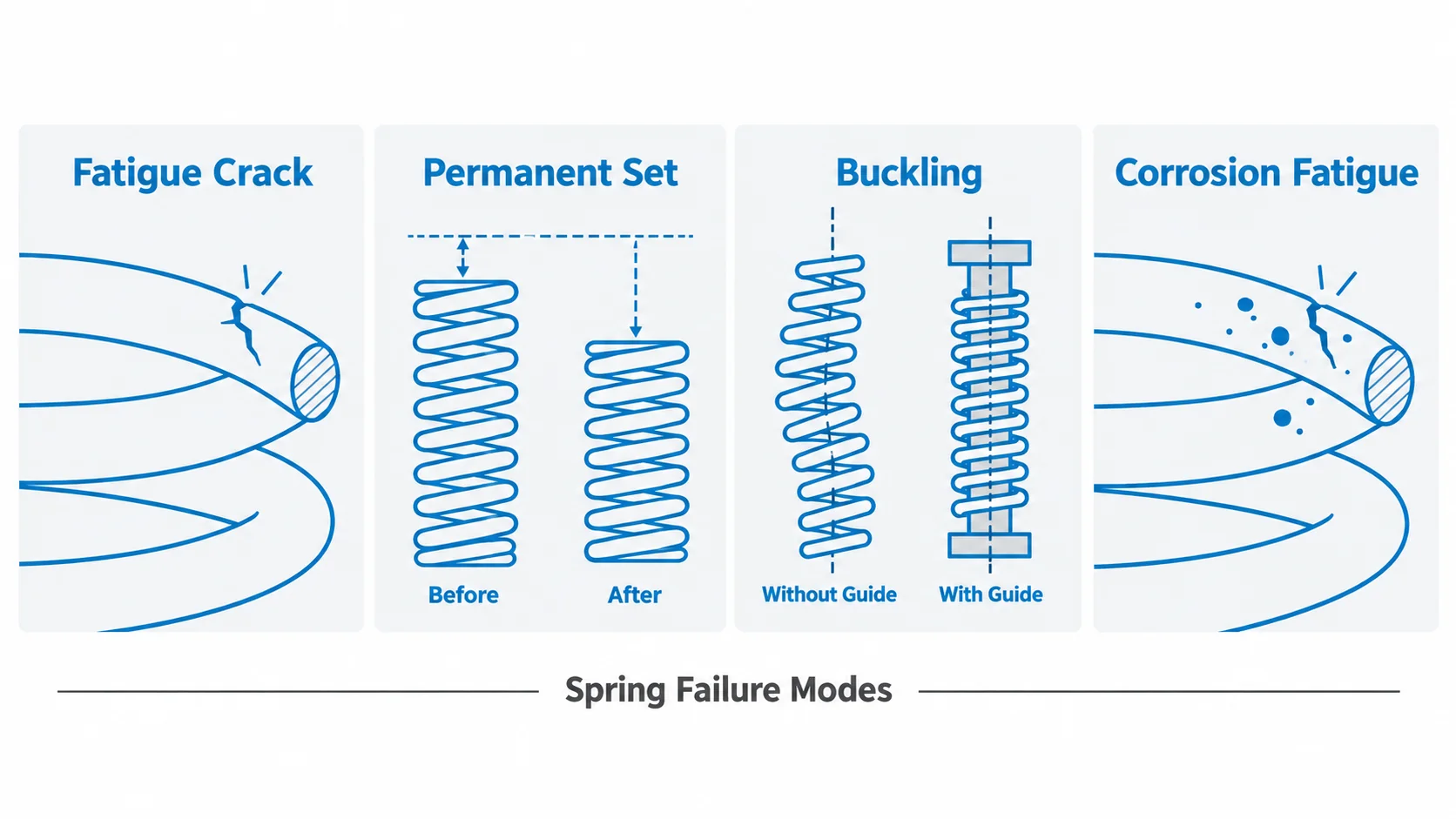
Spring Failure Modes and Fatigue Life
Springs rarely fail because the design was too weak in a single overload. Most field failures come from fatigue, relaxation, or an assembly detail that was never checked.
| Failure Mode | Typical Cause | Prevention |
|---|---|---|
| Permanent set or relaxation | Stress above the elastic limit, or creep at elevated temperature | Preset (scrag) the spring, stress relieve, reduce stress, use a higher-temperature material |
| Fatigue cracking | Large stress range over millions of cycles | Shot peening, lower stress range, smoother surface, preload to reduce the range |
| Buckling | Free length too long relative to diameter | Guide rod or bore, lower length-to-diameter ratio, nested springs |
| Resonance (surge) | Excitation frequency matches the spring natural frequency | Change rate, mass, or number of active coils; add damping |
| Corrosion fatigue | Cyclic stress in a corrosive environment | Stainless or coated materials, avoid chloride exposure, control rinse and drainage |
| Clashing | Coils collide because clash allowance was too small | Increase free length or reduce travel |
Fatigue life is influenced by stress range, material, surface condition, corrosion, heat treatment, and operating deflection. Two springs with the same rate can have very different life if one is shot peened, has a smoother surface, or is installed with less stress range.
Springs used occasionally and springs cycling millions of times require different designs, and this is exactly where a design review before production saves the most money.
Wound Springs vs Machined Springs
Most springs are wound from wire or formed from strip. Machined springs, produced by cutting the spring geometry from bar or tube, are a smaller but useful category for precision assemblies.
| Aspect | Wound Springs | Machined Springs |
|---|---|---|
| Manufacturing | Coiled from wire, then heat treated and end formed | CNC turned and slotted from bar or tube |
| Tooling | Coiling tooling and mandrels per size | No dedicated tooling |
| Rate accuracy | Within the tolerance of the applicable quality grade | Highly repeatable, tight rate control |
| Integral features | Separate end fittings or hooks required | Flanges, threads, bores, and mounting features cut in one piece |
| Best volume | High volume production | Prototypes, low to medium volume, high-precision assemblies |
| Materials | Spring wire grades | Bar and tube grades, including corrosion-resistant alloys |
| Multiple starts | Limited | Multiple independent coils possible in one part |
Machined springs are often chosen when the spring must also be a structural element, when the rate must be extremely consistent, or when prototypes are needed quickly. The machining side of that work is standard CNC turning and milling, and small diameters are well suited to Swiss turning.
How to Choose the Right Spring
A practical spring selection process should start with the function of the mechanism.
1. Determine the load direction
Ask how the spring will be loaded.
- Push → compression spring
- Pull → extension spring
- Twist → torsion spring
- Bend → leaf spring
- High force with short travel → disc spring
- Constant pull → constant force spring
2. Define force and travel
Determine how much force or torque is required and how far the spring must move.
A spring that fits physically may still be unsuitable if its spring rate is too high or too low.
3. Check available space
Consider outside diameter, inside diameter, free length, compressed length, and surrounding clearance.
For limited axial space, wave springs or disc springs may be more suitable than conventional compression springs.
4. Consider fatigue life
Fatigue life is influenced by stress range, material, surface condition, corrosion, heat treatment, and operating deflection.
5. Consider the environment
Temperature, moisture, chemicals, salt exposure, and cleanliness requirements can affect material selection.
Stainless steel is common in corrosive environments, while Inconel may be required for high-temperature service.
6. Choose material and end design
Finally, select the spring material and mounting configuration based on strength, fatigue resistance, corrosion resistance, temperature, weight, cost, and assembly method.
7. Verify by calculation and test
Confirm rate, stress, solid height, and buckling by calculation, then verify load at working height and free length on a sample before production. A short functional test on the first parts is usually cheaper than a field failure.
Spring Selection by Application
| Application | Common Spring Types | Main Considerations |
|---|---|---|
| Automotive | Compression, torsion, leaf, disc | Fatigue, vibration, temperature |
| Aerospace | Compression, torsion, wave | Weight, reliability, corrosion |
| Medical | Compression, wave, constant force | Cleanliness, corrosion, repeatability |
| Industrial machinery | Compression, disc, gas | Load, shock, cycle life |
| Electronics | Leaf, torsion, compression | Size, conductivity, contact force |
| Consumer products | Compression, torsion, extension | Cost, durability, compact size |
Industries that combine springs with precision machined hardware, such as aerospace and medical devices, usually apply additional requirements for traceability, surface condition, and cleanliness.
How Springs Are Manufactured
Most conventional springs are produced by wire or strip forming rather than CNC machining.
Typical processes include:
- coiling or forming
- heat treatment
- end grinding
- shot peening
- surface treatment
- dimensional and load inspection
The exact process depends on spring type, material, size, and performance requirements. Presetting or scragging is often added for springs that must hold a stable length, and stress relieving follows coiling for many cold-formed springs.
CNC Machined Components Used with Springs
Spring assemblies often include precision-machined parts such as:
- spring seats
- shafts and guide rods
- plungers
- pins, including quick-release pins
- housings
- retainers and end caps
- threaded adjusters
- bushings and spacers
These components can affect spring alignment, preload, travel, and assembly reliability.
Typical requirements to control on the machined side:
| Feature | Why It Matters |
|---|---|
| Seat flatness and squareness | Prevents side loading and coil misalignment |
| Bore diameter and depth | Sets spring fit, preload, and available travel |
| Concentricity of bore to shaft | Keeps the spring working on its intended axis |
| Surface finish | Reduces wear, fretting, and friction against the spring |
| Lead-in chamfers | Prevents damage during assembly |
| Thread and adjuster tolerances | Determines repeatable preload adjustment |
These features are produced by CNC milling, turning, and sometimes 5-axis machining when a housing has features on several faces. Small pins and plungers are usually turned, which is why dimensional and geometric CNC machining tolerances should be agreed together with the spring specification.
For new mechanisms, the surrounding hardware is often machined as a working prototype so that preload, travel, and fit can be verified before tooling or volume production is committed.
For precision mechanisms, the spring and surrounding parts should be considered as one complete system. A perfectly specified spring can still fail early if the seat is not square, the bore is oversized, or the guide rod is off-axis.
Conclusion
The most common spring types include compression, extension, torsion, leaf, disc, conical, barrel, wave, constant force, spiral, volute, and gas springs.
Each type is suited to a different load and motion.
When choosing a spring, focus first on load direction, force, travel, available space, fatigue life, environment, and material.
The best spring is not simply the one that fits the available space. It must also provide the required force and motion reliably throughout the intended service life.
At YUANYI Precision Manufacturing, we machine the seats, housings, guide rods, pins, and adjusters that springs work with, and we review spring preload, alignment, and fit as part of the assembly design rather than as separate parts.
Have a spring assembly that needs precision machined components? Send us your drawing for a DFM review and quotation.
Frequently Asked Questions
The three most common spring types are compression, extension, and torsion springs. Other important types include leaf, disc, wave, constant force, spiral, conical, barrel, volute, and gas springs.
A compression spring becomes shorter under a pushing force, while an extension spring becomes longer under a pulling force. Compression springs usually need end grinding for square seats, while extension springs need end hooks or loops for attachment.
A constant force spring can provide relatively consistent force over a long range of travel.
Disc springs (Belleville springs) are often suitable when high axial force is required with limited movement and installation height. Wave springs are the better choice when the requirement is a moderate preload in a shallow cavity.
Music wire and stainless steel are widely used. Chrome silicon, chrome vanadium, Inconel, titanium, and copper alloys are used for more demanding applications.
For a linear spring, k = F / x, where k is spring rate, F is force, and x is deflection. For a compression spring, rate can also be calculated from geometry as k = G × d&sup4; / (8 × D³ × n), where G is the shear modulus, d is wire diameter, D is mean coil diameter, and n is the number of active coils.
Spring index is the mean coil diameter divided by the wire diameter. Most designs use a value between about 4 and 12, with 5 to 10 being the usual preference. Lower values raise the stress concentration and are harder to manufacture, while higher values make the spring soft and prone to buckling.
Stacking disc springs in parallel increases the force at the same deflection, while stacking them in series increases travel at the same force. Mixed stacks are used to tune both. Friction between stacked discs should be considered in the design.
Loss of force is usually caused by permanent set or relaxation, which happens when the spring is stressed beyond its elastic limit or operates at elevated temperature. Presetting, stress relieving, lower operating stress, and a higher-temperature material all reduce this effect.
Specify the standard and quality grade, for example DIN 2095 with grade 1, 2, or 3, together with the load at a defined deflection. Tighter grades control wire diameter, outside diameter, free length, and force more closely, so they cost more and should be reserved for critical assemblies.
Machined springs are useful when the spring must include integral features such as flanges, threads, or mounting bores, when rate consistency must be very high, when quantities are low, or when prototypes are needed quickly without tooling.
Reduce the operating stress range, shot peen the surface, avoid sharp nicks and tight end bends, select a corrosion-resistant material or coating, preset the spring, and keep the surrounding seats square and concentric.



