

Machining is a manufacturing process that removes material from a workpiece to create the required shape, dimensions, holes, and surface features.
Common machining processes include milling, turning, drilling, boring, grinding, 5-axis machining, Swiss machining, mill-turn machining, EDM, laser cutting, waterjet cutting, and electrochemical machining.
What Is a Machining Process?
A machining process removes controlled amounts of material from a workpiece until the required geometry and dimensions are achieved.
The material may be removed using a cutting tool, abrasive wheel, electrical discharge, laser, fluid jet, or chemical reaction.
Machining is commonly used for metals such as aluminum, stainless steel, alloy steel, titanium, brass, and copper, as well as engineering plastics such as POM, PEEK, nylon, PTFE, and polycarbonate.
One important distinction is that CNC is not a machining process itself.
CNC refers to computer-controlled machine movement. Milling, turning, drilling, and grinding are the actual machining processes.
Types of Machining Processes at a Glance
| Process | Best For | Typical Parts | Main Advantage |
|---|---|---|---|
| CNC Milling | Prismatic and complex parts | Housings, brackets, plates | High geometric flexibility |
| CNC Turning | Rotational parts | Shafts, bushings, pins | Efficient for round geometry |
| Drilling / Boring | Holes and precision bores | Housings, fixtures, bearing seats | Accurate hole production |
| Grinding | Tight tolerances and finishes | Shafts, hardened parts | High precision and fine finish |
| 5-Axis Machining | Complex multi-sided parts | Aerospace parts, impellers | Fewer setups |
| Swiss Machining | Small slender parts | Pins, connectors, fittings | High repeatability |
| Mill-Turn Machining | Combined milled and turned parts | Complex shafts, valve parts | Multiple operations in one setup |
| EDM | Hard conductive materials | Dies, molds, sharp internal features | No cutting-force contact |
| Laser Cutting | Thin sheet profiles | Panels, brackets, covers | Fast 2D cutting |
| Waterjet Cutting | Heat-sensitive materials | Plates, composites | No heat-affected zone |
| Electrochemical Machining | Difficult conductive materials | Turbine and specialty parts | No conventional cutting force |
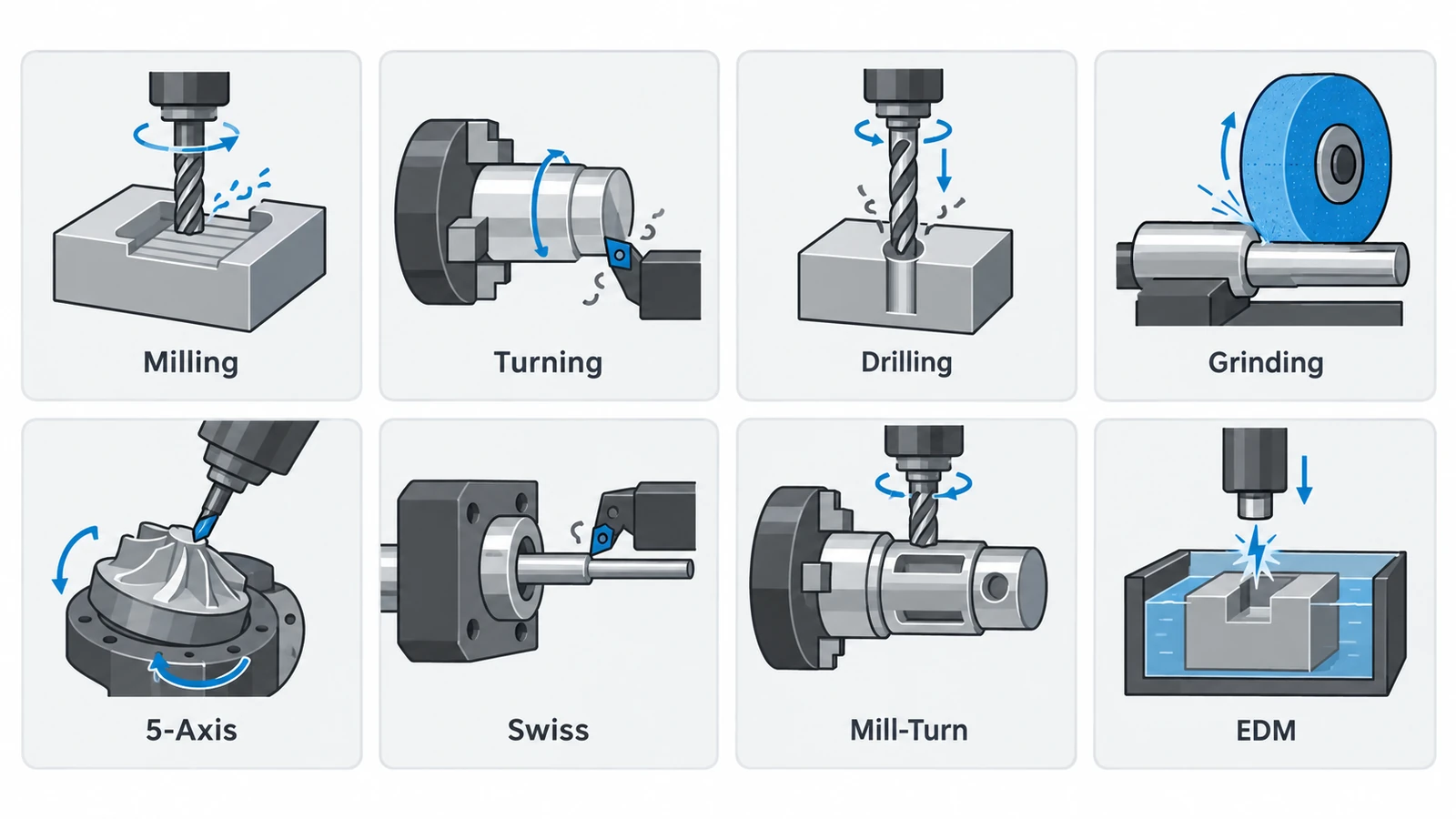
1. CNC Milling
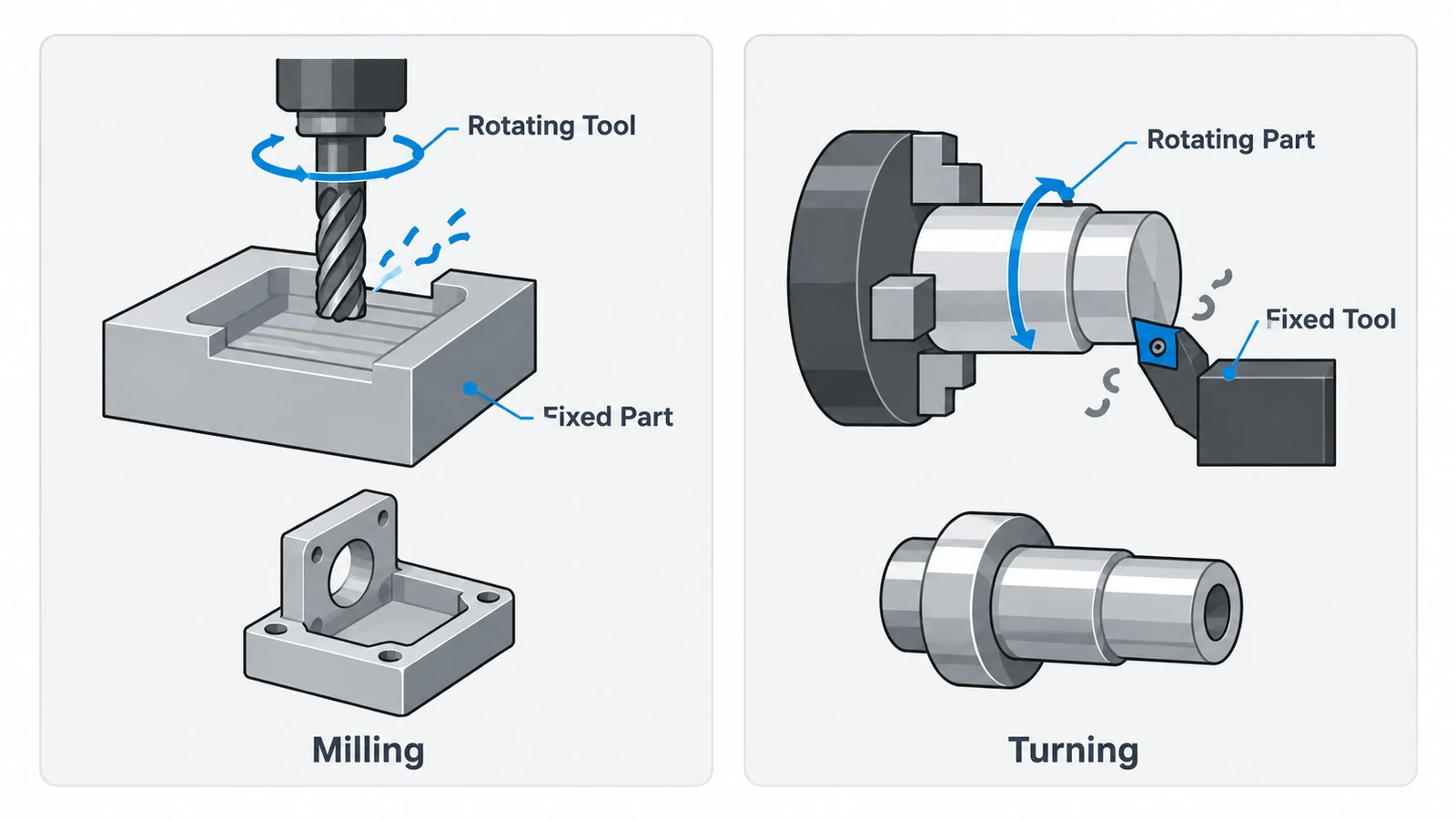
CNC milling removes material using a rotating cutting tool while the workpiece is normally held stationary.
It can produce:
- Pockets
- Slots
- Holes
- Flat surfaces
- Contours
- Threads
- Complex 3D geometry
Milling is commonly used for housings, brackets, plates, fixtures, aerospace components, medical parts, and machine components.
When to Choose CNC Milling
Milling is usually the best option when the part is mainly:
- Block-shaped
- Plate-shaped
- Irregular in geometry
- Designed with pockets or multiple surfaces
Simple components can often be produced on a 3-axis machine, while more complex parts may require 4-axis or 5-axis machining.
2. CNC Turning
CNC turning rotates the workpiece while a cutting tool removes material from its outer or inner diameter.
It is mainly used for rotational parts such as:
- Shafts
- Pins
- Bushings
- Sleeves
- Rollers
- Connectors
- Fittings
Turning can produce diameters, grooves, tapers, threads, shoulders, and internal bores.
When to Choose CNC Turning
Turning is generally the better option when most of the geometry revolves around a central axis.
For simple cylindrical parts, it is usually faster and more economical than milling.
3. Drilling and Boring
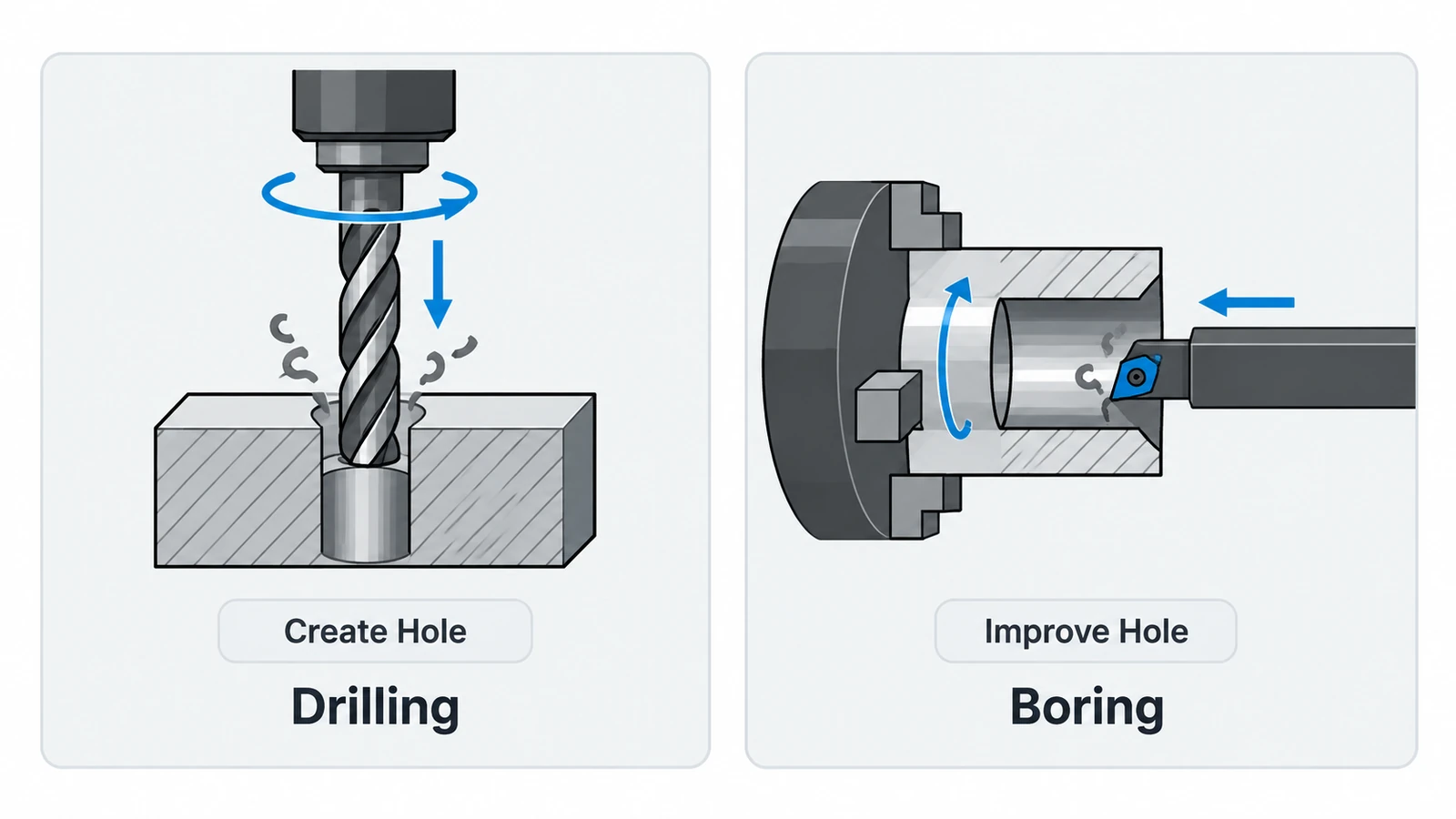
Drilling creates a hole using a rotating drill.
Common applications include:
- Through holes
- Blind holes
- Bolt holes
- Pilot holes
- Countersunk holes
- Counterbored holes
Boring is used after a hole already exists and improves its diameter, alignment, or accuracy.
Typical boring applications include:
- Bearing bores
- Precision housings
- Cylinder bores
- Large internal diameters
In simple terms:
Drilling creates the hole. Boring improves the hole.
4. Grinding
Grinding removes small amounts of material using an abrasive wheel.
It is often used after milling or turning when a component requires tighter tolerance or a finer surface finish.
Common types include:
- Surface grinding
- Cylindrical grinding
- Centerless grinding
- Internal grinding
Grinding is particularly useful for hardened steel, bearing surfaces, precision shafts, tooling, and flat reference surfaces.
It is usually a finishing process rather than the primary method used to create the entire part.
5. 5-Axis CNC Machining
5-axis CNC machining allows the tool and workpiece to move relative to each other along five axes.
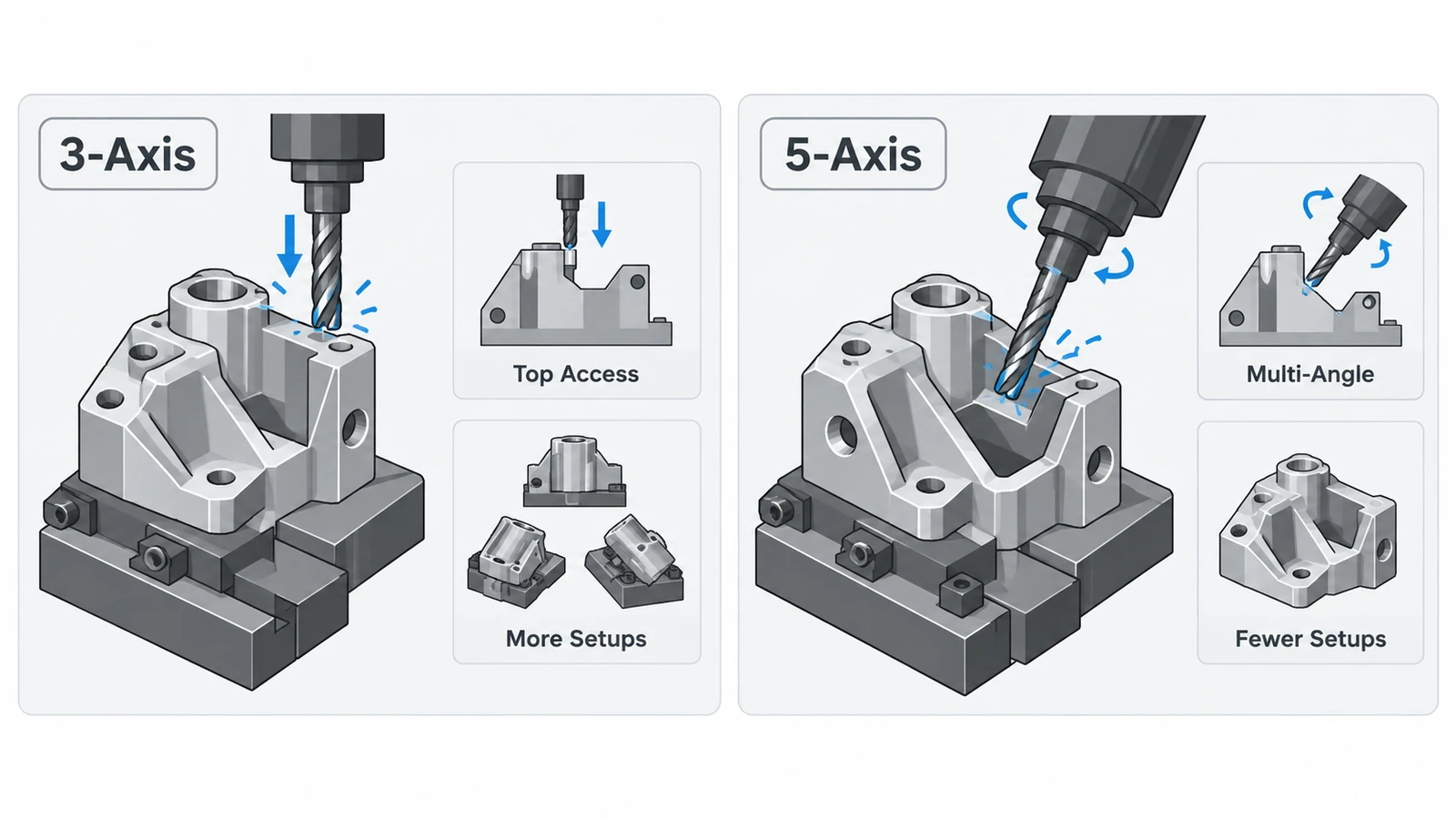
Compared with 3-axis machining, it can reach angled features and multiple sides of a component with fewer setups.
Typical applications include:
- Aerospace parts
- Impellers
- Medical components
- Complex housings
- Curved surfaces
- Deep cavities
At YuanYi, our 5-axis machining capacity supports parts up to approximately 600 × 910 × 450 mm, with typical machining tolerances around ±0.005 mm, depending on geometry and material.
When to Choose 5-Axis Machining
5-axis machining is useful when a part contains:
- Features on multiple sides
- Compound angles
- Complex surfaces
- Difficult tool access
- Deep cavities
- Tight positional relationships
Its main advantage is often the ability to reduce the number of setups.
6. Swiss Machining
Swiss machining is a specialized turning process designed for small, slender, and highly precise parts.
The workpiece is supported close to the cutting area, which helps reduce deflection during machining.
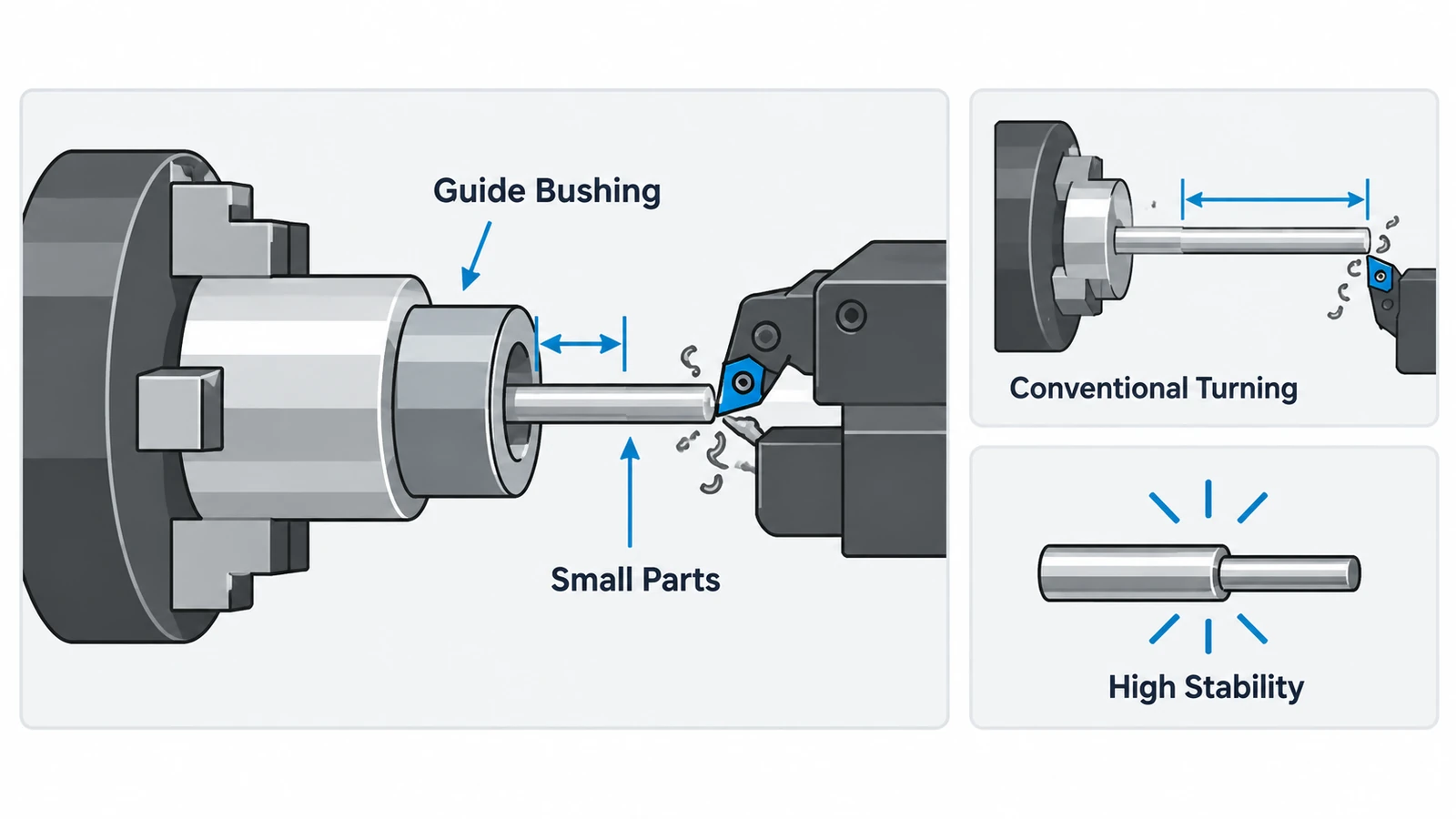
Typical Swiss-machined parts include:
- Precision pins
- Small shafts
- Connectors
- Fasteners
- Fittings
- Medical components
Swiss machines can often perform turning, drilling, threading, grooving, and some milling operations in the same cycle.
YuanYi’s Swiss machining capability supports bar diameters from approximately Ø1–100 mm, with typical tolerances down to around ±0.003 mm where geometry and material allow.
When to Choose Swiss Machining
Swiss machining is particularly suitable when the part is:
- Small in diameter
- Relatively long
- Highly precise
- Produced in repeat quantities
- Designed with several turning features
7. Mill-Turn Machining
Mill-turn machining combines turning and milling in one machine.
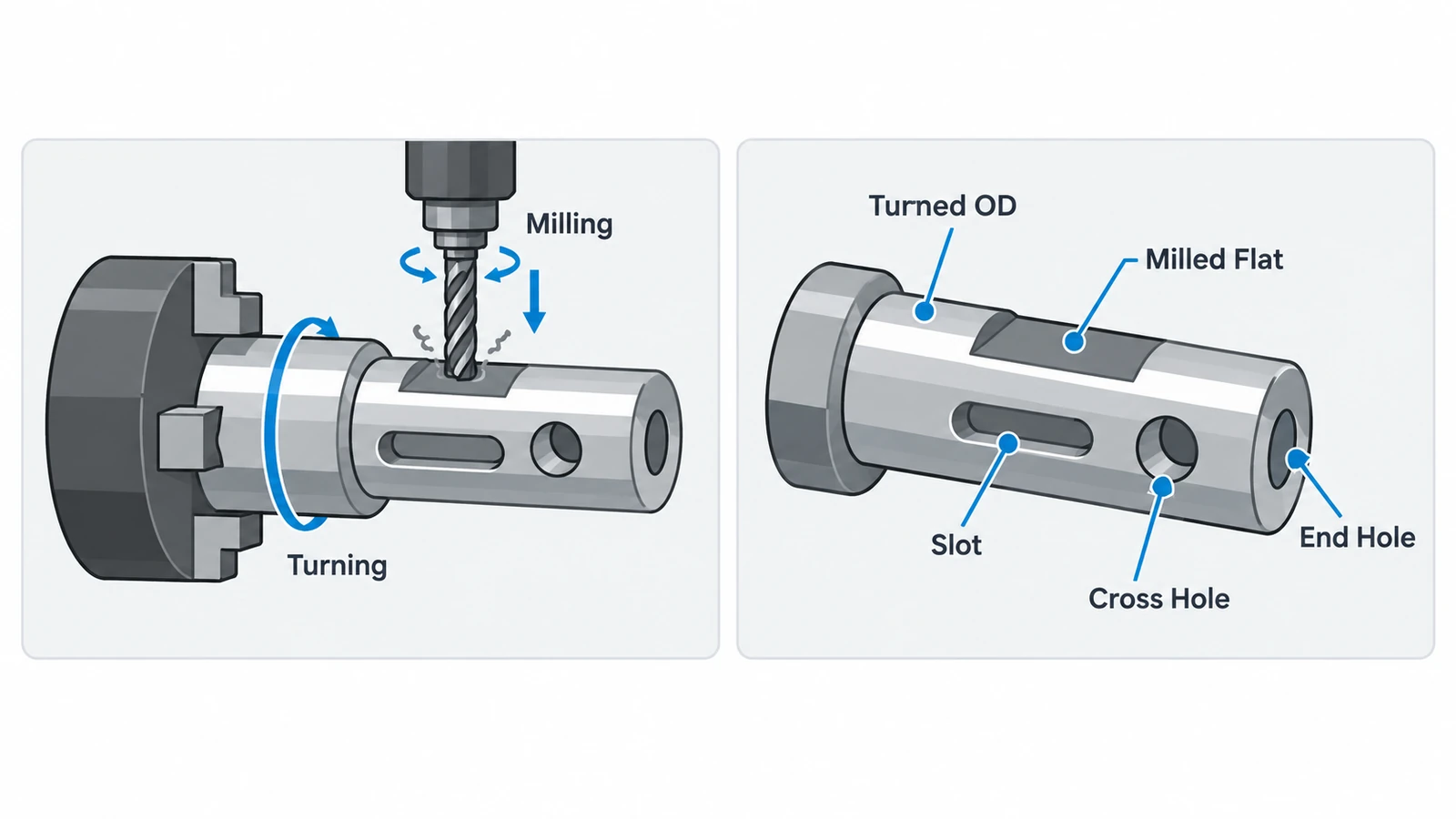
A part can often be turned, drilled, milled, threaded, and machined on several faces without being moved to another machine.
Typical applications include:
- Complex shafts
- Hydraulic parts
- Valve components
- Aerospace fittings
- Medical parts
Mill-turn is especially useful when a component contains both:
- Cylindrical turned features
- Flats, slots, cross holes, or milled details
Reducing machine transfers can improve positional consistency and shorten setup time.
8. Electrical Discharge Machining
EDM removes material using controlled electrical sparks between an electrode and a conductive workpiece.
It is useful for hard materials and features that are difficult to reach with conventional cutting tools.
The two common types are:
Wire EDM
A thin wire cuts precise profiles through conductive material.
Typical uses include:
- Dies
- Tooling
- Narrow slots
- Hardened steel profiles
Sinker EDM
A shaped electrode forms a cavity in the workpiece.
It is commonly used for:
- Mold cavities
- Deep recesses
- Sharp internal corners
EDM only works with electrically conductive materials and is usually slower than conventional machining for simple geometry.
9. Laser Cutting
Laser cutting uses a focused beam to cut sheet or plate material.
It is commonly used for:
- Sheet metal panels
- Covers
- Flat brackets
- Enclosures
- 2D profiles
Laser cutting is fast for flat profiles, but it cannot replace CNC milling when a part requires pockets, precision bores, or 3D geometry.
10. Waterjet Cutting
Waterjet cutting uses a high-pressure stream of water, often mixed with abrasive particles.
It can cut:
- Metals
- Plastics
- Composites
- Stone
- Glass
One of its main advantages is that it does not create a concentrated heat-affected zone.
However, critical dimensions and precision features may still require secondary CNC machining.
11. Electrochemical Machining
Electrochemical machining, or ECM, removes conductive material through an electrochemical reaction.
It is mainly used for specialized applications involving:
- Hard conductive alloys
- Turbine components
- Aerospace parts
- Difficult internal geometry
Compared with milling and turning, ECM is much less common for general prototype and low-volume work because of higher process and tooling costs.
Conventional vs Non-Conventional Machining
Machining processes can also be grouped into two broad categories.
Conventional Machining
These processes normally use physical tool contact.
Examples include:
- Milling
- Turning
- Drilling
- Boring
- Grinding
Non-Conventional Machining
These methods remove material using electrical, thermal, chemical, or fluid energy.
Examples include:
- EDM
- ECM
- Laser machining
- Waterjet machining
| Factor | Conventional Machining | Non-Conventional Machining |
|---|---|---|
| Material removal | Cutting or abrasion | Electrical, thermal, chemical, or fluid energy |
| Tool contact | Usually yes | Often limited |
| Typical use | General precision parts | Difficult materials or geometry |
| Cutting force | Present | Often lower |
| Cost | Usually lower | Often higher |
Machining Process vs CNC Machine Type
A machining process describes how material is removed.
Examples:
- Milling
- Turning
- Drilling
- Grinding
- EDM
A machine type or configuration describes how the equipment is arranged.
Examples:
- 3-axis machining center
- 5-axis machining center
- CNC lathe
- Swiss lathe
- Mill-turn center
For example, 5-axis machining is generally a form of CNC milling, while Swiss machining is a specialized turning method.
How to Choose the Right Machining Process
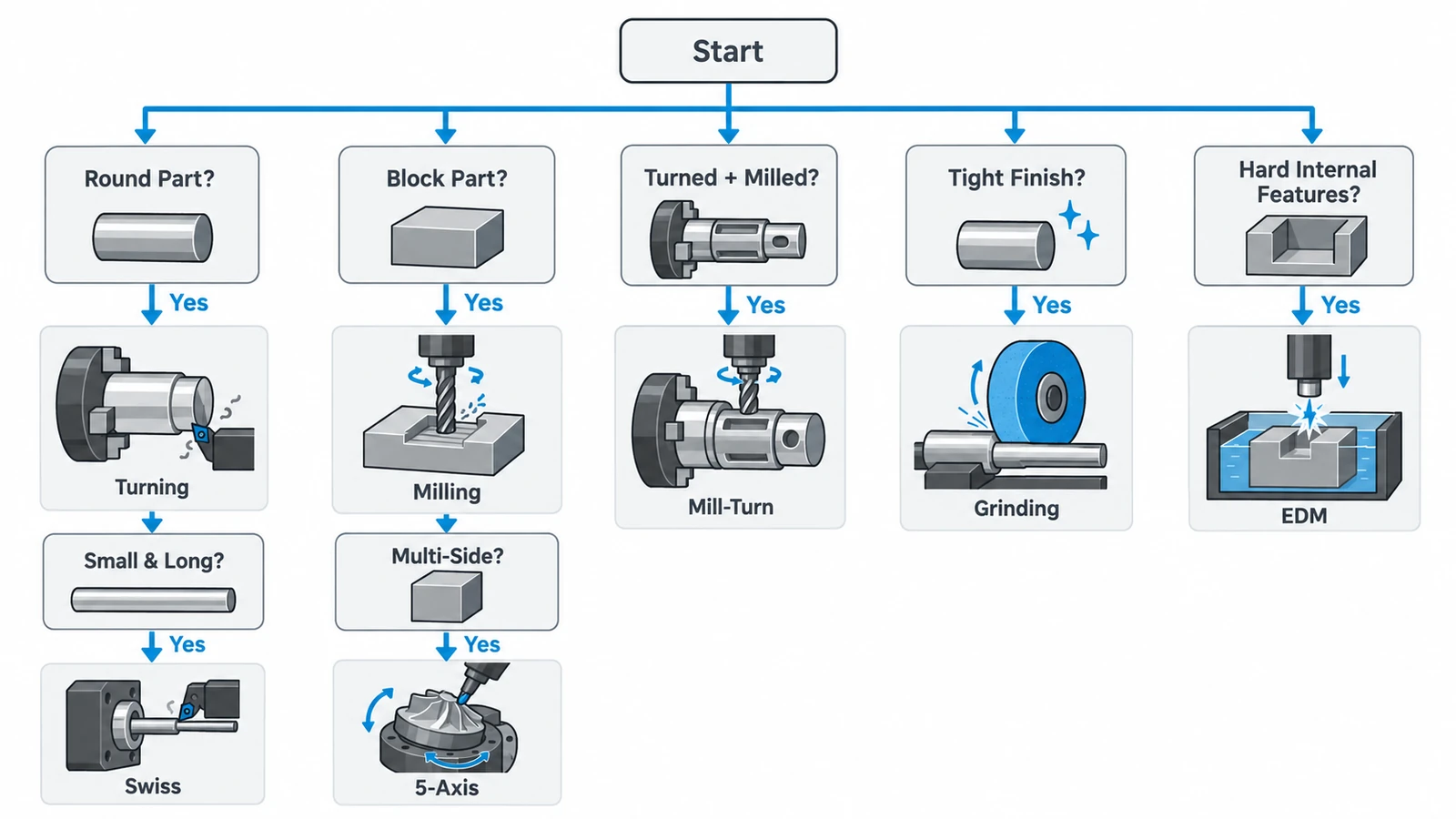
The best way to choose a process is to start with the part geometry.
Mainly Cylindrical
Choose CNC turning.
For small, slender, precision components, consider Swiss machining.
Mainly Block-Shaped or Irregular
Choose CNC milling.
If the part contains features on several sides or difficult angles, consider 5-axis machining.
Contains Both Turned and Milled Features
Consider mill-turn machining.
Requires Very Tight Final Tolerance or Finish
Consider grinding as a finishing operation.
Contains Hard-to-Reach Features in Conductive Metal
Consider EDM.
The most advanced machine is not always the best choice. The best process is usually the simplest one that can reliably meet the drawing requirements.
What Factors Affect Process Selection?
Several factors should be reviewed before machining begins.
Geometry
Rotational parts favor turning, while prismatic components usually favor milling.
Material
Aluminum, titanium, stainless steel, engineering plastics, and hardened steels all behave differently during machining.
Tolerance
Tighter tolerances require more stable machining, workholding, tooling, and inspection.
Surface Finish
Standard turning and milling are enough for many parts, while precision surfaces may require grinding or additional finishing.
Production Volume
Low-volume parts usually benefit from flexible CNC equipment, while larger production runs may justify dedicated fixtures, Swiss machining, or automation.
Cost
A simpler process is usually preferable if it can meet the same specification.
Conclusion
Different machining processes are suited to different part geometries and production requirements.
CNC turning is usually the best option for rotational parts, while CNC milling is widely used for prismatic and irregular components.
5-axis machining is useful for complex multi-sided parts, Swiss machining suits small and slender precision components, and mill-turn machining works well when a part contains both turned and milled features.
Processes such as grinding and EDM are typically used when conventional machining alone cannot efficiently achieve the required tolerance, finish, material condition, or geometry.
The best approach is to select the simplest machining process, or combination of processes, that can reliably meet the drawing, tolerance, quantity, and cost requirements.
FAQ
Common machining processes include milling, turning, drilling, boring, grinding, EDM, laser cutting, waterjet cutting, and electrochemical machining. Specialized CNC methods include 5-axis, Swiss, and mill-turn machining.
Milling rotates the cutting tool, while turning rotates the workpiece. Milling is generally used for block-shaped or irregular parts, while turning is better for cylindrical components.
CNC describes the computer control system rather than a single machining process. CNC machines can perform milling, turning, drilling, grinding, and other operations.
Complex prismatic parts often require multi-axis milling. If a part has features on several sides or complex angles, 5-axis machining may reduce setups.
Swiss machining is commonly used for small, slender, high-precision turned components such as pins, connectors, and fittings.



