

Aluminum anodizing is an electrochemical surface treatment that converts the outer surface of aluminum into a harder, more corrosion-resistant oxide layer. It is widely used on CNC machined aluminum parts to improve wear resistance, appearance, and long-term surface durability.
Type II anodizing is commonly used for colored housings, brackets, and general mechanical parts, while Type III hard anodizing is better suited to components exposed to friction and wear.
Because anodizing also changes part dimensions, engineers should consider coating thickness, holes, threads, fits, masking, and alloy selection before machining is finalized.
What Is Aluminum Anodizing?
Aluminum anodizing is an electrochemical process that increases the thickness of the naturally occurring oxide layer on an aluminum surface.
During anodizing, the aluminum part is placed in an electrolytic bath and connected as the anode in an electrical circuit. The process forms a controlled aluminum oxide layer that is harder and more corrosion-resistant than untreated aluminum.
The porous oxide layer can also absorb dyes before sealing, allowing anodized parts to combine functional protection with decorative color.
Common reasons for anodizing aluminum include:
- Improved corrosion resistance
- Increased surface hardness
- Better wear resistance
- Decorative color options
- Improved surface appearance
- Electrical insulation
- Better long-term durability
Anodizing is especially common on CNC parts made from 6061 and 7075 aluminum.
How Does the Aluminum Anodizing Process Work?
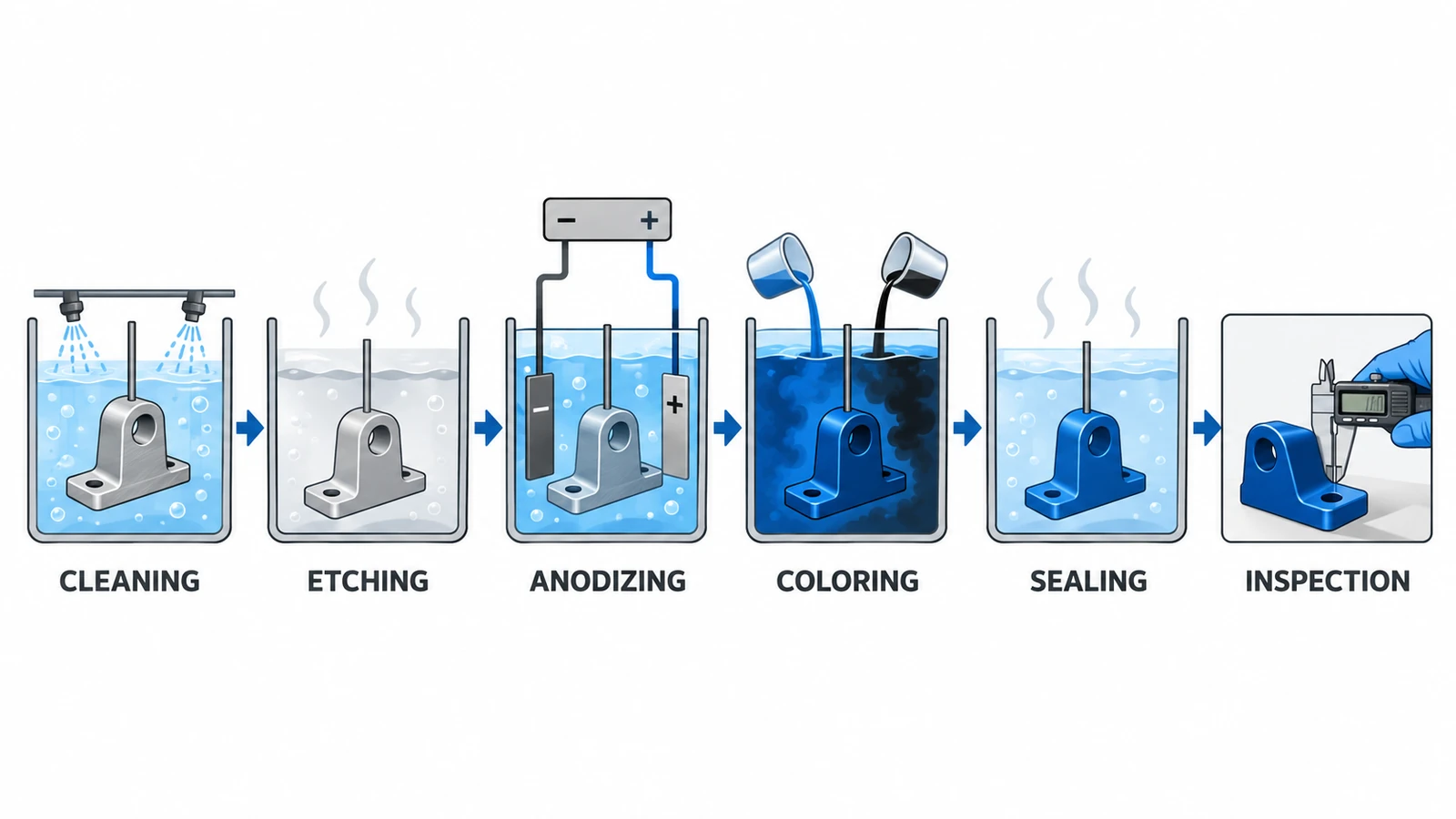
Most aluminum parts follow a similar anodizing sequence.
1. Cleaning
Machining oil, dirt, fingerprints, and other contaminants are removed from the surface to prevent uneven anodizing or cosmetic defects.
2. Etching and Desmutting
The aluminum may be chemically etched to create a more uniform surface. Desmutting then removes residues caused by alloying elements such as copper or silicon.
3. Anodizing
The part is submerged in an acid electrolyte and connected to an electrical current.
This creates a porous aluminum oxide layer. Electrolyte chemistry, temperature, current density, and processing time affect the final coating thickness and properties.
4. Coloring
For colored anodized aluminum, dye is absorbed into the porous oxide layer.
Common colors include black, blue, red, gold, green, and clear or natural finishes.
5. Sealing
The anodized surface is sealed to close the pores and improve corrosion resistance and color stability.
6. Inspection
Finished parts may be checked for coating thickness, appearance, color consistency, dimensions, and critical tolerances.
Types of Aluminum Anodizing
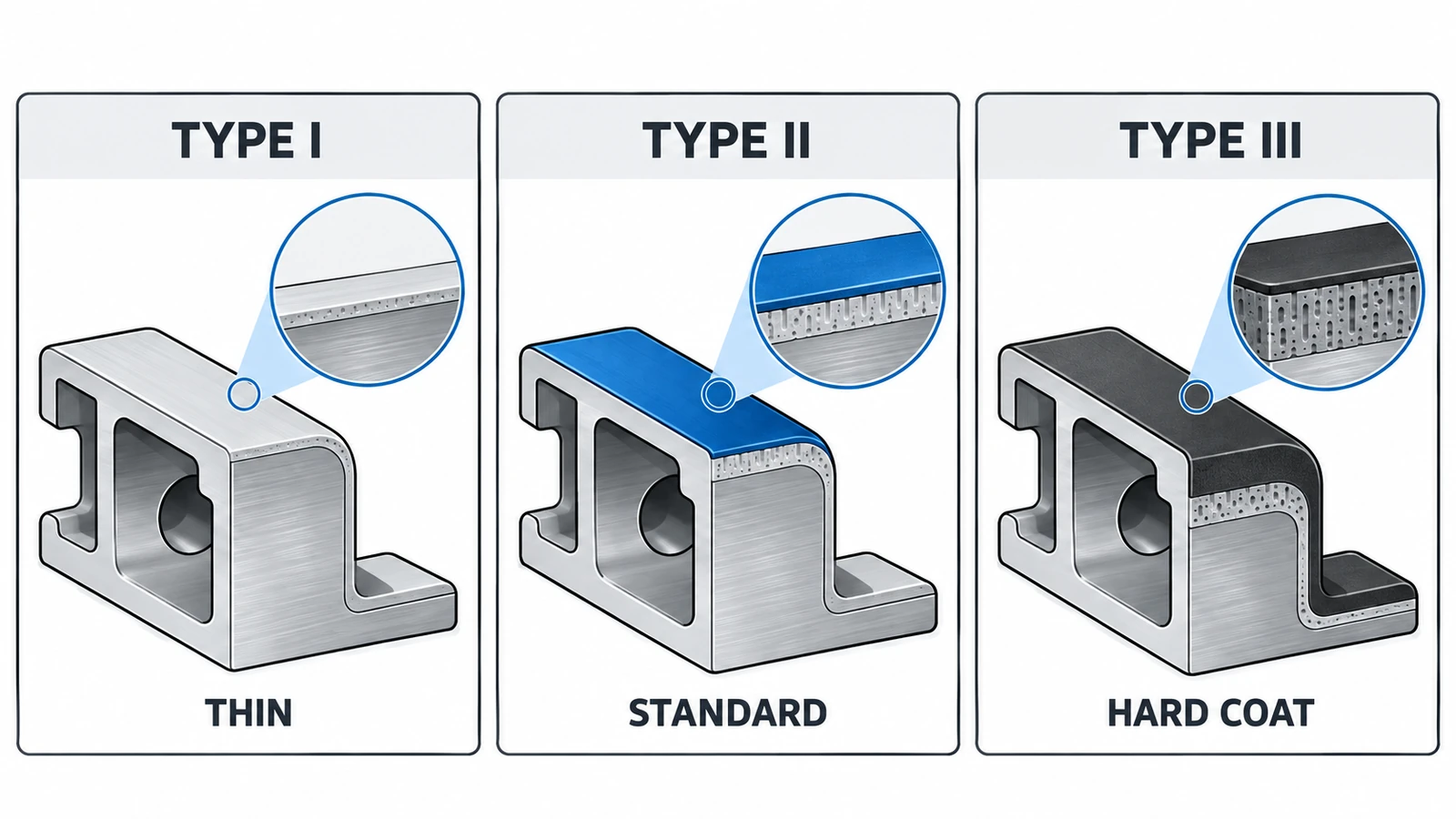
The three commonly referenced categories are Type I, Type II, and Type III anodizing.
| Anodizing Type | Typical Process | Relative Thickness | Typical Purpose |
|---|---|---|---|
| Type I | Chromic acid anodizing | Thin | Corrosion protection, aerospace |
| Type II | Sulfuric acid anodizing | Medium | General protection and color |
| Type III | Hard coat anodizing | Thick | Wear resistance and durability |
Type I Anodizing
Type I traditionally uses chromic acid and produces a relatively thin oxide layer.
It causes less dimensional change than thicker anodizing processes and has historically been used in aerospace applications where corrosion protection is required without significant coating buildup.
For most commercial CNC aluminum parts, Type II and Type III are more common.
Type II Anodizing
Type II sulfuric acid anodizing is widely used for general CNC parts.
It provides a good balance of:
- Corrosion resistance
- Cosmetic appearance
- Color options
- Moderate surface hardness
- Limited dimensional impact
Typical applications include:
- CNC aluminum housings
- Electronic enclosures
- Brackets
- Automation components
- Camera parts
- Machine covers
- Robotic components
Black anodizing is especially common, although clear, blue, red, gold, and other colors are also available.
Type III Hard Anodizing
Type III anodizing, also called hard anodizing or hard coat anodizing, creates a thicker and harder oxide layer.
It is normally selected when wear resistance and surface durability matter more than decorative appearance.
Typical applications include:
- Sliding components
- Guide surfaces
- Pistons
- Machine components
- Aerospace parts
- Automation equipment
- Fixtures
- High-wear mechanical parts
Because Type III coatings are thicker, dimensional changes need closer attention.
Type II vs Type III Anodizing
Choosing between Type II and Type III usually depends on whether appearance or wear resistance is the main requirement.
| Factor | Type II Anodizing | Type III Hard Anodizing |
|---|---|---|
| Main purpose | Corrosion protection and appearance | Wear resistance and durability |
| Coating thickness | Relatively thin | Relatively thick |
| Color selection | Wide | More limited |
| Dimensional impact | Lower | Higher |
| Surface hardness | Moderate | High |
| Cosmetic finish | Excellent | More functional |
| Typical parts | Housings, brackets, covers | Wear parts and mechanical components |
For most cosmetic CNC aluminum parts, Type II is normally sufficient.
Type III is better suited to parts exposed to abrasion, friction, or repeated mechanical contact.
If a drawing only specifies “black anodize” without stating the anodizing type or coating requirement, additional clarification may be needed before production.
Common Anodized Aluminum Colors
Type II anodizing supports a wide range of colors, including:
- Black
- Clear or natural
- Blue
- Red
- Gold
- Green
- Bronze
- Gray
Black and clear anodizing are among the most common choices for industrial CNC parts.
The final color is influenced by several factors:
- Aluminum alloy
- Surface roughness
- Etching process
- Coating thickness
- Dye concentration
- Sealing conditions
- Production batch
For cosmetic assemblies with multiple matching components, anodizing the parts together can help reduce visible color differences.
Which Aluminum Alloys Are Best for Anodizing?
Not all aluminum alloys produce the same anodized appearance.
For CNC machining, 6061 and 7075 are among the most commonly anodized grades.
| Aluminum Alloy | Anodizing Performance | Typical Applications |
|---|---|---|
| 6061 | Very good and generally consistent | Housings, brackets, machine parts |
| 7075 | Good, but color may be darker | Aerospace and high-strength parts |
| 5052 | Very good | Sheet metal and formed parts |
| 2024 | More difficult | Aerospace structural components |
6061 Aluminum
6061 is one of the most popular materials for anodized CNC parts.
It offers good machinability, corrosion resistance, strength, and generally consistent anodizing results.
It is commonly used for black, clear, and colored anodized housings, brackets, fixtures, and mechanical parts.
7075 Aluminum
7075 provides significantly higher strength than 6061 and is widely used in aerospace, robotics, and high-load mechanical applications.
It can be anodized successfully, but the finished color may appear slightly darker or less consistent than 6061 because of its alloy composition.
For cosmetic parts, this should be considered when exact color matching is important.
2024 Aluminum
2024 contains relatively high levels of copper.
It can be anodized, but the process and resulting appearance are generally more challenging than with 6061.
The alloy is usually selected for its mechanical properties rather than cosmetic anodizing performance.
How Thick Is Aluminum Anodizing?
Anodizing thickness depends on the process and required performance.
Type II generally produces a thinner coating, while Type III hard anodizing produces a thicker oxide layer.
The coating does not grow entirely above the original surface. Part of the oxide forms inward into the aluminum, while part grows outward.
As a simplified engineering rule, roughly half of the total coating thickness may contribute to outward dimensional growth, although the actual value depends on the process and specification.
For example, a 20 μm anodized layer may create around 10 μm of outward buildup on each treated surface.
This matters for precision holes, shafts, threads, bearing seats, and mating components.
How Anodizing Affects CNC Part Dimensions
Anodizing should be considered during machining rather than after the part is finished.
For example, anodizing a precision bore adds coating to both sides of the internal surface, reducing the final diameter.
Similarly:
- External shafts become slightly larger
- Slots become narrower
- Precision bores become smaller
- Threads can become tighter
- Press fits can change
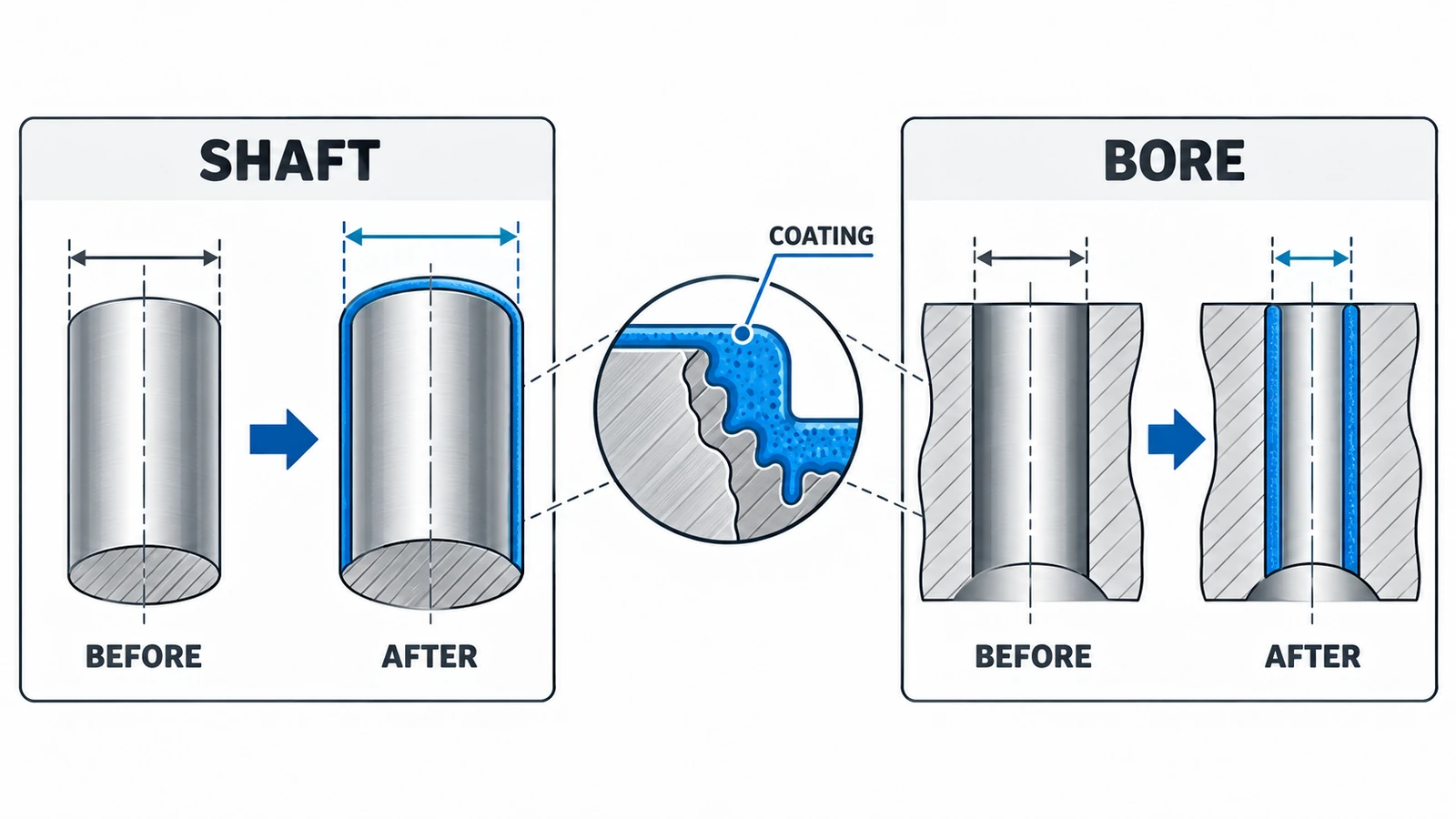
For wide-tolerance cosmetic parts, the difference may be negligible.
For ±0.01 mm or tighter mating features, coating buildup can become significant, so the machining allowance should be planned together with the finishing requirement.
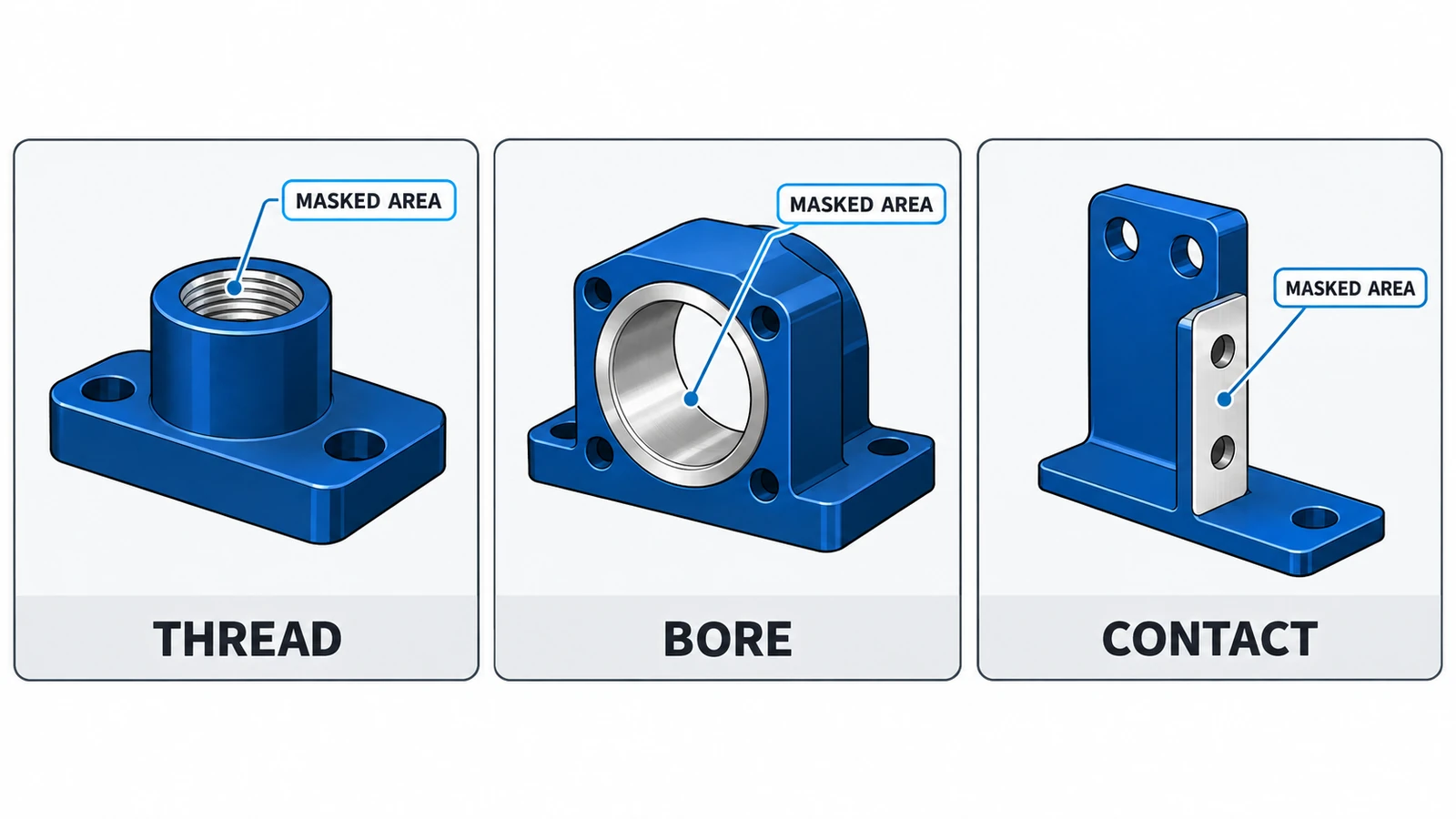
Threads, Holes and Masking
Certain features require special attention before anodizing.
Threaded Holes
Thick anodizing can affect thread fit.
Critical internal or external threads may require machining compensation or masking before anodizing.
Bearing Bores
Bearing seats often require tight diameter control.
If a precision bore is anodized without allowance, coating buildup may prevent correct assembly.
Critical bearing surfaces can be masked or machined with a calculated allowance.
Electrical Contact Areas
Anodized aluminum is electrically insulating.
Areas requiring conductivity, grounding, or electrical contact may therefore need to remain unanodized.
Masking is commonly used for this purpose.
Mating Surfaces
Closely fitted mechanical surfaces may also require masking to maintain dimensional accuracy and metal-to-metal contact.
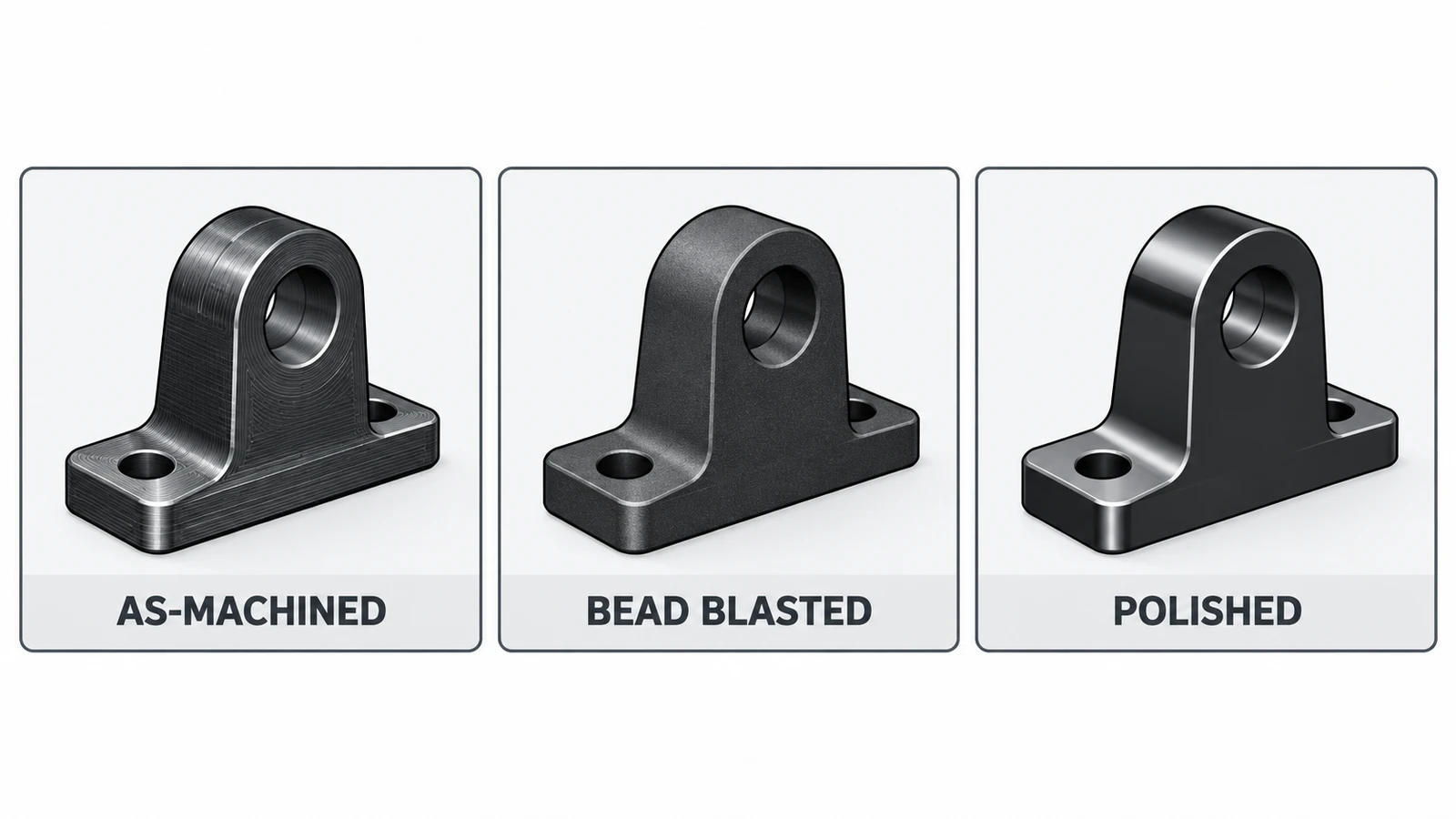
Surface Finish Before Anodizing
Anodizing does not completely hide the underlying surface.
Machining marks, bead blasting, polishing, scratches, and other surface conditions can remain visible after treatment.
As-Machined + Anodizing
Machining marks remain visible to some degree.
This is suitable for many functional industrial components.
Bead Blasted + Anodizing
Bead blasting creates a more uniform matte or satin appearance.
This combination is commonly used for:
- Electronic housings
- Consumer products
- Machine covers
- Robotics
- Cosmetic CNC components
Polished + Anodizing
Polishing before anodizing can produce a smoother and brighter decorative appearance.
It is generally used when cosmetic requirements justify the additional finishing cost.
Advantages and Limitations of Aluminum Anodizing
| Advantages | Limitations |
|---|---|
| Good corrosion resistance | Mainly suitable for aluminum |
| Increased surface hardness | Changes dimensions |
| Good wear resistance | Exact color matching can be difficult |
| Wide range of colors | Local repair is difficult |
| Does not peel like paint | Sharp edges may anodize differently |
| Professional cosmetic appearance | Alloy composition affects appearance |
For many precision aluminum components, anodizing offers a strong combination of appearance, corrosion protection, and durability.
Other finishes such as powder coating, painting, chemical conversion coating, or plating may still be more appropriate for some applications.
How to Specify Anodizing on a CNC Drawing
A clear anodizing specification helps prevent problems between design, machining, and finishing.
A drawing should ideally identify:
- Anodizing type
- Required color
- Required coating thickness
- Cosmetic requirements
- Areas to be masked
- Critical dimensions
- Whether dimensions apply before or after anodizing
For example:
Type II sulfuric acid anodize, black, 10–15 μm, matte finish, mask threaded holes.
For a harder functional coating:
Type III hard anodize, black, 40–50 μm, mask bearing bores and electrical contact surfaces.
The exact callout should follow the engineering requirements and applicable specification for the project.
When Should You Choose Anodizing?
Anodizing is a good choice when a CNC aluminum part needs:
- Corrosion resistance
- Surface durability
- Low coating weight
- Decorative appearance
- Color identification
- Improved wear resistance
Type II is normally preferred for general-purpose and cosmetic aluminum components.
Type III is more suitable for high-wear mechanical parts.
Other finishes can be better in certain situations.
Powder coating is useful when a thicker coating, broader color selection, or stronger cosmetic coverage is required.
Painting offers flexible colors and easier touch-up.
Chemical conversion coating is often selected when conductivity and minimal dimensional change are more important.
The right surface treatment should therefore be selected based on material, tolerance, working environment, appearance, and functional requirements.
Aluminum Anodizing for CNC Machined Parts
For CNC machined aluminum parts, good anodizing results begin before finishing.
Material selection, surface condition, machining allowance, threads, precision bores, and masking requirements should all be considered during machining.
At YuanYi Precision, we machine aluminum components in materials including 6061, 7075, 5052, and 2024 and support different anodizing requirements for prototype and low-volume production projects.
For parts with tight-tolerance bores, threaded features, cosmetic surfaces, or hard anodized wear areas, reviewing the finishing requirements before machining can help reduce dimensional problems and unnecessary rework.
Frequently Asked Questions
Most common aluminum alloys can be anodized, but the final color, corrosion resistance, and appearance vary with alloy composition. 6061 generally produces consistent results, while 2024 and other high-copper alloys can be more challenging.
Type II is mainly used for corrosion resistance and decorative color. Type III hard anodizing creates a thicker, harder surface for wear-resistant mechanical parts.
Yes. The oxide layer grows partly into the aluminum and partly outward from the original surface. Precision holes, shafts, threads, and mating features should therefore account for coating thickness.
Yes. Anodizing improves surface hardness but does not make aluminum completely scratch-proof. Heavy impact or abrasive contact can still damage the surface.
They can use the same process and dye, but the final shade may not look identical because alloy composition affects the anodized surface.
It depends on thread size, tolerance, coating thickness, and application. Thin Type II anodizing may be acceptable on some threads, while thicker hard anodizing often requires additional allowance or masking.



