

A composite material is made by combining two or more different materials to create properties that a single material may not provide on its own.
Most engineering composites contain two main parts:
- A matrix, which holds the material together
- A reinforcement, which improves strength, stiffness, wear resistance, or other properties
Common examples include carbon fiber reinforced polymer (CFRP), fiberglass, Kevlar composites, aluminum matrix composites, and ceramic matrix composites.
Composite materials are widely used in aerospace, automotive, robotics, medical equipment, and industrial applications because they can provide high strength and stiffness at relatively low weight.
What Is a Composite Material?
A composite combines different materials while keeping their individual roles within the final structure.
For example, in a carbon fiber composite:
- Epoxy resin acts as the matrix
- Carbon fibers act as the reinforcement
The matrix holds and protects the fibers, while the fibers provide much of the strength and stiffness.
This allows engineers to design materials around specific performance requirements such as lower weight, higher stiffness, corrosion resistance, or improved wear performance.
What Are Composite Materials Made Of?
Most composites contain the following elements:
| Component | Main Function | Common Examples |
|---|---|---|
| Matrix | Holds the reinforcement and transfers load | Epoxy, polyester, aluminum, ceramic |
| Reinforcement | Improves strength, stiffness, or wear resistance | Carbon fiber, glass fiber, aramid, SiC |
| Interface | Transfers stress between the matrix and reinforcement | Fiber-matrix bonding area |
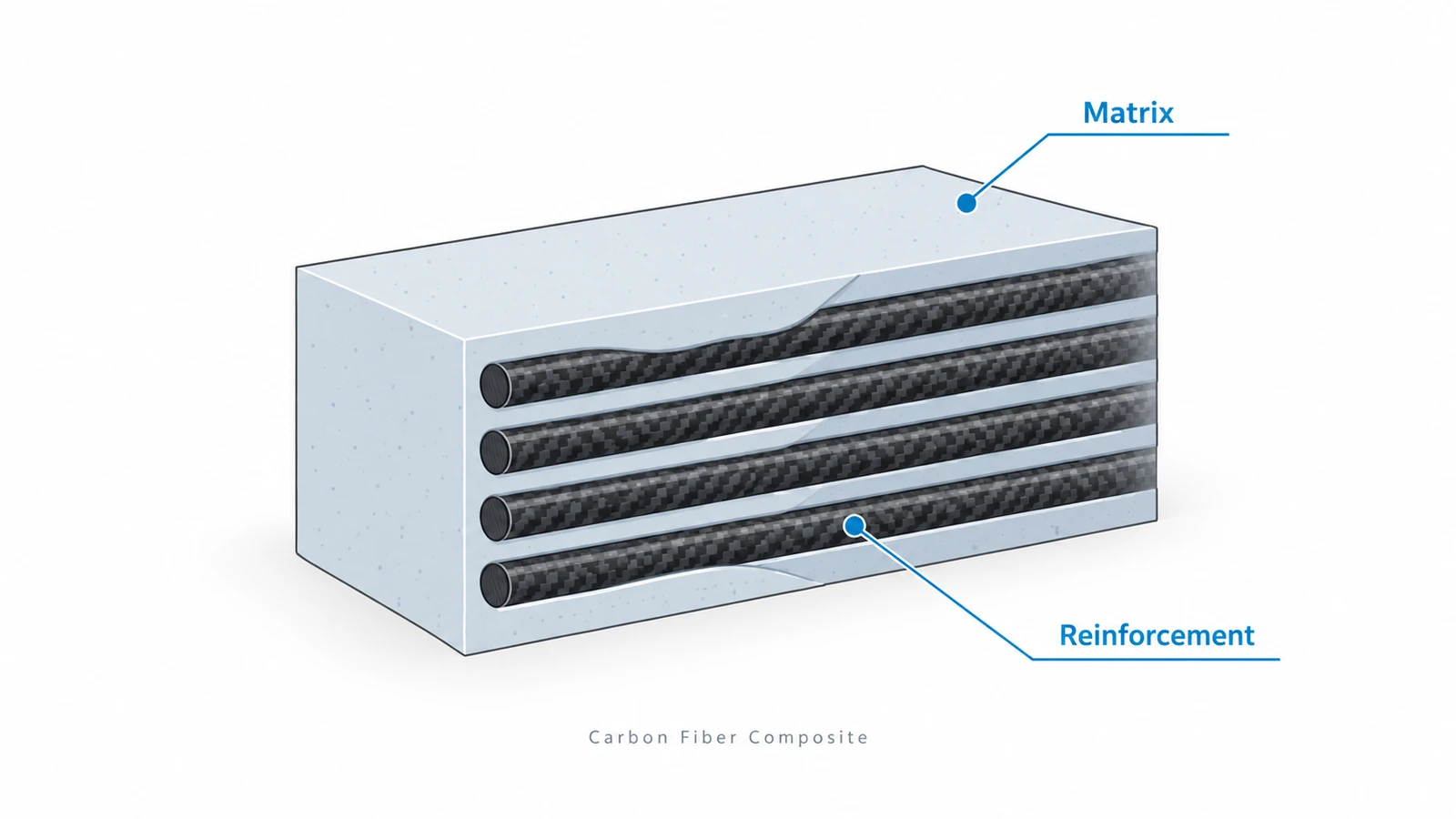
The final performance depends not only on the materials used, but also on factors such as fiber orientation, reinforcement content, bonding quality, and manufacturing method.
Main Types of Composite Materials
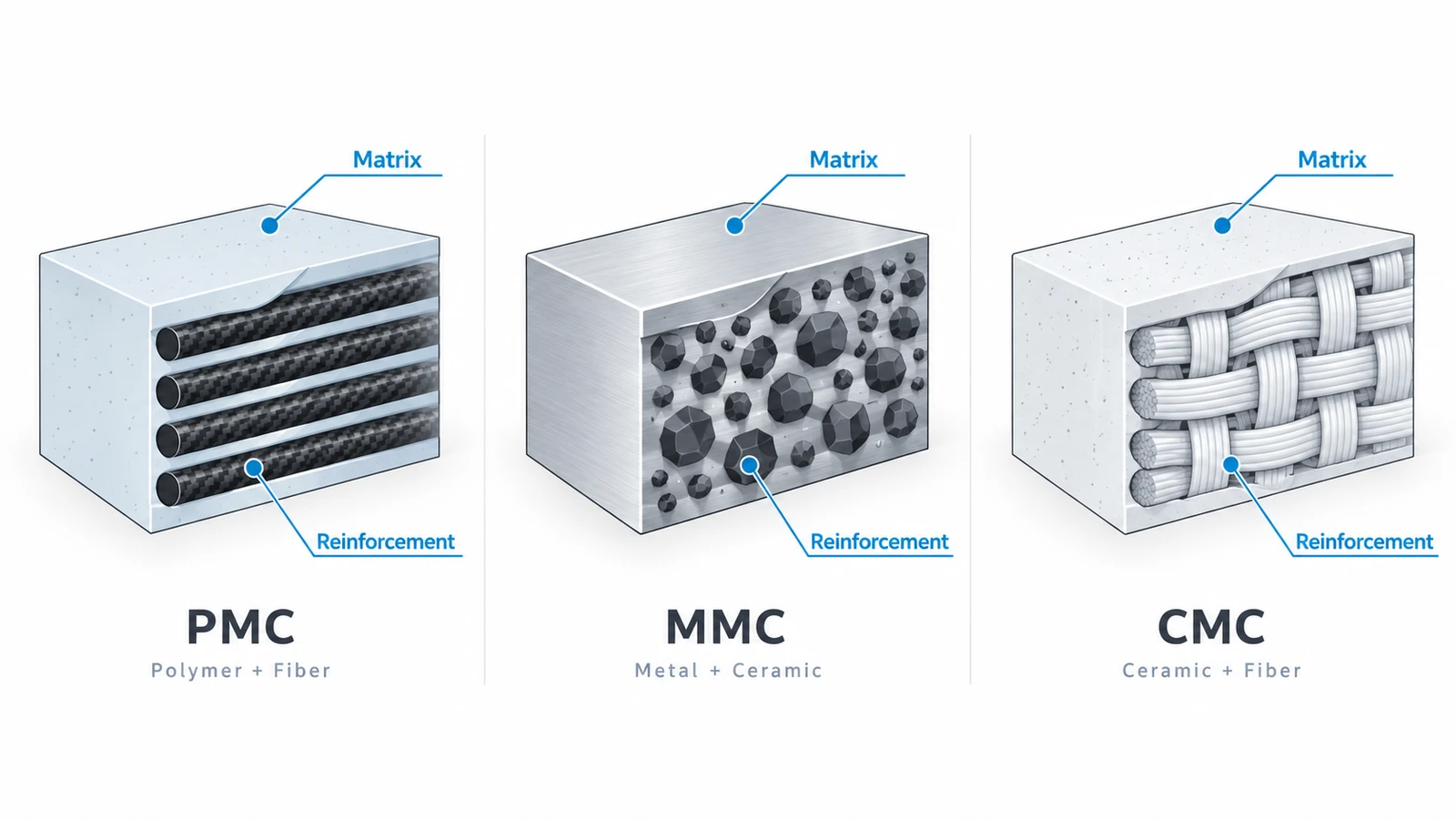
The clearest way to classify composites is by their matrix material.
Polymer Matrix Composites
Polymer matrix composites (PMCs) use a polymer resin as the matrix.
Common examples include:
- Carbon fiber reinforced polymer
- Glass fiber reinforced polymer
- Aramid fiber composites
PMCs are widely used because they combine low weight, corrosion resistance, and good mechanical performance.
They are common in aircraft, vehicles, robotics, sporting equipment, and industrial components.
Metal Matrix Composites
Metal matrix composites (MMCs) use metals such as aluminum, magnesium, or titanium as the matrix.
The metal may be reinforced with materials such as:
- Silicon carbide
- Alumina
- Carbon fibers
A common example is aluminum reinforced with silicon carbide particles.
MMCs can provide higher stiffness, wear resistance, and thermal stability than conventional metal alloys.
Ceramic Matrix Composites
Ceramic matrix composites (CMCs) use a ceramic matrix with ceramic or carbon reinforcement.
Examples include:
- SiC/SiC
- C/SiC
- Carbon-carbon composites
They are mainly used where high-temperature resistance is important, such as aerospace engines, braking systems, and thermal protection components.
Common Composite Material Examples
Some common composites include:
| Composite Material | Matrix | Reinforcement | Typical Uses |
|---|---|---|---|
| CFRP | Epoxy or polymer | Carbon fiber | Aerospace, robotics, automotive |
| GFRP | Polyester or epoxy | Glass fiber | Panels, covers, marine parts |
| Aramid Composite | Polymer | Aramid fiber | Impact-resistant components |
| Aluminum-SiC | Aluminum | Silicon carbide | Electronics, aerospace, mechanical parts |
| Reinforced Concrete | Cement | Steel | Construction |
| Plywood | Adhesive | Wood layers | Furniture and construction |
Among engineering composites, CFRP and GFRP are especially common because they provide useful strength and stiffness while keeping weight relatively low.
Key Properties of Composite Materials
Composite materials vary significantly, but several characteristics make them attractive in engineering.
High Strength-to-Weight Ratio
Many composites provide high mechanical strength without the weight of steel or other dense metals.
This makes them valuable in aerospace, vehicles, robotics, and moving equipment.
High Stiffness-to-Weight Ratio
Carbon fiber composites can provide very high stiffness while remaining lightweight.
This is useful for structures where deflection needs to be minimized.
Corrosion Resistance
Many polymer-based composites resist moisture and chemicals well, making them suitable for marine, outdoor, and industrial environments.
Tailorable Properties
One of the main advantages of composites is that their properties can be adjusted through:
- Fiber direction
- Fiber content
- Layer orientation
- Matrix selection
This gives engineers more control over how the part behaves under load.
Directional Properties
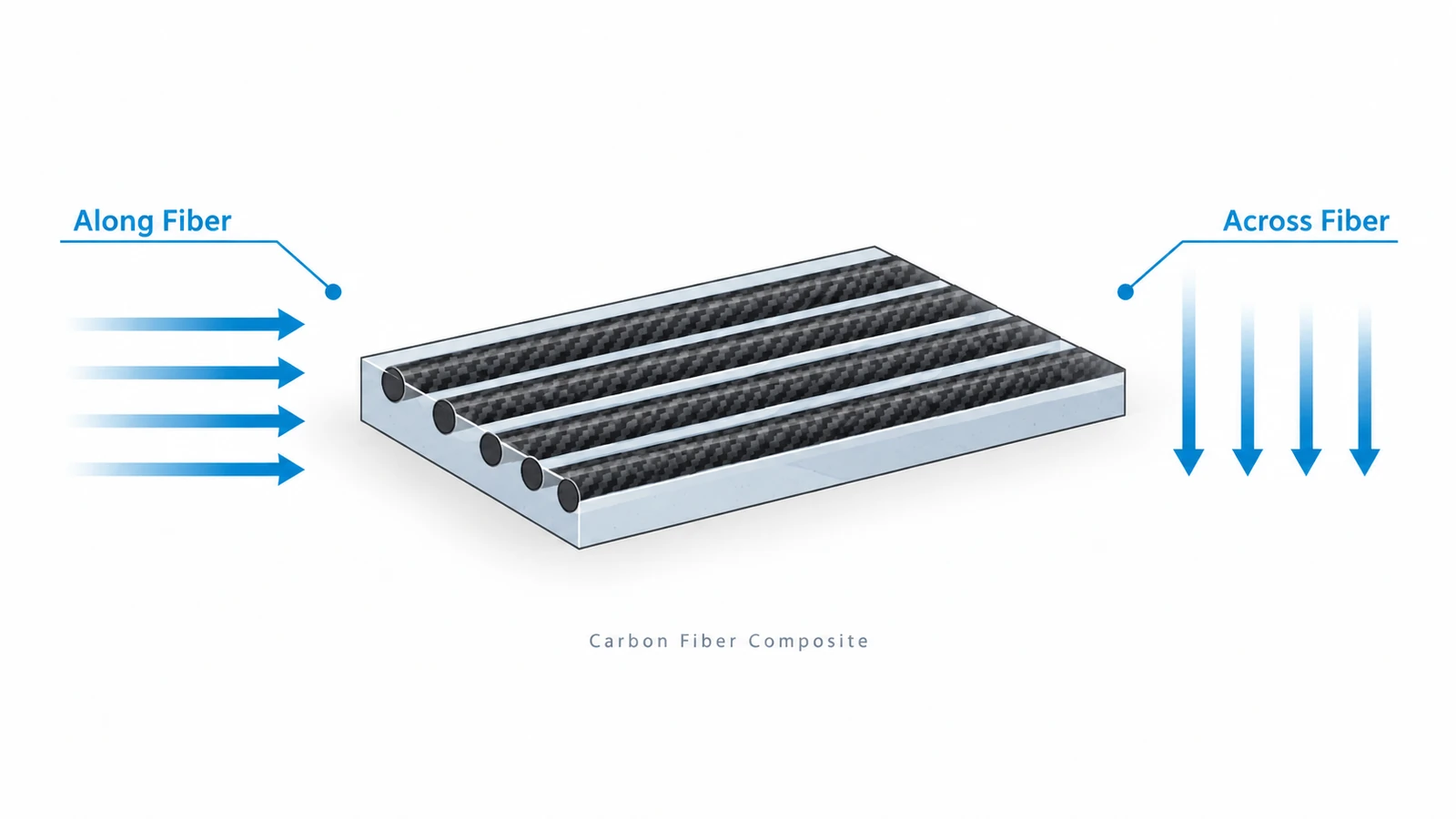
Many composites are anisotropic, meaning their properties change depending on direction.
For example, a carbon fiber laminate may be very strong along the fiber direction but much weaker across the fibers.
This is an important consideration in both part design and machining.
Advantages and Disadvantages of Composite Materials
Composite materials offer clear benefits, but they also create manufacturing challenges.
Advantages
Common advantages include:
- Low weight
- High strength-to-weight ratio
- High stiffness-to-weight ratio
- Good corrosion resistance
- Tailorable mechanical properties
- Good fatigue performance in suitable designs
Disadvantages
Common limitations include:
- Higher material cost
- More complex manufacturing
- Delamination risk
- Difficult inspection and repair
- Direction-dependent properties
- Faster tool wear during machining
- Recycling challenges
Composites are therefore not automatically better than metals. The correct choice depends on the application.
Can Composite Materials Be CNC Machined?
Yes. Composite materials can be CNC machined, drilled, trimmed, and finished.
However, machining composites is different from machining aluminum or steel.
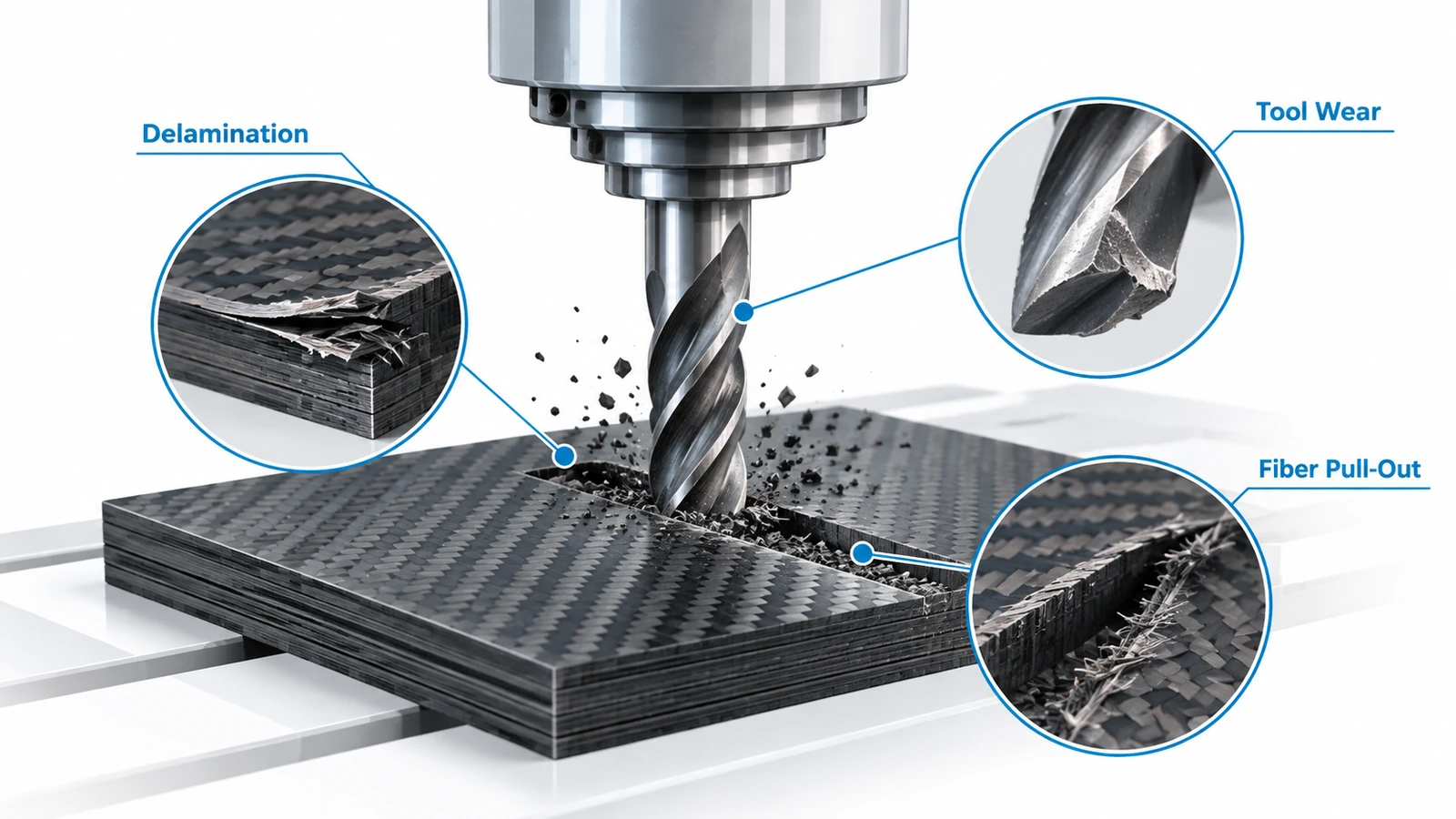
The main challenges include:
Tool Wear
Carbon and glass fibers are highly abrasive and can wear cutting tools quickly.
For higher production volumes, diamond-coated or PCD tooling may be used to improve tool life.
Delamination
Layers can separate during drilling or milling, especially near unsupported edges and hole exits.
Proper tooling, workholding, and cutting parameters help reduce this risk.
Fiber Pull-Out
Fibers may be pulled from the matrix instead of being cut cleanly, resulting in rough edges and poor surface quality.
Sharp tools and correct cutting direction are important.
Heat
Excessive heat can damage polymer-based matrices and affect dimensional accuracy.
Machining parameters should therefore limit heat generation.
Dust
Machining CFRP and GFRP can generate fine abrasive dust.
Proper extraction and machine protection are important during production.
Composite Materials vs Metals
Composite materials and metals each have advantages.
| Factor | Composite Materials | Metals |
|---|---|---|
| Weight | Often lower | Usually higher |
| Strength Direction | Often directional | Usually more uniform |
| Corrosion Resistance | Often very good | Depends on alloy and treatment |
| Machining | More specialized | Well established |
| Repair | More difficult | Usually easier |
| Design Flexibility | Very high | High |
| Recycling | Often more difficult | Generally easier |
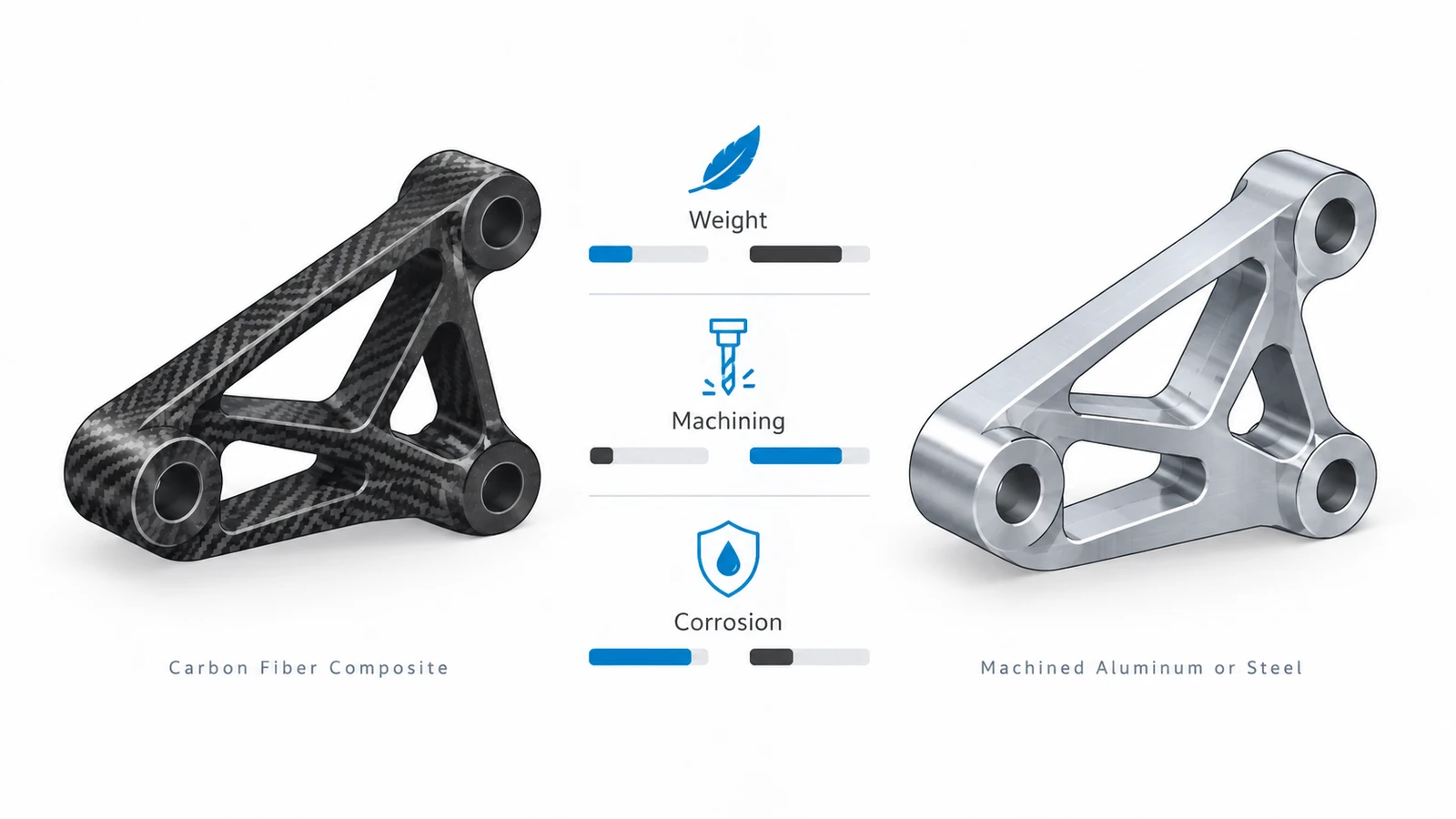
For parts with many threads, bearing seats, tight-tolerance holes, or heavily machined features, metals are often easier to manufacture.
For lightweight structural parts, panels, robotic arms, or covers, composites can provide major advantages.
Common Applications of Composite Materials
Composite materials are commonly used in industries where weight, stiffness, corrosion resistance, or high-temperature performance matter.
Typical applications include:
- Aircraft panels and UAV components
- Automotive body and structural parts
- Robotic arms and frames
- Medical equipment structures
- Industrial panels and lightweight supports
- Marine components
- High-temperature aerospace components
The exact material depends on the mechanical, thermal, environmental, and cost requirements of the part.
How to Choose a Composite Material
When selecting a composite material, engineers should consider:
Load Direction
Fiber orientation should match the main load direction whenever possible.
Weight
If weight reduction is a major priority, CFRP may justify its higher material cost.
Temperature
The matrix must remain stable at the operating temperature.
Chemical Environment
Consider exposure to moisture, fuels, oils, solvents, and outdoor conditions.
Impact Resistance
Some composites are very stiff but can be vulnerable to localized impact.
Machining Requirements
Parts with many holes, tight tolerances, or precision interfaces may require more careful material selection and machining planning.
Cost
Material price is only one part of total cost.
Tooling, machining time, inspection, scrap rate, and production volume should also be considered.
Final Thoughts
Composite materials are useful when engineers need to reduce weight, improve stiffness, resist corrosion, or tailor material performance to a specific load direction.
The most common groups are polymer matrix, metal matrix, and ceramic matrix composites, with CFRP and GFRP being widely used in engineering applications.
When composite parts require CNC machining, material behavior, fiber direction, tool selection, workholding, and heat control should be considered early in the design process.
YuanYi Precision supports CNC machining for a wide range of engineering materials and can provide DFM feedback for parts requiring precision milling, drilling, turning, and secondary machining.
Frequently Asked Questions
A composite material combines two or more different materials to create improved or specifically tailored properties. Most engineering composites contain a matrix and a reinforcement.
The three main groups are:
- Polymer matrix composites
- Metal matrix composites
- Ceramic matrix composites
Carbon fiber itself is a reinforcement. When it is combined with a resin such as epoxy, it becomes a carbon fiber reinforced polymer composite.
Yes. Fiberglass usually consists of glass fibers combined with a polymer resin matrix.
Not always.
Many composites provide excellent strength-to-weight and stiffness-to-weight ratios, but actual performance depends on fiber direction, loading, temperature, and material structure.
Yes. Composite materials can be milled, drilled, trimmed, and finished using CNC equipment, but machining strategies must account for tool wear, delamination, fiber pull-out, heat, and dust.



