

The main difference between reaming and boring is how they improve an existing hole. Reaming uses a multi-edge cutting tool to finish a pre-drilled hole to an accurate diameter and smooth surface. Boring uses a cutting tool, typically a single-point boring bar, to enlarge a hole while providing greater control over its diameter, position, and alignment.
Choose reaming when the hole is already correctly positioned and needs a precise finished size. Choose boring when the hole requires diameter adjustment, alignment correction, or a nonstandard size.
Both processes are widely used in CNC machining for precision holes, bearing seats, bushings, and mechanical assemblies.
Reaming vs Boring: Key Differences
Both operations remove material from an existing hole, but their cutting methods and applications differ.
| Feature | Reaming | Boring |
|---|---|---|
| Cutting tool | Multi-edge reamer | Usually a single-point boring tool |
| Primary purpose | Finish diameter and surface | Enlarge and correct hole geometry |
| Starting condition | Pre-drilled or pre-bored hole | Existing drilled, cast, or machined hole |
| Material removal | Small finishing allowance | Variable, depending on operation |
| Diameter flexibility | Usually fixed tool size | Adjustable diameter |
| Hole position correction | Very limited | Better correction capability |
| Surface finish | Generally good | Good to excellent with finish boring |
| Common tolerance | H7–H8 under suitable conditions | H7 and tighter may be achievable with suitable equipment |
| Cycle time | Often faster for standard holes | Depends on diameter and number of passes |
| Typical applications | Dowel pin holes, bushings | Bearing bores, large or nonstandard precision holes |
Neither process is automatically more accurate in every application. Results depend on machine rigidity, tool condition, material, hole depth, cutting parameters, and inspection methods.
What Is Reaming?
Reaming is a precision finishing operation that removes a small amount of material from an existing hole.
A reamer has multiple cutting edges arranged around its circumference. As it enters the hole, the cutting edges remove a controlled allowance to improve diameter accuracy, roundness, and surface finish.
For example, a CNC-machined aluminum bracket may require a Ø10 H7 hole for a locating pin.
The hole can first be drilled slightly undersize, then finished with a suitable 10 mm reamer.
How the Reaming Process Works
A typical CNC reaming sequence includes:
- Drill or bore the hole slightly below its final diameter.
- Select a reamer suitable for the material and hole size.
- Align the tool with the existing hole.
- Ream at the recommended speed and feed.
- Inspect the finished diameter and surface condition.
A reamer is not designed to remove a large amount of material. Excessive stock can cause tool deflection, chatter, and poor dimensional accuracy.
For a 10 mm hole, approximately 0.1–0.3 mm of diametral finishing allowance may be appropriate in many applications. The exact allowance should follow the tool manufacturer’s recommendations.
Advantages of Reaming
- Good dimensional consistency for standard hole sizes.
- Smooth internal surfaces with suitable cutting parameters.
- Relatively short finishing cycles in production.
- Useful for dowel pins, locating holes, and precision bushings.
The main limitation is that a reamer generally follows the existing hole. It cannot reliably correct significant hole-position or straightness errors.
What Is Boring?
Boring is a machining operation that enlarges or finishes an existing hole using a boring tool.
In CNC machining, a boring bar or adjustable boring head removes material from the internal surface while controlling the finished diameter.
Unlike reaming, boring can establish a new cutting path relative to the machine spindle and programmed coordinates.
This makes it useful when the existing hole is slightly off-center, requires improved alignment, or has a nonstandard diameter.
How the Boring Process Works
A typical boring sequence includes:
- Drill, mill, or otherwise create an initial hole.
- Select a boring tool that fits the hole diameter and depth.
- Set the required tool diameter or cutting offset.
- Perform rough boring if substantial material must be removed.
- Finish bore the hole to the required size.
- Inspect diameter, geometry, and positional accuracy.
For high-precision bores, the final cut may require a small controlled allowance and a rigid machining setup.
Advantages of Boring
- Flexible diameter adjustment.
- Greater ability to correct hole location and alignment.
- Suitable for larger and nonstandard hole diameters.
- Useful for bearing seats and precision mechanical housings.
- Can achieve excellent accuracy and surface finish with finish boring.
However, boring bars can deflect or vibrate, particularly in deep holes or when the tool has a long overhang.
Tool rigidity, cutting conditions, and machine stability are therefore critical.
Reaming vs Boring: Which Is More Accurate?
Both reaming and finish boring can produce highly accurate holes.
The important distinction is that diameter accuracy and hole-position accuracy are different requirements.
Reaming is effective at bringing a correctly located hole to its final diameter.
Boring provides more flexibility for controlling the relationship between the finished hole axis and the machine’s reference coordinates.
Diameter Tolerance
For suitable materials, tooling, and machining conditions, both processes can produce holes meeting an H7 tolerance.
Consider a Ø10 H7 hole.
Under the commonly used ISO 286 tolerance system, the permitted diameter range is:
10.000–10.015 mm
This is a total diameter tolerance of 0.015 mm.
Either reaming or precision boring may be suitable, provided the manufacturing process is capable of consistently meeting the specified limits.
An H7 designation controls hole size; it does not independently guarantee hole position, straightness, or surface finish.
Surface Finish
Reaming often provides a smooth finished surface because several cutting edges remove a small, consistent amount of material.
A typical reamed surface may achieve approximately Ra 0.8–1.6 µm under suitable conditions.
Precision finish boring can also produce a high-quality surface, sometimes with comparable or finer roughness.
However, neither process has a guaranteed surface finish based solely on the operation name.
The actual result depends on the material, tool geometry, cutting parameters, vibration, and coolant conditions.
Hole Geometry
If a pre-drilled hole is already straight and correctly positioned, reaming may be the most efficient finishing method.
If the hole has a positional or alignment error, boring is often more appropriate.
This distinction becomes particularly important for bearing housings, precision locating features, and components with multiple aligned holes.
Can Reaming Correct Hole Position?
Reaming cannot reliably correct a significant hole-position error because the tool tends to follow the existing hole axis.
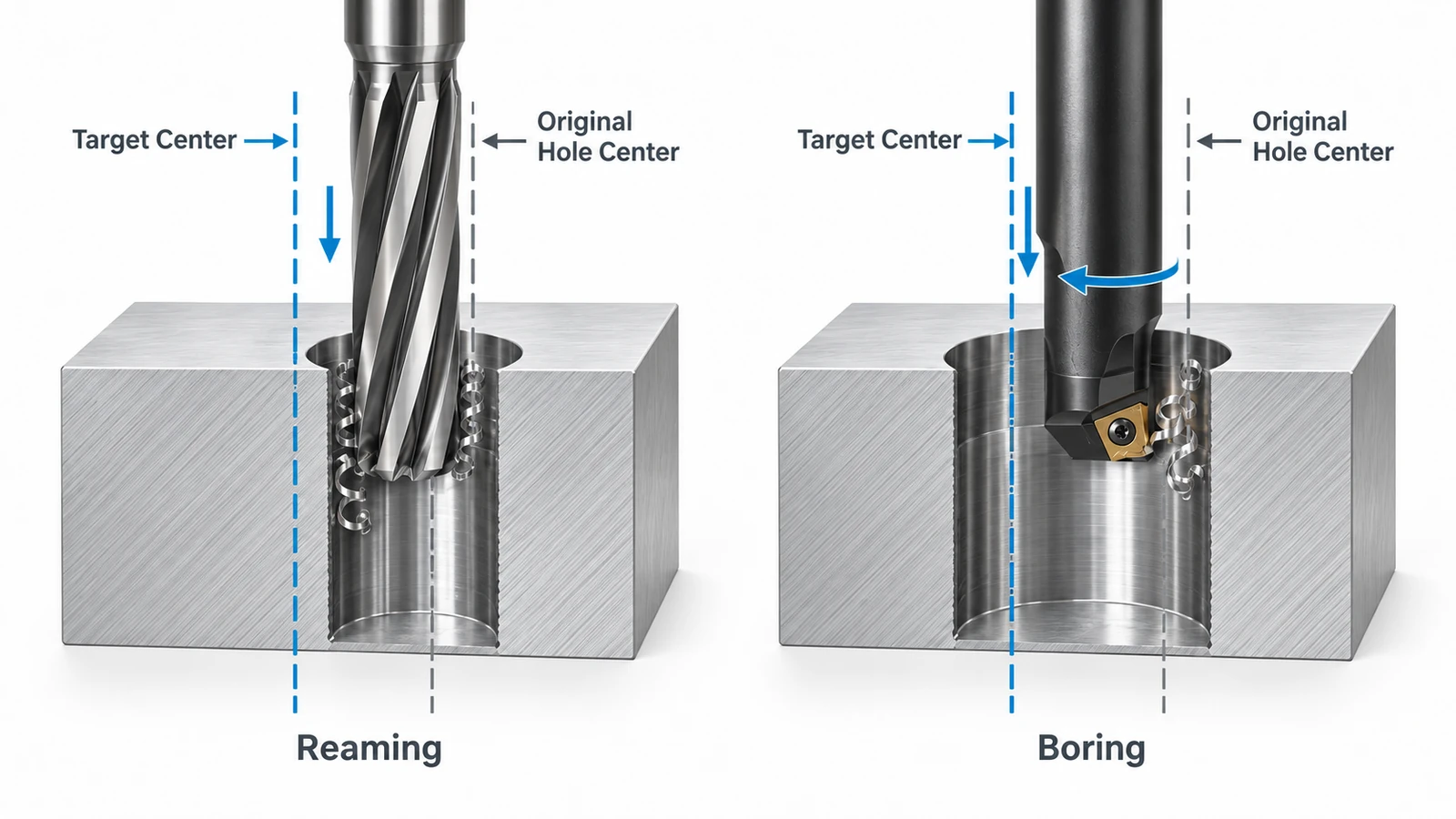
Suppose an aluminum mounting plate requires a Ø10 mm precision locating hole, but the drilled hole center is offset from its intended position.
Reaming the hole to Ø10 H7 may improve the diameter and surface finish, but the final hole can remain incorrectly located.
For example, imagine the pre-drilled hole center is shifted 0.15 mm from its specified position.
Even if the reamer produces a perfect 10.010 mm diameter, the hole may still fail its positional tolerance.
Boring can provide a better solution because the cutting path can be established from the required machine coordinates.
However, boring can only correct the error if sufficient material remains around the hole to produce the complete finished diameter.
Engineering takeaway: If hole position is critical, establish the correct geometry before final sizing. Do not rely on reaming to repair a poorly positioned drilled hole.
Reaming vs Boring: Cost and Production Efficiency
Reaming is often more economical for repeated production of standard-size precision holes.
Once the correct reamer and machining parameters are established, the final size can usually be produced in a single finishing pass.
Boring offers greater flexibility but may require additional setup, tool adjustment, and roughing or finishing passes.
| Cost Factor | Reaming | Boring |
|---|---|---|
| Standard hole diameter | Often economical | Suitable |
| Nonstandard diameter | May need special tooling | Usually more flexible |
| High-volume repeated holes | Often efficient | Depends on equipment |
| Hole-position correction | Not suitable as primary correction method | Better suited |
| Large hole diameter | Tool availability and cost matter | Often advantageous |
| Tool setup | Usually straightforward | May require adjustment |
| Deep or slender holes | Tool guidance and chip removal matter | Bar deflection and vibration matter |
A boring operation is not always more expensive. For a large or nonstandard diameter, adjustable boring tooling may be more economical than purchasing a special reamer.
The most cost-effective choice depends on the feature, material, quantity, and available machining equipment.
How to Choose Between Reaming and Boring
The best process depends on what the hole must accomplish in the finished assembly.
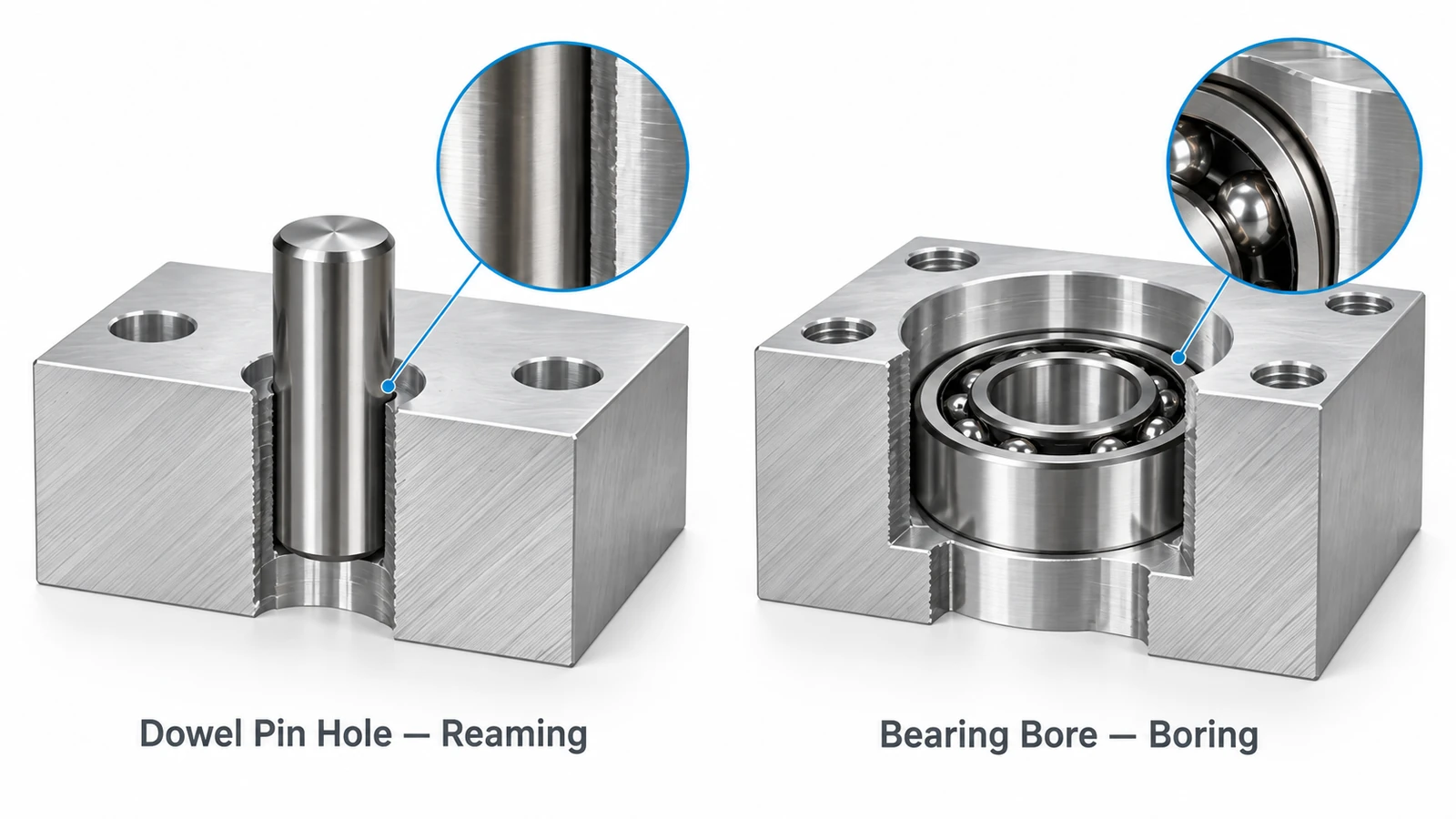
Case 1: Ø10 H7 Dowel Pin Hole
A CNC-machined aluminum plate requires a Ø10 H7 locating hole.
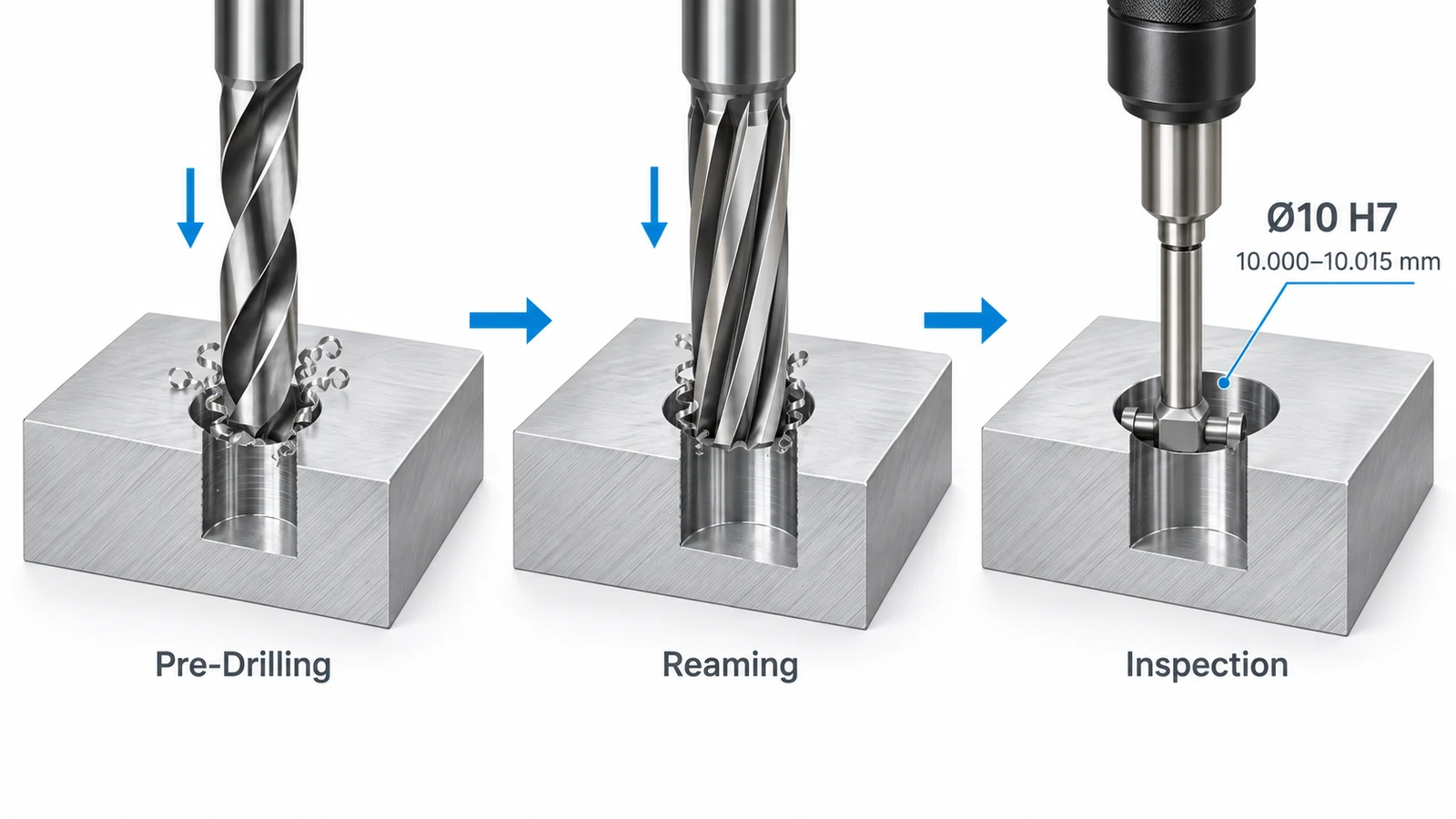
If the initial hole is accurately positioned, drilling followed by reaming can be a practical solution.
A possible process is:
Spot/Drill → Ream → Inspect
The actual pre-drilled diameter should be selected for the material and reamer.
However, if the locating hole has a tight positional tolerance and the drilled location is not sufficiently accurate, the hole should first be corrected by boring or another suitable positioning operation.
Case 2: Precision Bearing Housing
An aluminum housing requires a bearing seat with a tightly controlled diameter and location.
Finish boring may be preferred when the bore must be positioned accurately relative to mounting faces, datums, or adjacent bores.
A possible process is:
Rough Machine → Rough Bore → Finish Bore → Inspect
The correct fit must also account for the bearing manufacturer’s recommendations, thermal expansion, housing material, and operating conditions.
Case 3: Nonstandard Hole Diameter
A custom mechanical part requires a precision hole with a nonstandard diameter.
Using a standard reamer may not be practical if the required size is unavailable.
An adjustable boring tool can often produce the diameter without custom fixed-size tooling.
Quick Selection Guide
| Requirement | Preferred Starting Point |
|---|---|
| Standard-size precision hole, correctly positioned | Reaming |
| Need to correct a misplaced pre-hole | Boring |
| Nonstandard finished diameter | Boring |
| Multiple identical holes in production | Reaming |
| Large precision housing bore | Finish boring |
| Tight hole size and position requirements | Boring, potentially followed by reaming |
| Very fine surface finish beyond normal cutting capability | Consider honing or grinding |
These are process-selection guidelines rather than universal rules. The final choice should follow the drawing and manufacturing requirements.
Common Reaming and Boring Mistakes
Precision hole machining problems often result from incorrect process planning rather than machine capability alone.
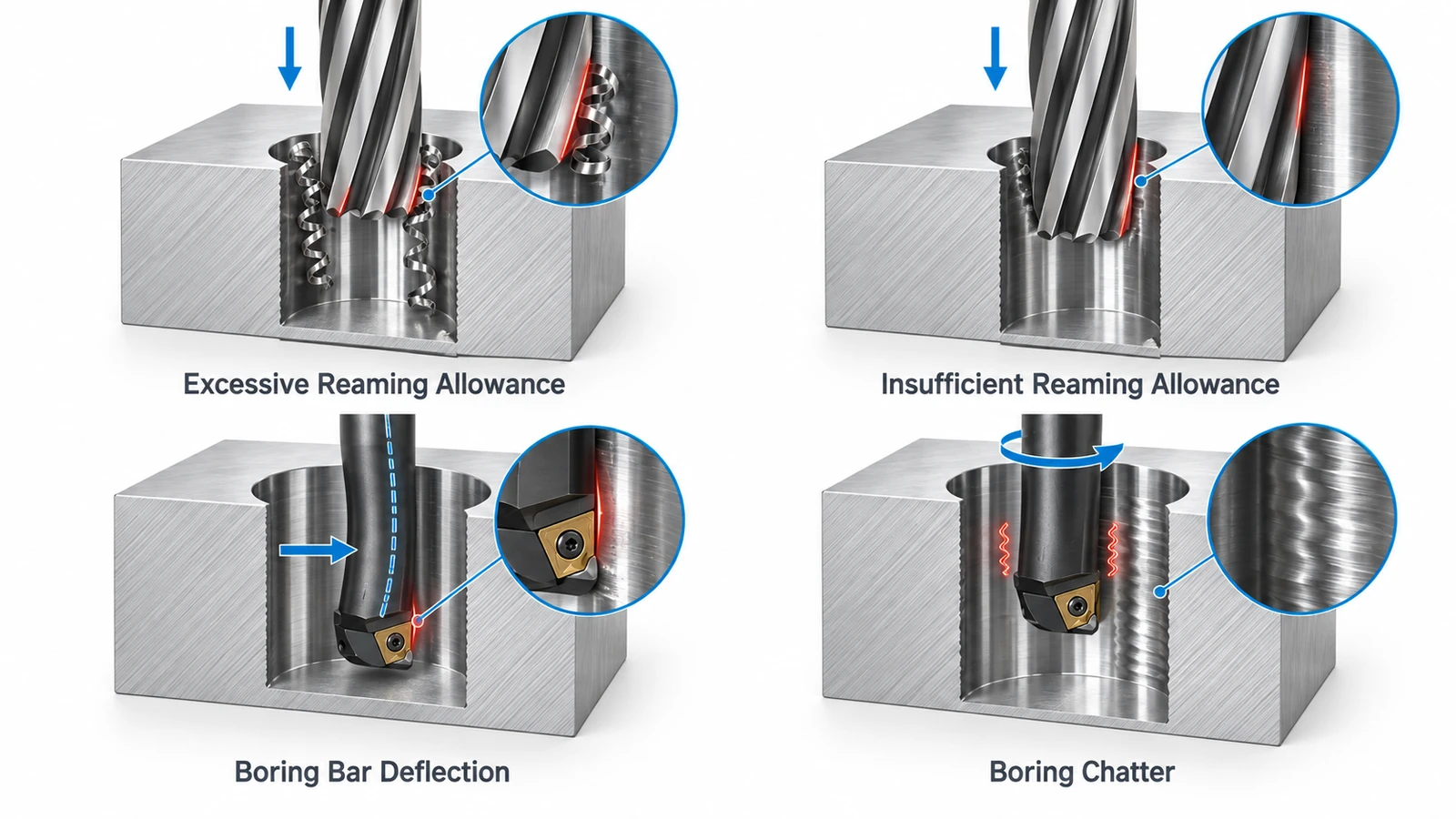
| Common Mistake | Possible Result | Recommended Solution |
|---|---|---|
| Reaming an off-position hole | Correct diameter but incorrect location | Correct position before finishing |
| Excessive reaming allowance | Chatter, rapid tool wear, poor finish | Use suitable stock allowance |
| Insufficient reaming allowance | Rubbing instead of cutting | Follow tool recommendations |
| Long boring-bar overhang | Vibration and tapered or inaccurate bores | Improve rigidity and reduce overhang |
| Ignoring thermal effects | Diameter variation | Control machining and inspection temperature |
| Selecting an unnecessarily tight tolerance | Higher machining cost | Specify tolerances based on function |
For critical applications, inspection should verify more than diameter alone.
Depending on the drawing, hole position, roundness, cylindricity, surface finish, and alignment may also require verification.
Conclusion
Reaming and boring are both important precision hole-machining operations, but they solve different problems.
Reaming is generally preferred when a correctly located hole requires accurate sizing and a smooth finish. Boring is more appropriate when the hole needs diameter flexibility, position correction, or greater control over its geometry.
For demanding components, the correct approach may involve drilling, boring, and reaming in a carefully planned sequence.
Need precision CNC-machined holes, bearing seats, or locating features?
YUANYI provides custom CNC milling and precision machining services for aluminum, stainless steel, and engineering plastic components. Send us your CAD files or engineering drawings for a quotation and manufacturability review.
Frequently Asked Questions
Not necessarily. Both processes can achieve H7 under suitable conditions. Reaming is often efficient for standard holes that are correctly positioned, while boring offers greater flexibility for diameter and alignment correction.
Yes. Precision finish boring can produce a surface comparable to or better than reaming in suitable applications. Results depend on tooling, material, machine rigidity, and cutting conditions.
No. Conventional finishing reamers are intended to remove relatively small amounts of material. If a hole requires substantial enlargement, drilling, milling, or boring should generally be used first.
Yes. Boring can establish the required hole location and geometry, while reaming can be used afterward to finish the diameter and surface. However, many holes can be completed by precision boring alone.
Yes. Boring can machine blind holes when tool clearance, chip evacuation, and bottom geometry are considered. The tool must have sufficient space to operate without interfering with the hole bottom.



