

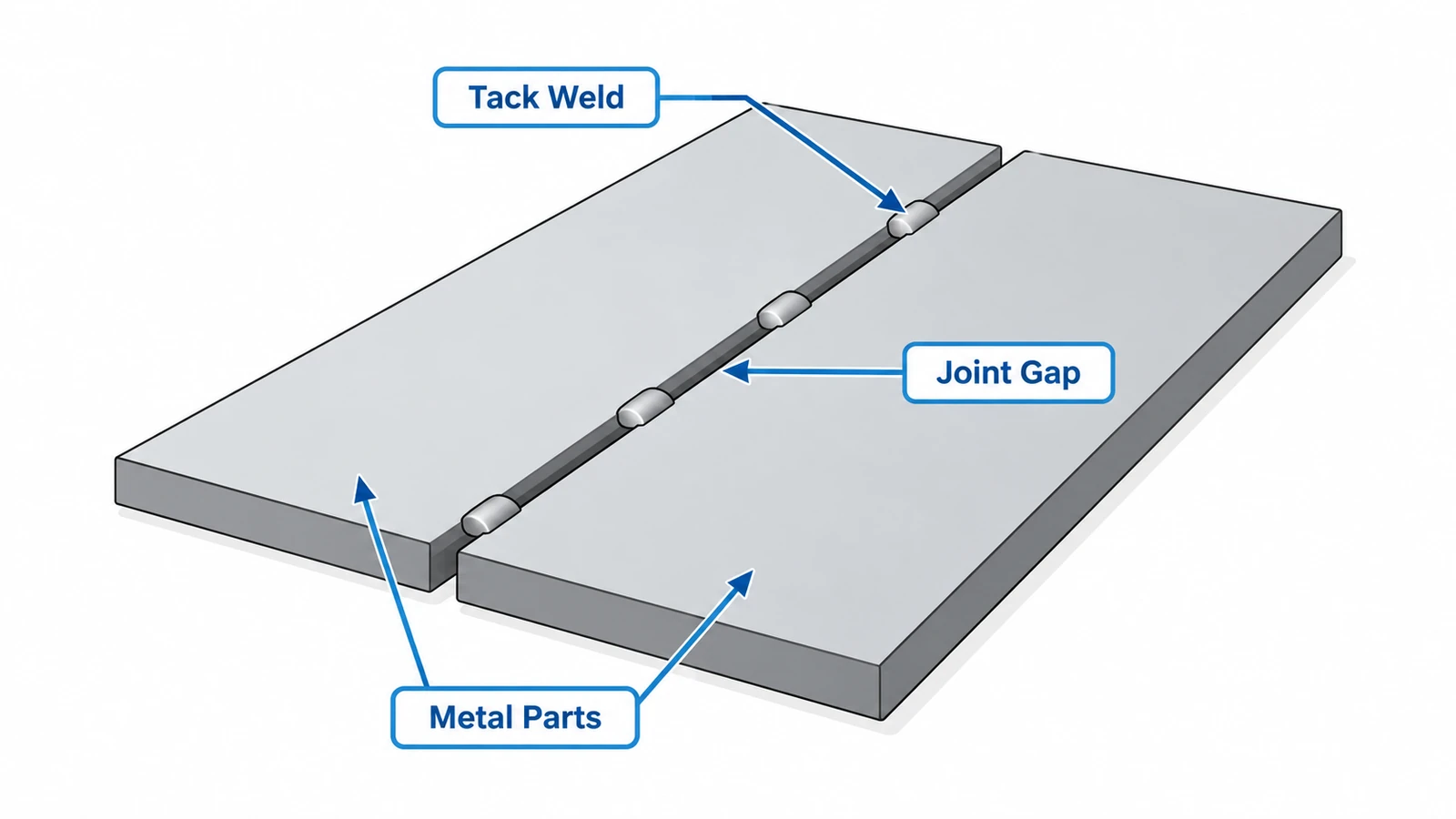
Tack welding is a preliminary welding technique used to hold metal parts in the correct position before the final weld is completed. Small, localized welds—known as tack welds—secure the workpieces, maintain joint alignment and help prevent movement during welding.
What Is Tack Welding?
Tack welding involves placing several short welds at selected points along a joint before creating the final continuous weld.
Think of tack welds as temporary welded clamps.
Instead of relying entirely on fixtures to keep two components in position, tack welds hold the parts together while dimensions, angles, gaps and alignment are checked.
Depending on the welding procedure, tack welds may later be:
- melted into the final weld;
- ground or removed before final welding; or
- left as part of the completed joint when permitted by the welding procedure.
Tack welding is not a separate welding process by itself. MIG, TIG, stick and other welding processes can all be used to create tack welds.
The main difference is purpose: the tack establishes and maintains fit-up before the final joint is completed.
Why Is Tack Welding Important?
The main purpose of tack welding is to keep components in the required position while the final weld is being made.
This sounds simple, but several important manufacturing problems are being controlled at the same time.
Maintain Part Alignment
Once welding begins, heating and cooling generate thermal expansion and shrinkage.
Without sufficient restraint, components can move away from their intended position.
Tack welds help maintain:
- straightness;
- squareness;
- angular alignment;
- component position; and
- joint orientation.
This is especially important for frames, long plates and assemblies where small positioning errors can accumulate across the structure.
Maintain the Joint Gap
Many welded joints require a specific gap between components.
Tack welds help prevent that gap from opening or closing as additional welds are added.
This is particularly important in butt joints, where weld shrinkage can progressively pull the two workpieces toward each other.
Reduce Welding Distortion
Tack welding cannot eliminate thermal distortion, but a suitable tack pattern can help control it.
The sequence matters.
For long joints, simply placing all tack welds progressively from one end to the other may allow shrinkage to accumulate. Techniques such as center-out or back-step tacking can distribute the effect more evenly.
Reduce the Need for Complex Fixtures
Fixtures, clamps and jigs are still important in production welding, but tack welds can reduce the amount of external fixturing needed.
This makes tack welding particularly useful for:
- prototypes;
- one-off fabrications;
- repair work; and
- low-volume production.
Building a dedicated fixture may not be economical for these applications.
Allow Inspection Before Final Welding
Tack welding creates an intermediate stage where the assembly can still be checked.
Before completing the permanent weld, manufacturers can verify:
- dimensions;
- joint gaps;
- perpendicularity;
- hole locations;
- assembly orientation; and
- overall fit.
Correcting a positioning problem at this stage is usually much easier than repairing a completed welded assembly.
How Does Tack Welding Work?
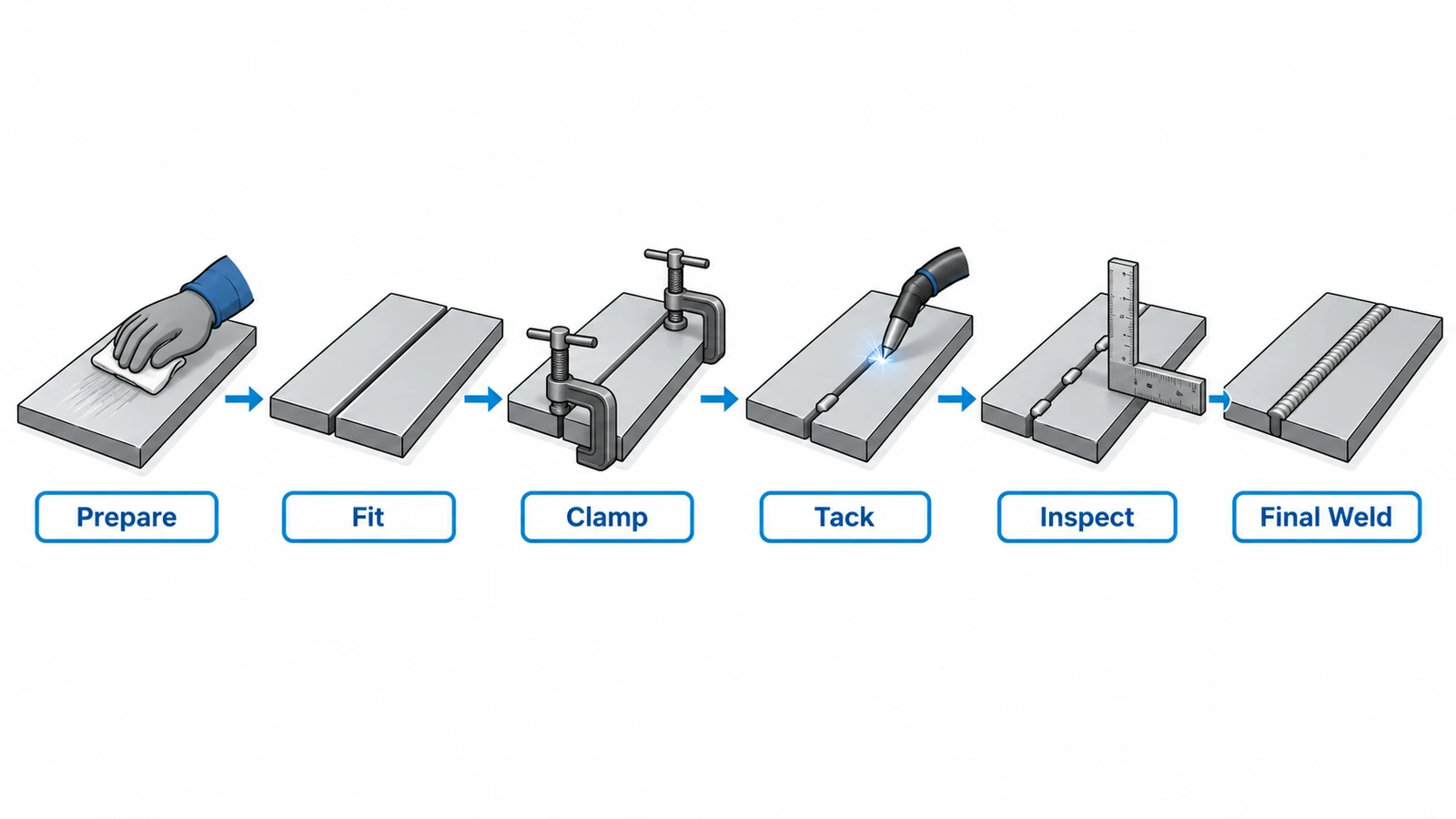
A typical tack welding process can be summarized as:
Prepare → Fit → Clamp → Tack → Inspect → Final Weld
1. Prepare the Joint
The contact surfaces should be cleaned before welding.
Oil, rust, moisture, oxide, coatings and other contamination can interfere with fusion and may introduce defects into both the tack and final weld.
2. Position the Components
Parts are arranged according to the drawing or assembly requirements.
At this stage, the manufacturer establishes:
- joint gap;
- orientation;
- alignment;
- angle; and
- relative component position.
3. Clamp the Assembly
Clamps, fixtures, magnets or jigs may initially hold the workpieces in place.
This prevents movement while the first tack welds are made.
4. Apply Tack Welds
Small welds are placed at selected positions around or along the joint.
The tack must provide enough strength to resist movement and weld shrinkage without adding unnecessary heat.
5. Recheck Dimensions
After tacking, the assembly should be measured again.
Heat from even a small weld can cause movement, particularly in thin sheet metal or long structures.
If dimensions have shifted, the assembly can often still be corrected before permanent welding.
6. Complete the Final Weld
After fit-up is confirmed, the final weld is completed using the specified welding procedure.
If tack welds are incorporated into the finished joint, they should be free from defects that could remain inside the final weld.
Tack Weld Size, Spacing and Sequence
There is no universal tack weld size or spacing that works for every fabrication.
The correct approach depends on:
- material;
- material thickness;
- joint geometry;
- assembly size;
- welding process;
- weld sequence; and
- applicable welding specification.
This is why simply specifying “a tack every X millimeters” without considering the actual joint can be misleading.
Tack Weld Size
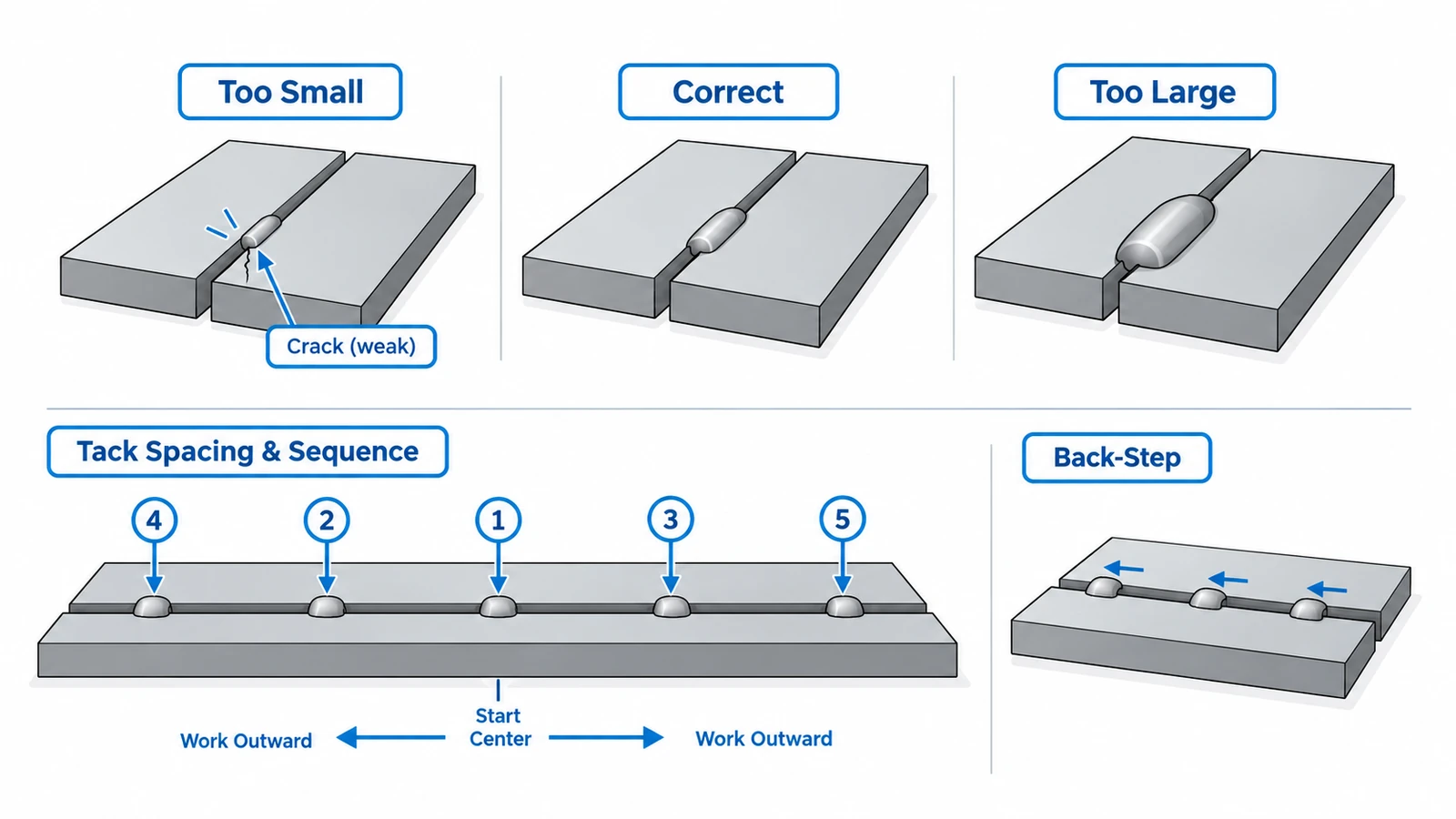
A tack should be large enough to resist the forces acting on the joint but not unnecessarily large.
If the tack is too small:
- it may crack;
- the joint may move;
- the root gap may change; or
- the tack may fail during handling.
If the tack is too large:
- excessive heat can increase distortion;
- removing it becomes more difficult;
- it may interfere with the final weld; and
- additional grinding may be required.
The ideal tack is therefore not the largest possible weld—it is the smallest reliable weld that adequately maintains the required fit-up.
Tack Weld Spacing
Spacing also changes with the application.
Thin or flexible components generally require more attention to positioning because relatively small thermal forces can change their shape.
Large rigid structures may tolerate wider spacing, but each tack may need to carry greater loads.
Corners, ends and areas with limited stiffness may also require additional restraint.
TWI notes that too few tack welds can allow the joint gap to progressively close as welding proceeds, which demonstrates why spacing cannot be treated as a cosmetic detail.
Tack Welding Sequence
Sequence becomes increasingly important as joint length increases.
Three general approaches include:
Straight sequence
Tacks are placed progressively from one end toward the other.
This is simple but may allow shrinkage to accumulate.
Back-step sequence
Tacks are placed in short steps opposite to the overall direction of progression.
This can help distribute shrinkage more evenly.
Center-out sequence
Tacking begins near the center and moves toward both ends.
This approach is often useful for long joints where dimensional stability is important.
The exact sequence should match the geometry and expected direction of weld shrinkage rather than following one pattern for every assembly.
Materials Commonly Used for Tack Welding
Most weldable metals can also be tack welded, but their behavior under localized heating varies considerably.
| Material | Main Tack Welding Consideration |
|---|---|
| Carbon Steel | Generally straightforward but heat input and cracking still require control |
| Stainless Steel | Low thermal conductivity can increase localized heating and distortion |
| Aluminum | High thermal conductivity requires careful heat control and clean surfaces |
| Titanium | Requires excellent shielding and contamination control |
| Galvanized Steel | Zinc coating affects welding and requires proper fume control |
| Copper Alloys | High thermal conductivity can make heat control more difficult |
Carbon Steel
Carbon steel is common in fabricated frames, brackets, machinery structures and equipment.
It is generally easier to tack weld than many non-ferrous metals, although carbon content, thickness and restraint can affect cracking behavior.
Stainless Steel
Stainless steel can distort noticeably during welding because heat remains concentrated near the weld zone.
Excessive tack size and poorly planned weld sequences can therefore create dimensional problems in thin stainless components.
Aluminum
Aluminum transfers heat rapidly away from the weld area.
Its oxide layer also has very different melting behavior from the base metal, making proper surface preparation particularly important.
Thin aluminum parts need careful control to avoid burn-through and distortion.
Titanium
Titanium is highly sensitive to contamination at welding temperatures.
Proper shielding must therefore extend beyond the molten weld pool to protect heated material from atmospheric oxygen and nitrogen.
Common Tack Welding Methods
Because tack welding describes the function of the weld rather than one specific welding technology, several processes can be used.
MIG Tack Welding
MIG welding is commonly used for steel fabrication and production environments.
It offers:
- relatively fast tack placement;
- easy arc starting;
- good productivity; and
- suitability for many general fabrication jobs.
TIG Tack Welding
TIG welding provides excellent control over the weld pool and heat input.
It is frequently used for:
- stainless steel;
- aluminum;
- thin materials;
- precision fabrication; and
- applications where appearance is important.
Stick Tack Welding
Shielded metal arc welding can also be used for tack welding, particularly on structural steel and field fabrication.
The tack must be properly cleaned before subsequent weld passes so that slag does not become trapped in the finished joint.
Regardless of the welding process, the tack should follow the requirements of the final welding procedure when it will become part of the completed joint.
Tack Welding vs Spot Welding
Tack welding and spot welding are sometimes confused because both create relatively small welded areas.
Their functions are different.
| Factor | Tack Welding | Spot Welding |
|---|---|---|
| Main Purpose | Temporarily position components | Permanently join sheet metal |
| Stage | Usually before final welding | Can be the final joining process |
| Typical Process | MIG, TIG, stick or other welding methods | Resistance welding |
| Joint Type | Many weld joint configurations | Primarily overlapping sheet |
| Filler Metal | May be used | Usually not required |
| Final Result | May be removed or incorporated | Permanent joint |
| Typical Applications | Frames, pipes, structures, assemblies | Automotive sheet metal, enclosures, appliances |
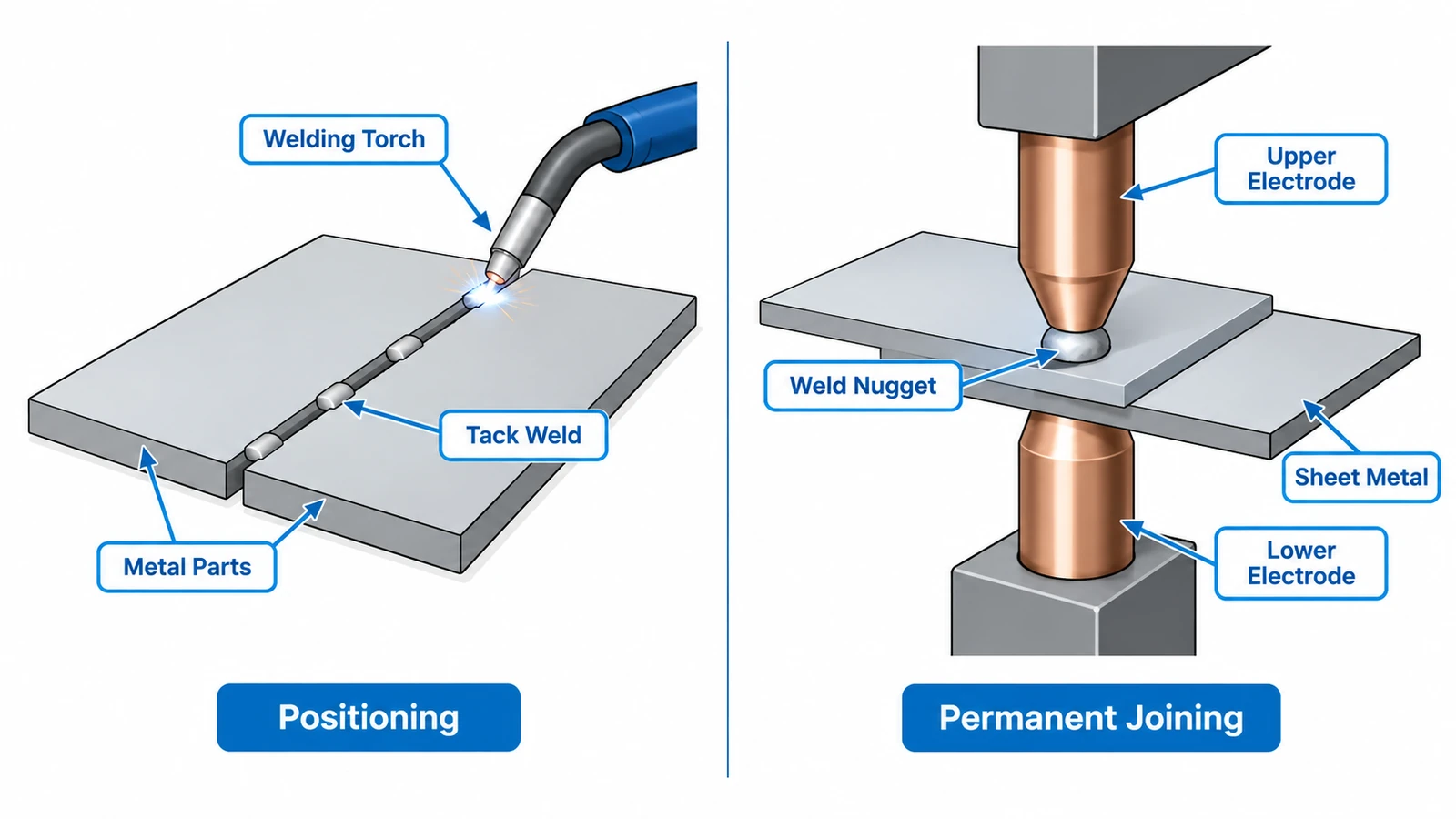
A tack weld is mainly a positioning weld.
A spot weld is normally the final joint.
Resistance spot welding works by applying electrode pressure and electric current through overlapping sheets, generating heat at the interface. Tack welding instead uses localized welds to preserve the position of components before a later weld is completed.
Common Tack Welding Problems
Although tack welds are small, poor tack welding can affect the entire assembly.
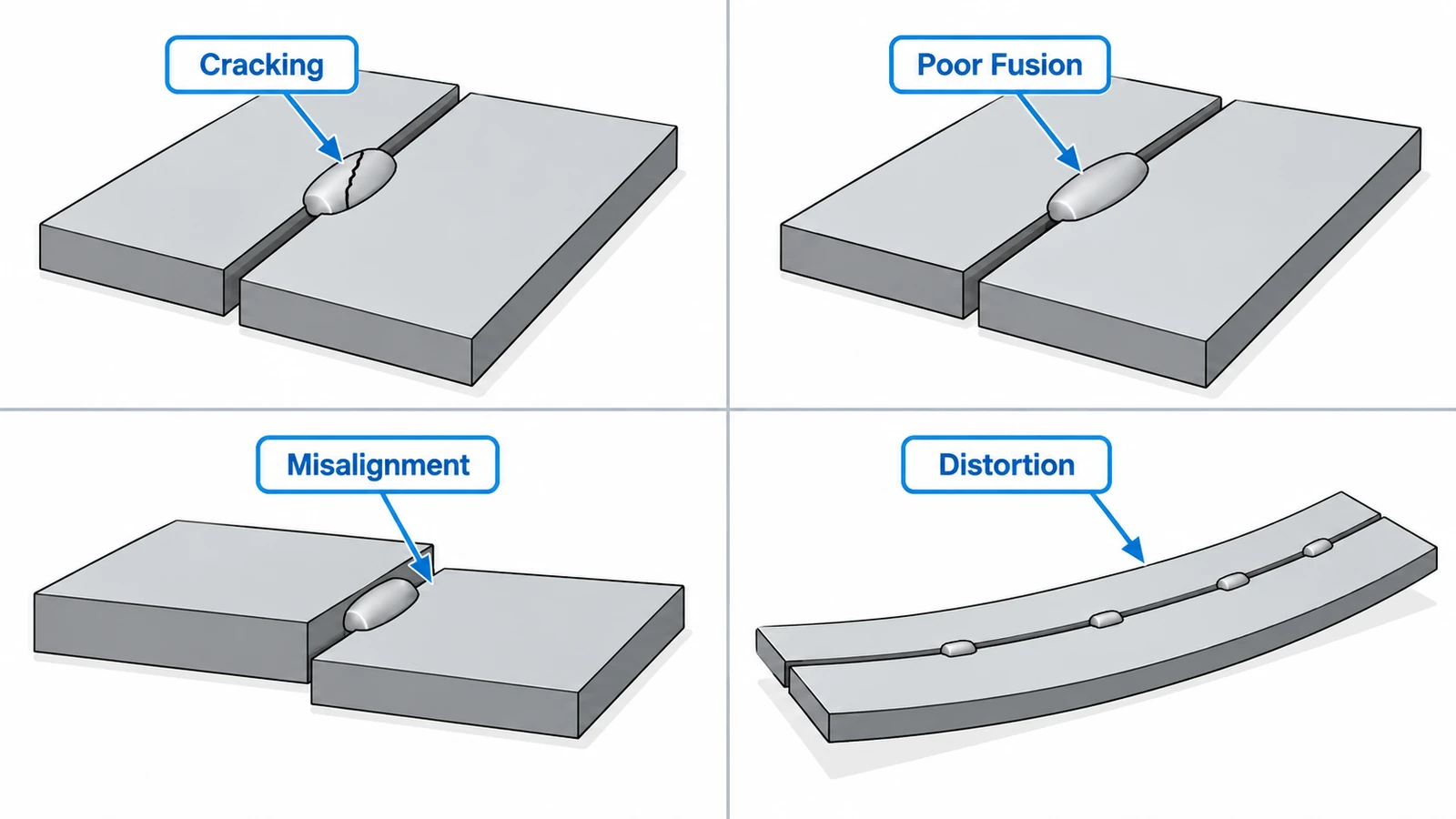
Cracked Tack Welds
A tack may crack when it is too small to resist shrinkage forces or when the material is susceptible to rapid cooling and cracking.
A cracked tack that is simply welded over can introduce a defect into the final joint.
Poor Fusion
Insufficient heat or poor technique may prevent proper fusion between the tack and base material.
The weld may appear to hold initially but fail when the assembly is moved.
Excessive Tack Size
Oversized tacks add unnecessary heat and can interfere with the final welding pass.
More grinding or blending may then be required.
Misalignment
Tack welding does not automatically guarantee alignment.
Parts should be measured again after tacking because thermal shrinkage may already have shifted the assembly.
Distortion
Thin plates and long welded structures are particularly vulnerable.
Tack size, location and sequence should therefore be considered together rather than individually.
Contamination
Rust, grease, oxide, paint and moisture can create porosity, inclusions or poor fusion.
Joint preparation remains important even though the tack itself is temporary.
Tack Welding in CNC Machined Assemblies
Tack welding is not limited to sheet metal fabrication.
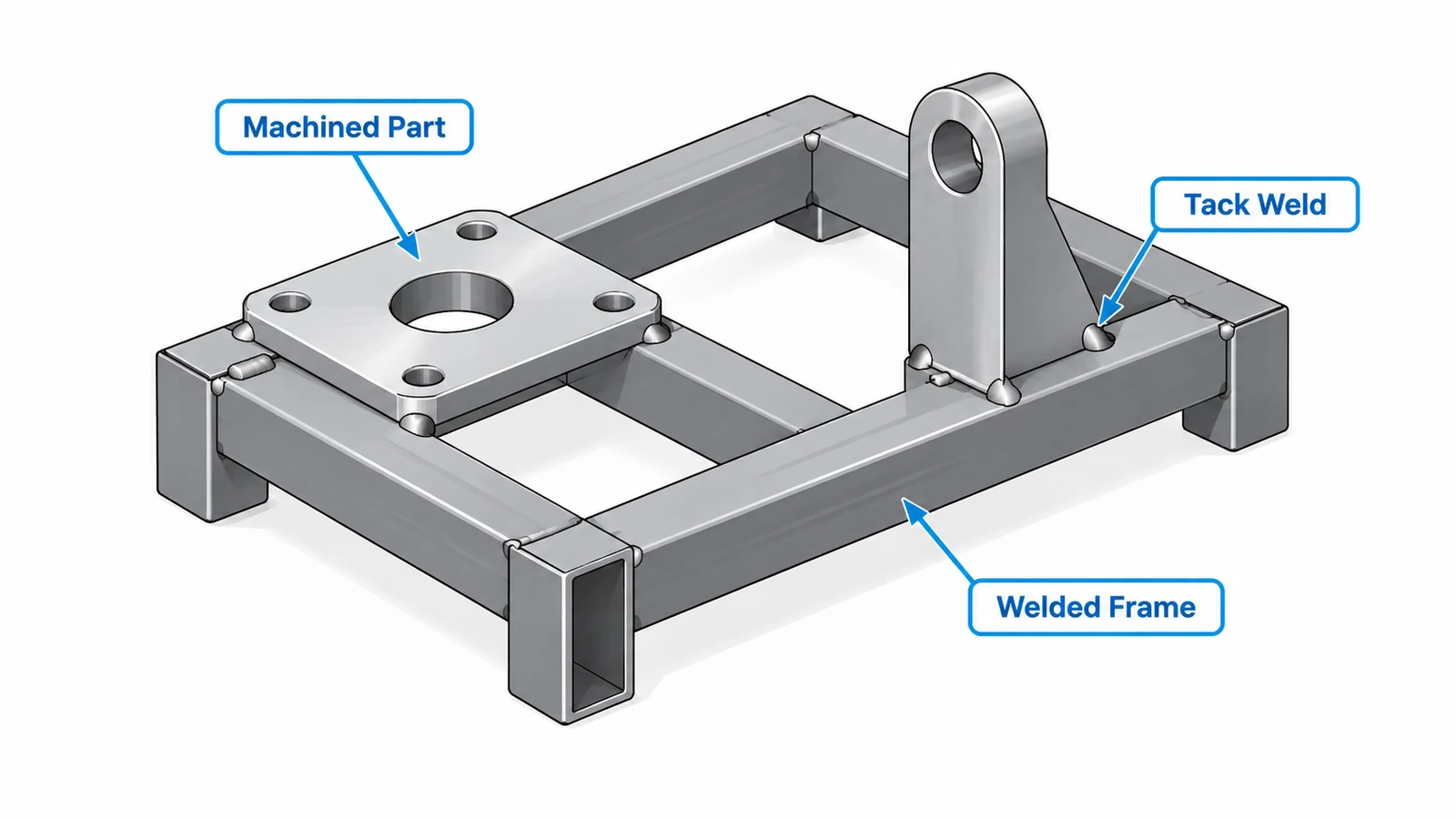
Many industrial products combine CNC machined components with welded structures.
For example, an assembly may contain:
- CNC machined mounting plates;
- precision brackets;
- bearing blocks;
- shafts;
- flanges;
- locating features;
- machined bosses; and
- welded structural tubing.
In these projects, machining can produce precise individual dimensions, but welding introduces another source of dimensional variation.
This creates an important distinction:
Machining accuracy does not automatically guarantee welded assembly accuracy.
Heat from welding can cause shrinkage, angular movement and distortion after the components leave the machining center.
Tack welding therefore becomes part of the assembly-control process.
A typical workflow may be:
CNC Machining → Inspection → Fit-Up → Tack Welding → Dimensional Check → Final Welding → Final Inspection
The position of critical machined surfaces should be considered carefully during welding.
For some components, the preferred manufacturing sequence may even be:
Rough Fabrication → Welding → Stress Relief → Finish Machining
rather than machining every precision surface before welding.
This avoids spending time creating tight tolerances that are later affected by welding distortion.
The best process depends on which dimensions are most critical in the finished assembly.
Applications of Tack Welding
Tack welding appears throughout metal manufacturing.
Machinery and Industrial Equipment
Machine frames, bases, guards, brackets and structural supports are often tack welded before final assembly welding.
Automotive Manufacturing
Tack welding can be used during fabrication of frames, fixtures, prototypes and custom vehicle components before permanent joints are completed.
Pipe and Tube Fabrication
Pipe sections, flanges and fittings often require accurate alignment before welding.
Tack welds help maintain the required orientation and root gap.
Sheet Metal Fabrication
Enclosures, cabinets, frames and panels may use tack welds to maintain shape before completing longer weld seams.
Aerospace Fabrication
Fixtures, controlled heat input and accurate alignment become especially important when working with thin stainless steel, aluminum or titanium assemblies.
Custom Prototypes
Tack welding is particularly useful during prototype development because assemblies can be checked before committing to permanent welding.
It allows engineers to verify fit, geometry and part interaction earlier in the manufacturing process.
Advantages and Limitations of Tack Welding
Tack welding offers several practical manufacturing advantages.
Advantages include:
- maintaining component alignment;
- controlling joint gaps;
- reducing movement during welding;
- assisting distortion control;
- reducing dependence on elaborate fixtures;
- allowing dimensional checks before final welding; and
- simplifying prototype and low-volume assembly.
However, it also has limitations.
Potential drawbacks include:
- additional fabrication steps;
- distortion if excessive heat is used;
- cracking in poor-quality tacks;
- defects being carried into the final weld;
- additional grinding if tacks must be removed; and
- the need for skilled positioning and weld sequencing.
The goal is therefore not simply to add more tack welds. The tack pattern should provide sufficient restraint while minimizing unnecessary heat and rework.
Conclusion
Tack welding uses small, localized welds to hold metal components in position before final welding. Its primary purpose is to maintain alignment, control joint gaps and prevent unwanted movement while the assembly is completed.
Good tack welding depends on more than simply creating a few small welds. Tack size, spacing, sequence, material behavior and final weld strategy all affect the dimensional accuracy of the finished assembly.
This becomes particularly important when welded structures contain precision CNC machined components. The individual parts may be manufactured to tight tolerances, but welding heat can still change the geometry of the completed assembly.
Planning machining, fit-up, tack welding and final inspection as one manufacturing process helps reduce distortion, rework and assembly problems.
Need Precision CNC Machined Parts for Your Assembly?
YuanYi provides custom CNC machining for prototypes and low-volume production, including CNC milling, turning, 5-axis machining, Swiss machining and complex precision components.
Upload your drawings to receive a quote and DFM feedback for your next machined-part project.
Frequently Asked Questions
Tack welds are normally made to hold components during fit-up and final welding. Depending on the welding procedure, they may later be removed, remelted into the final weld or remain as part of the completed joint.
A tack weld should be strong enough to maintain the assembly during handling and welding, but it is generally not intended to replace the specified final weld.
Its required strength depends on the size, geometry and weight of the assembly.
There is no universal spacing.
Material thickness, component stiffness, joint type, overall length and expected weld shrinkage all influence tack spacing.
Long or flexible joints generally require more careful control than short, rigid assemblies.
Yes, when the tack weld is acceptable under the welding procedure and is properly prepared.
Defective or cracked tack welds should not simply be buried beneath the final weld.
Yes.
Aluminum is commonly tack welded using processes such as TIG or MIG welding. Proper cleaning, shielding and heat control are particularly important because aluminum conducts heat rapidly and its surface oxide affects welding.
Tack welding mainly positions parts before final welding.
Stitch welding uses a series of separated weld segments as part of the finished joint instead of producing one continuous weld.
Therefore, their appearances may look similar, but their intended functions are different.
Tack welding can help control distortion, but it cannot completely prevent it.
Material thickness, joint design, heat input, fixtures, welding direction and final weld sequence all influence distortion.



