

Choosing between thin gauge and thick gauge sheet metal affects more than part strength. Thickness also influences weight, bending, welding, cutting, material cost, and the overall manufacturability of a component.
In general, thin gauge sheet metal is lighter, easier to form, and uses less material, while thick gauge sheet metal provides greater stiffness, load capacity, and resistance to deformation. However, thicker does not automatically mean better.
The right sheet metal thickness depends on the material, part geometry, expected loads, manufacturing process, and cost requirements. A well-designed thin sheet metal part with bends, ribs, or flanges can sometimes provide sufficient stiffness without the weight and cost of a much thicker plate.
| Factor | Thin Gauge Sheet Metal | Thick Gauge Sheet Metal |
|---|---|---|
| Weight | Lower | Higher |
| Stiffness | Lower | Higher |
| Load Capacity | Lower | Higher |
| Formability | Generally easier | Requires more forming force |
| Heat Distortion | More sensitive | Less sensitive |
| Material Use | Lower | Higher |
| Bending Force | Lower | Higher |
| Typical Parts | Covers, panels, enclosures | Frames, supports, heavy brackets |
What Does Sheet Metal Gauge Mean?
Sheet metal gauge is a traditional system used to describe metal thickness. One important rule often causes confusion:
The higher the gauge number, the thinner the sheet.
For example, 18 gauge steel is thinner than 16 gauge steel.
However, gauge should not be treated as a universal thickness measurement. The actual thickness associated with a gauge number depends on the material. A 16 gauge steel sheet, for example, does not necessarily have the same thickness as 16 gauge aluminum.
This is why engineering drawings and manufacturing specifications often use an actual thickness in millimeters or inches rather than relying only on gauge numbers.
When comparing sheet metal gauge thickness, always confirm three things:
- Material
- Gauge number
- Actual thickness in mm or inches
This avoids purchasing or manufacturing parts from material that is thicker or thinner than intended.
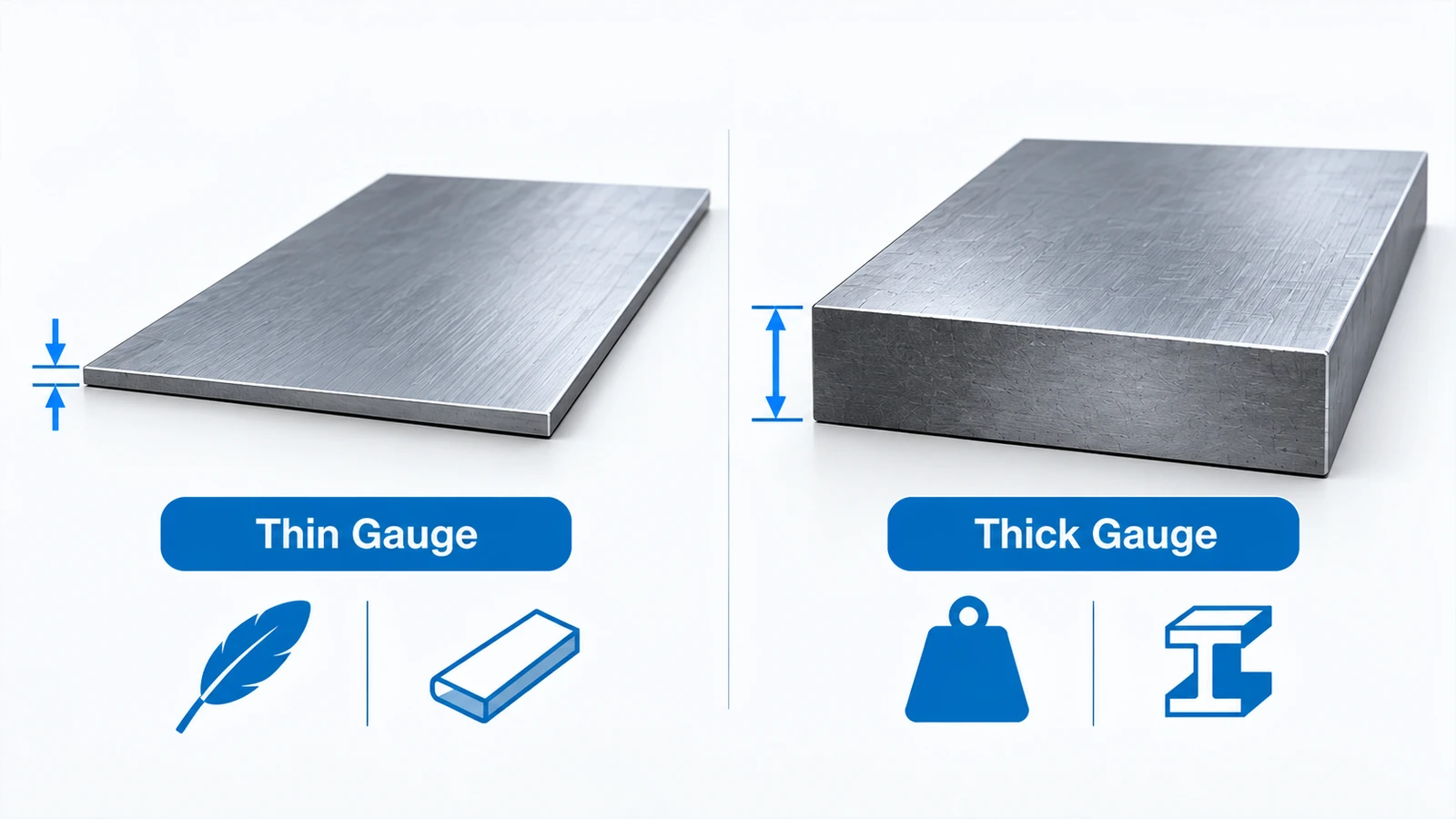
What Is Thin Gauge Sheet Metal?
Thin gauge sheet metal generally refers to relatively thin sheets used where low weight, formability, and material efficiency are important.
Common applications include:
- Electronic enclosures
- Equipment covers
- Control panels
- HVAC components
- Appliance housings
- Automotive panels
- Light-duty brackets
One of the biggest advantages of thin sheet metal is that manufacturers can create relatively rigid structures without using large amounts of material.
A flat sheet may flex easily, but adding bends, flanges, ribs, beads, hems, or formed sections can significantly increase its stiffness.
For this reason, reducing sheet thickness does not necessarily mean sacrificing acceptable part performance. Good part geometry can often compensate for some reduction in material thickness.
Thin sheet metal does, however, require careful control during fabrication. It is more susceptible to bending deformation, welding distortion, vibration, and handling damage.
What Is Thick Gauge Sheet Metal?
Thick gauge sheet metal is used when greater rigidity, load capacity, impact resistance, or dimensional stability is required.
Typical applications include:
- Machine frames
- Structural brackets
- Mounting plates
- Heavy-duty enclosures
- Industrial equipment
- Automotive supports
- Equipment bases
- Load-bearing assemblies
Increasing thickness generally improves the stiffness of a flat sheet and makes the component more resistant to bending and deformation.
However, thicker material also adds weight and changes the manufacturing requirements.
Cutting may require more power or longer processing time. Bending requires greater force and typically a larger bend radius. Material consumption and shipping weight also increase.
For these reasons, using thicker material than necessary can add cost without providing a meaningful improvement in the final application.
Thin Gauge vs Thick Gauge Sheet Metal: Key Differences
The difference between thin and thick sheet metal goes far beyond the thickness itself. It affects nearly every stage of fabrication.
1. Strength and Stiffness
Thicker sheet metal generally provides greater stiffness and resistance to deformation when the material and geometry remain the same.
But thickness is only one factor affecting structural performance.
Part strength and stiffness also depend on:
- Material type
- Alloy and temper
- Part geometry
- Bends and flanges
- Ribs and beads
- Support locations
- Load direction
For example, a thin sheet with several formed flanges may be much more rigid than a flat sheet made from the same material.
This is why simply increasing material thickness is not always the most efficient way to improve a sheet metal design.
2. Weight
For the same material and surface area, increasing thickness increases weight approximately in proportion to the thickness.
A basic way to estimate sheet metal weight is:
Weight = Area × Thickness × Material Density
If a steel panel is changed from 1 mm to 2 mm without changing its dimensions, the material volume—and therefore its approximate weight—doubles.
Weight matters particularly in automotive, aerospace, robotics, portable equipment, and large assemblies where unnecessary material can increase both operating and shipping costs.
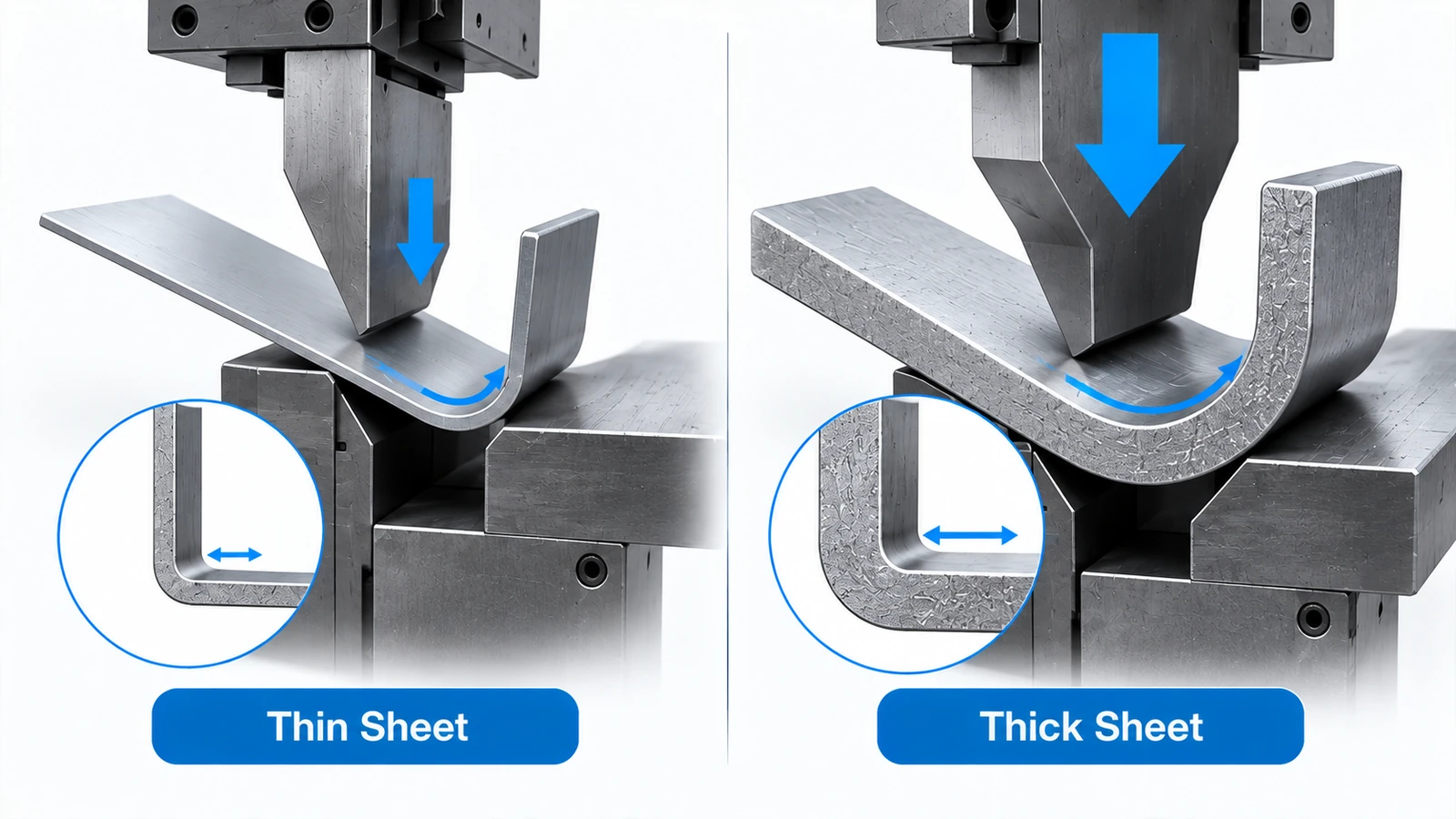
3. Bending and Formability
Thin sheet metal generally requires less force to bend and can often be formed using smaller equipment.
Thicker material requires:
- Higher press brake tonnage
- Larger tooling
- Larger bend radii
- Greater attention to springback
- More clearance around bends
The minimum practical bend radius also depends on the material and its condition.
Trying to create an excessively tight bend in thick material can lead to cracking along the outside of the bend.
Thin material has its own challenges. Because it is less rigid, improper tooling or handling can create unwanted deformation, dents, or inconsistent bends.
4. Welding and Heat Distortion
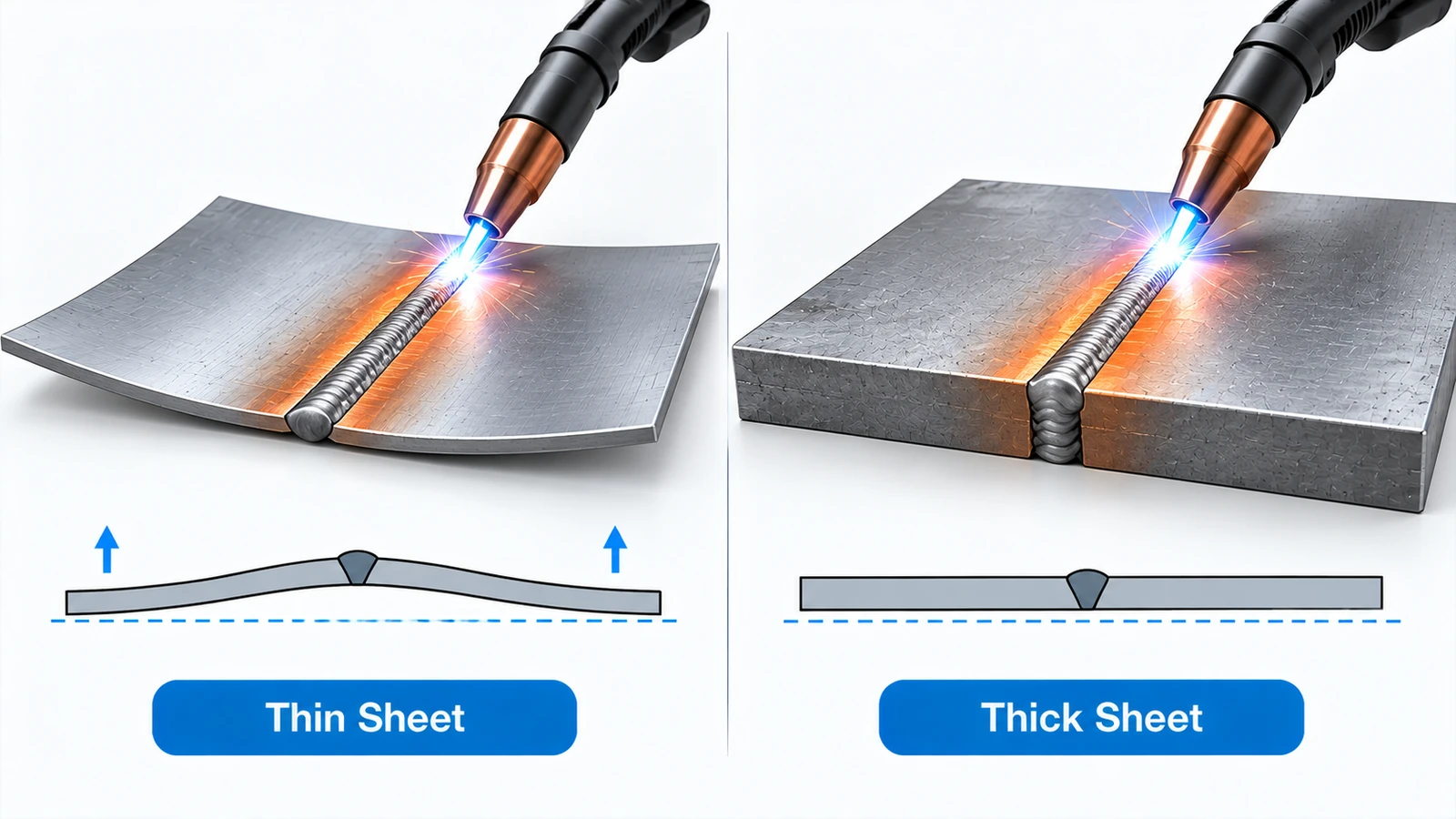
Welding behavior changes significantly with material thickness.
Thin sheet metal heats quickly and has less material available to absorb and distribute welding heat. This makes it more susceptible to:
- Warping
- Burn-through
- Distortion
- Excessive weld penetration
Manufacturers may use controlled heat input, intermittent welds, fixtures, or optimized welding sequences to reduce these problems.
Thicker sheet metal generally tolerates more heat before severe distortion occurs, but it may require higher welding current, greater heat input, joint preparation, or multiple weld passes depending on the thickness and joint design.
Therefore, welding cost should not be evaluated based on material thickness alone.
5. Cutting and Machining
Sheet thickness also affects cutting speed and process selection.
Thin sheets can typically be cut quickly using processes such as laser cutting, punching, or shearing.
As thickness increases, cutting may require:
- Higher laser power
- Slower cutting speeds
- Different cutting parameters
- More powerful punching equipment
- Alternative cutting processes for very thick material
Secondary machining can also become more important on thicker components.
For example, thicker plates may allow tapped holes, counterbores, precision bores, or machined locating features that would not be practical in very thin sheet.
6. Material and Fabrication Cost
Thin sheet usually requires less raw material, but that does not automatically mean the finished part will be cheaper.
The total cost of a sheet metal component may include:
Material + Cutting + Forming + Welding + Machining + Finishing + Assembly
A thinner design may require additional ribs, brackets, bends, or reinforcement to achieve the required stiffness.
A thicker design may eliminate some reinforcement but increase raw material cost, cutting time, bending force, and shipping weight.
The most economical solution is therefore the minimum practical thickness that reliably meets the functional and manufacturing requirements of the part.
Thin vs Thick Sheet Metal Cost Comparison
The following comparison shows how thickness can affect common fabrication cost factors.
| Cost Factor | Thin Gauge | Thick Gauge |
|---|---|---|
| Raw Material | Generally lower | Generally higher |
| Part Weight | Lower | Higher |
| Cutting Time | Usually shorter | Often longer |
| Bending Force | Lower | Higher |
| Tooling Requirements | Generally lighter | May require heavier tooling |
| Welding Distortion Control | More important | Generally easier to control |
| Reinforcement | May be required | Often less necessary |
| Shipping Cost | Lower | Higher |
| Overall Cost | Design-dependent | Design-dependent |
For high-volume production, even a small reduction in material thickness can produce meaningful material and shipping savings across thousands of parts.
However, reducing thickness purely to lower material cost can backfire if the redesigned component requires more forming operations, additional reinforcement, tighter process control, or more complicated assembly.
The correct comparison should therefore focus on total manufactured cost, not raw sheet price alone.
How to Choose Between Thin and Thick Gauge Sheet Metal
Instead of choosing thickness based only on strength, consider how the part will actually be used and manufactured.
Choose Thinner Sheet Metal When:
Thin material is often a good option when:
- Weight reduction is important
- Structural loads are relatively low
- The part mainly functions as a cover or enclosure
- Bends and flanges provide sufficient rigidity
- Material efficiency is important
- Large production volumes make material savings significant
Electronic housings, machine covers, panels, and lightweight enclosures are common examples.
Choose Thicker Sheet Metal When:
Thicker material may be more appropriate when:
- The component carries significant loads
- High stiffness is required
- The part is exposed to impact or vibration
- Large flat surfaces must resist deformation
- Threads must be machined directly into the material
- The component supports other equipment
- Dimensional stability is especially important
Machine mounting plates, structural brackets, equipment frames, and heavy-duty supports often fall into this category.
Can You Reduce Sheet Thickness Without Losing Strength?
In many applications, sheet thickness can be reduced while maintaining adequate structural performance through better part design.
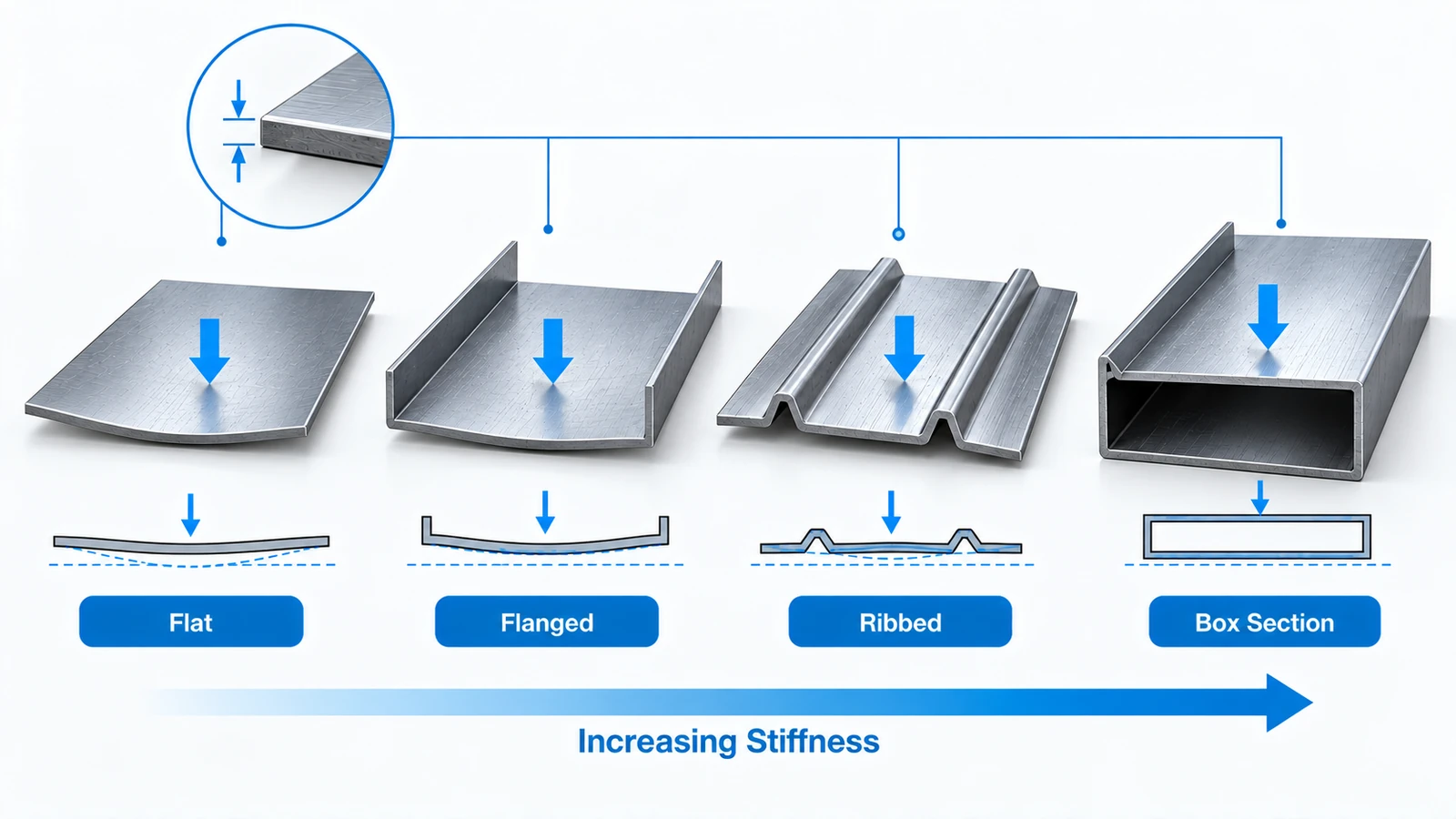
Instead of relying entirely on material thickness, engineers can increase stiffness using geometric features such as:
Flanges
Adding a flange along the edge of a sheet significantly increases its resistance to bending.
Ribs and Beads
Formed ribs or beads reinforce large flat surfaces without requiring thicker material across the entire component.
Bends
A formed profile is generally much more rigid than a flat sheet of the same thickness.
Box Sections
Creating closed or partially closed sections can dramatically increase structural rigidity.
Local Reinforcement
Additional material can be placed only around high-load areas instead of increasing the thickness of the entire part.
This approach is particularly useful when weight and material cost are important design constraints.
However, reducing thickness should always be evaluated against actual loads, vibration, fatigue, assembly requirements, and manufacturing tolerances.
Common Sheet Metal Thickness Selection Mistakes
Choosing the wrong sheet thickness can create unnecessary cost or manufacturing problems.
Choosing Thickness Based Only on Strength
Strength is important, but stiffness, vibration, geometry, joining method, and manufacturing processes must also be considered.
A thicker sheet may solve one problem while creating several others.
Assuming the Same Gauge Means the Same Thickness
Gauge numbers are material-dependent.
Always specify the material and actual thickness on engineering drawings whenever possible.
Using Material That Is Unnecessarily Thick
Overdesign increases:
- Material consumption
- Part weight
- Cutting requirements
- Bending force
- Shipping cost
If additional thickness does not improve functional performance, it may simply increase total manufacturing cost.
Ignoring Bend Radius
Material thickness directly influences practical bend radius and tooling selection.
A bend that works well in thin material may not be practical when the material thickness increases.
Ignoring Welding Distortion in Thin Sheets
Thin sheets are particularly sensitive to welding heat.
Weld placement, sequence, fixture design, and heat input should be considered early in the design rather than after fabrication problems appear.
Typical Applications for Thin and Thick Sheet Metal
There is no single thickness suitable for every type of component. The required thickness depends on material, dimensions, geometry, loading, and manufacturing method.
| Application | Main Requirement | General Thickness Direction |
|---|---|---|
| Electronic Enclosure | Lightweight and formable | Thin |
| Equipment Cover | Moderate rigidity | Thin |
| Control Panel | Flatness and low weight | Thin–Medium |
| Automotive Bracket | Strength-to-weight balance | Medium |
| Machine Enclosure | Rigidity and durability | Medium |
| Mounting Plate | Dimensional stability | Medium–Thick |
| Structural Bracket | Load capacity | Thick |
| Machine Frame | Structural rigidity | Thick |
| Heavy Equipment Support | High load resistance | Thick |
These categories should be treated as general design directions rather than fixed thickness specifications.
For example, a large enclosure may require thicker material than a small enclosure even when both perform the same basic function.
Final Thoughts
There is no universally best sheet metal gauge.
Thin gauge sheet metal reduces weight and material consumption and is generally easier to form, while thick gauge sheet metal provides greater stiffness, load capacity, and resistance to deformation.
The right choice depends on the material, geometry, loads, joining method, manufacturing process, and total fabrication cost.
Rather than simply increasing thickness for safety, engineers should consider whether bends, flanges, ribs, or localized reinforcement can achieve the required performance with less material.
For custom metal components, reviewing sheet thickness, bend geometry, tolerances, machining features, and assembly requirements during the DFM stage can help avoid unnecessary weight, fabrication difficulty, and cost.
Frequently Asked Questions
A higher gauge number generally means thinner sheet metal. For example, 18 gauge steel is thinner than 16 gauge steel. However, the actual thickness associated with each gauge depends on the material.
Yes. Within the same material gauge system, 16 gauge is thicker than 18 gauge.
When comparing different materials, however, always check the actual thickness rather than relying only on the gauge number.
Not necessarily.
Increasing thickness generally improves stiffness and load capacity, but part performance also depends on material properties and geometry. Bends, ribs, flanges, and structural sections can make relatively thin sheet metal significantly more rigid.
The correct thickness depends on the material, part dimensions, structural loads, stiffness requirements, bending geometry, welding requirements, and manufacturing process.
For critical components, thickness should be determined through engineering calculations, testing, or application-specific design requirements rather than a general rule.
No. Gauge numbers are not universal across different metals.
Steel, stainless steel, and aluminum can have different actual thicknesses for the same nominal gauge number. For manufacturing drawings, specifying the actual thickness in millimeters or inches helps avoid ambiguity.



