

Heat treatment of metals is a controlled process of heating, holding, and cooling metal to change its mechanical properties without changing the basic shape of the part. Depending on the process, heat treating metals can increase hardness and strength, improve toughness and wear resistance, relieve internal stresses, or make a material easier to machine.
Common metal heat treatment processes include annealing, normalizing, hardening, tempering, stress relieving, case hardening, nitriding, and precipitation hardening.
For CNC-machined parts, choosing the right heat treatment is only part of the decision. When the treatment is performed—before machining, between rough and finish machining, or after machining—can directly affect machinability, distortion, dimensional accuracy, and final part performance.
What Is Heat Treatment of Metals?
Heat treatment is the controlled heating and cooling of a metal or alloy to modify its microstructure and achieve specific mechanical or physical properties.
Unlike machining, heat treatment does not intentionally remove material or change the geometry of a component. Instead, it can change characteristics such as hardness, strength, toughness, ductility, wear resistance, machinability, residual stress, and dimensional stability.
The final result depends on several factors, including the alloy, treatment temperature, holding time, cooling rate, and starting condition of the material.
This is why the same metal can behave very differently after different heat treatments.
Why Are Metals Heat Treated?
Metals are heat treated when their original material condition does not provide the properties required for machining or final service.
For example, a steel part may need to be relatively soft during CNC machining but much harder and more wear-resistant in service. Another component may already have sufficient strength but contain residual stresses that could cause dimensional movement during precision machining.
Heat treatment can be used to:
- Increase hardness and strength
- Improve wear resistance and toughness
- Improve machinability or ductility
- Relieve residual stresses
- Improve dimensional stability
- Refine the grain structure
The goal is not always to make a metal harder. In many applications, heat treatment is about finding the right balance between hardness, strength, toughness, ductility, machinability, and dimensional stability.
How Does the Heat Treatment Process Work?
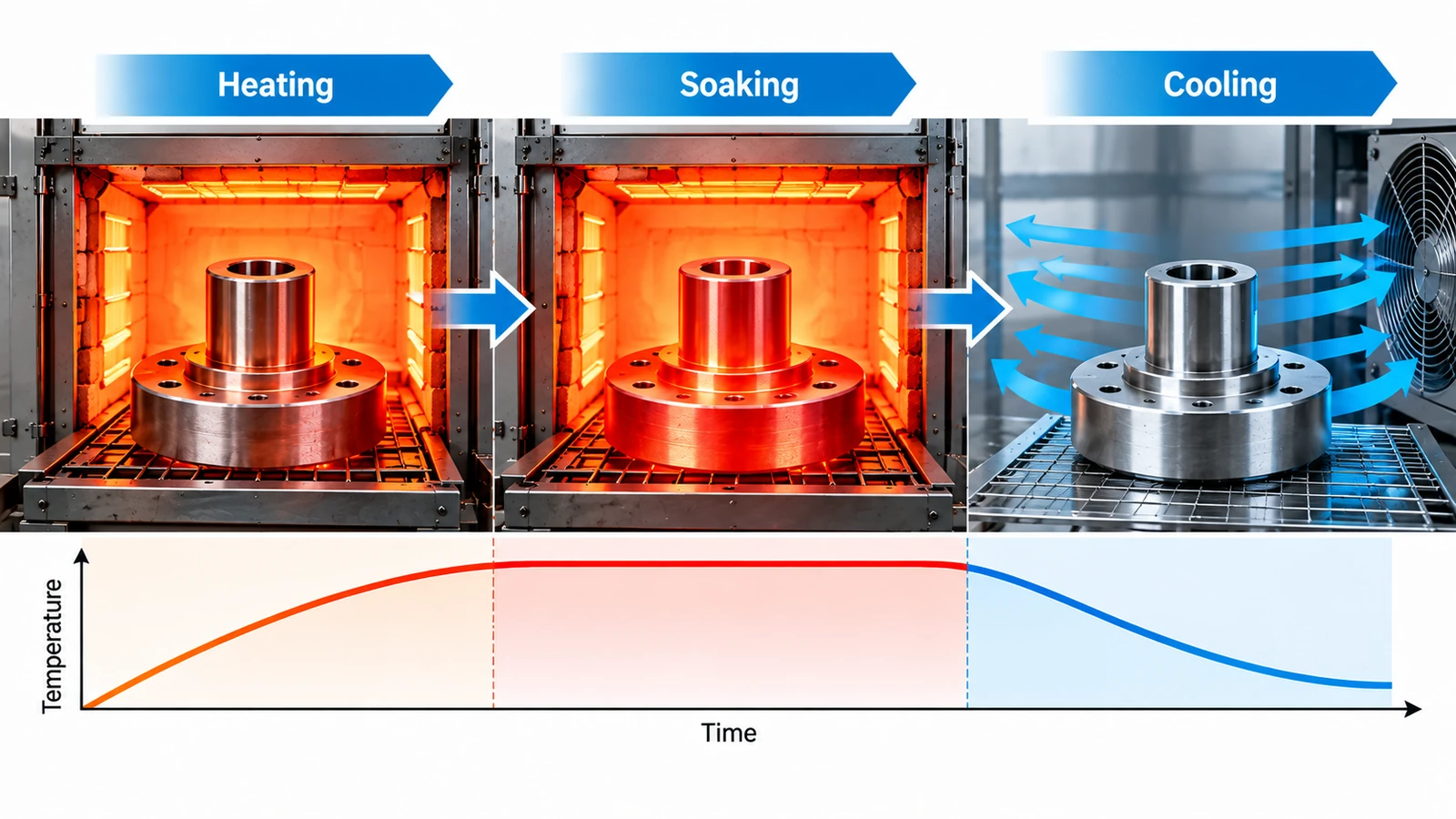
Most heat treatment processes can be understood through three basic stages:
Heating → Soaking → Cooling
Although the sequence is simple, controlling each stage is critical.
1. Heating
The metal is heated to a specified temperature at a controlled rate.
Heating too quickly can create temperature differences between the surface and core, particularly in thick or complex parts. This can increase thermal stress and the risk of distortion.
2. Soaking
Once the required temperature is reached, the metal is held at that temperature for a specified period.
This allows the temperature and intended microstructural changes to become more uniform throughout the component.
The required soaking time depends on the material, section thickness, part geometry, treatment method, and required properties.
3. Cooling
The component is then cooled at a controlled rate.
Depending on the heat treatment, cooling may take place in furnace conditions, still air, oil, water, polymer solution, gas, or another controlled medium.
Cooling rate is especially important because it can strongly influence hardness, microstructure, residual stress, and distortion.
8 Common Types of Heat Treatment
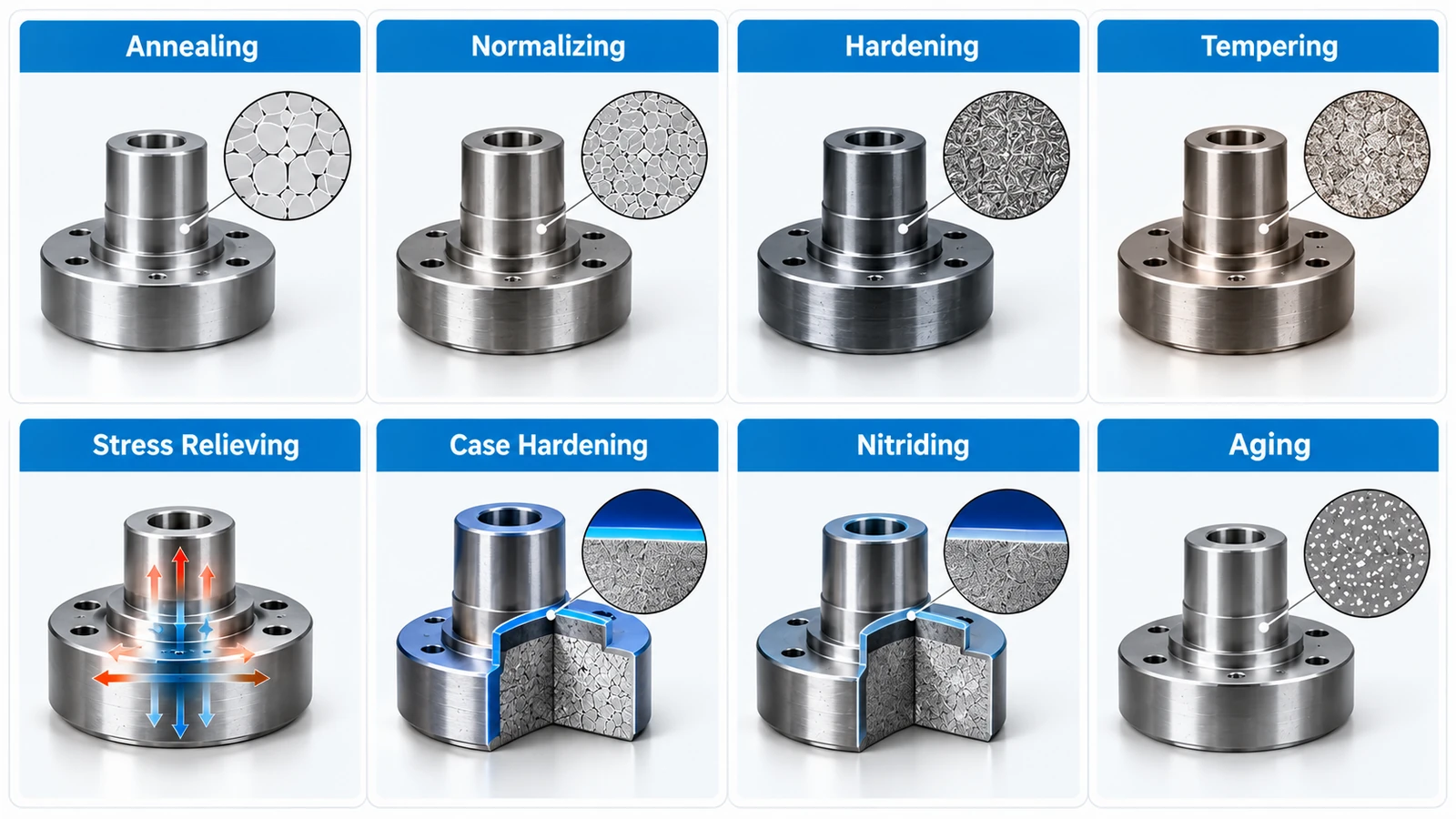
Different heat treatment processes are used to achieve different material properties. These are eight of the most common methods used for engineering metals and precision components.
1. Annealing
Annealing heats a metal to a suitable temperature, holds it there, and then cools it relatively slowly.
The process is used to soften the material, improve ductility, reduce internal stress, and improve machinability.
Annealing can be useful before CNC machining when a harder material condition would increase cutting forces and tool wear.
2. Normalizing
Normalizing is commonly applied to steels. The material is heated above its critical transformation temperature and then allowed to cool in air.
Compared with annealing, normalizing generally produces a finer and more uniform grain structure and often results in higher strength and hardness.
It is commonly used to produce more consistent material properties before subsequent machining or heat treatment.
3. Hardening
Hardening is used to increase the hardness and strength of suitable steels.
The steel is heated to the required austenitizing temperature and then rapidly cooled, or quenched, using an appropriate medium.
The resulting material can be very hard but may also become brittle and contain significant residual stress. Hardened steels are therefore commonly tempered afterward.
4. Tempering
Tempering is normally performed after hardening.
The hardened steel is reheated below its critical transformation temperature, held for a specified time, and then cooled.
This reduces excessive brittleness and residual stress while retaining much of the hardness achieved during hardening. The selected tempering temperature helps determine the final balance between hardness and toughness.
5. Stress Relieving
Stress relieving reduces residual stresses created by machining, welding, forging, casting, or previous thermal processing.
The component is heated below the temperature at which major phase transformations occur, held, and then cooled under controlled conditions.
For precision CNC parts, stress relieving can be particularly useful between rough and finish machining to improve dimensional stability.
6. Case Hardening
Case hardening creates a hard, wear-resistant outer layer while maintaining a tougher and more ductile core.
This combination is useful for components exposed to repeated surface contact or wear while still requiring resistance to impact.
Typical applications include gears, shafts, pins, bushings, and other wear components. Carburizing is one of the most widely used case-hardening methods.
7. Nitriding
Nitriding introduces nitrogen into the surface of suitable steels at elevated temperature.
The process can produce high surface hardness and excellent wear resistance while offering relatively good dimensional stability compared with processes involving rapid quenching.
It is commonly used for precision gears, shafts, dies, and wear surfaces.
8. Precipitation Hardening / Aging
Precipitation hardening, also called age hardening, increases the strength and hardness of suitable alloys through controlled heat treatment.
It is particularly important for materials such as 6061 and 7075 aluminum, 17-4PH stainless steel, and certain nickel and titanium alloys.
For heat-treatable aluminum alloys, solution heat treatment followed by controlled aging can produce high-strength tempers, including commonly specified conditions such as 6061-T6 and 7075-T6.
Annealing vs Normalizing vs Hardening vs Tempering
These four processes are often confused because all involve controlled heating and cooling. However, they serve different purposes.
| Process | Main Purpose | Cooling | Typical Result |
|---|---|---|---|
| Annealing | Soften material | Slow | Better ductility and machinability |
| Normalizing | Refine grain structure | Air cooling | More uniform strength and hardness |
| Hardening | Increase hardness | Rapid quenching | High hardness and strength |
| Tempering | Reduce brittleness after hardening | Controlled cooling | Better toughness with retained hardness |
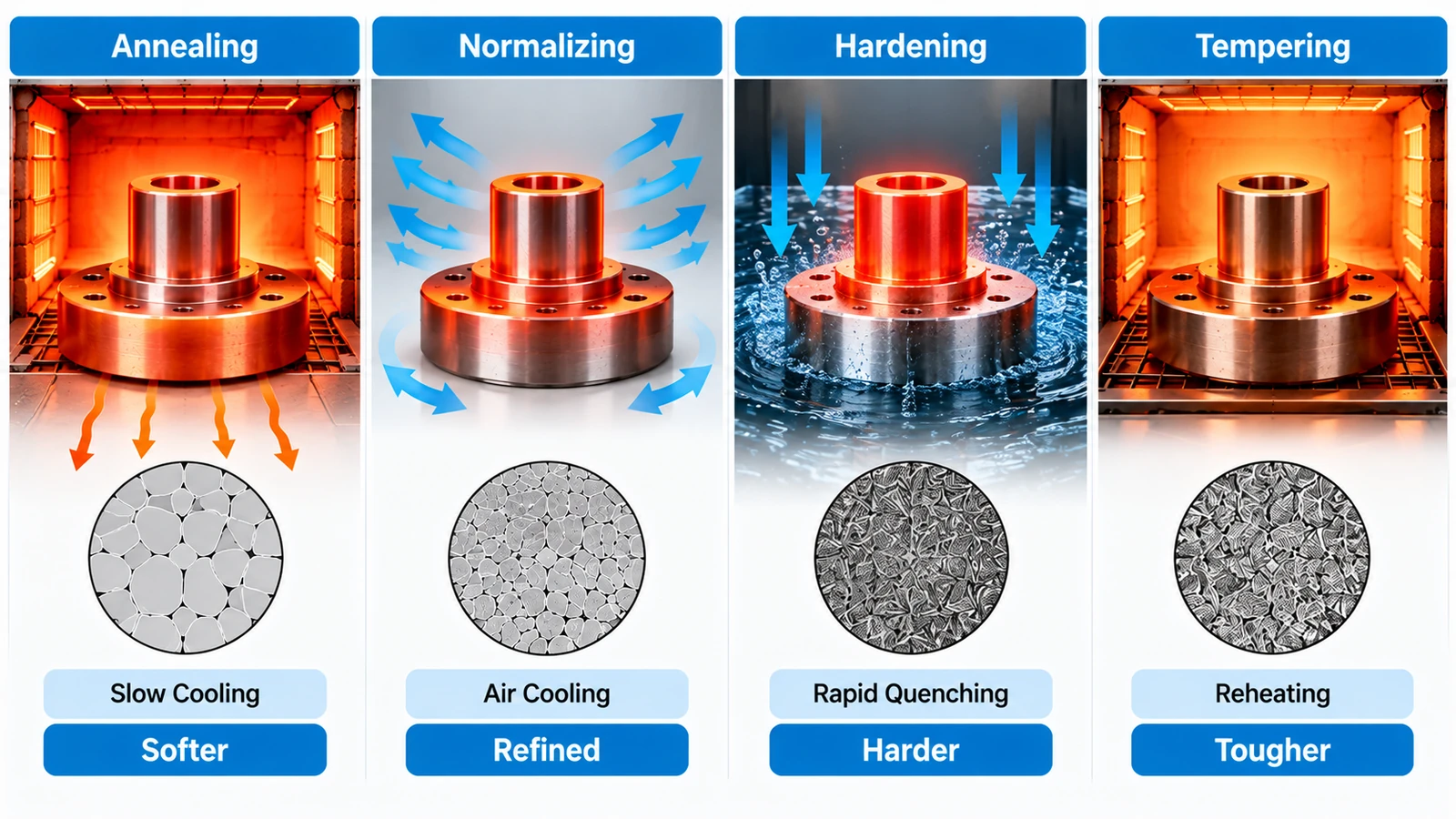
A simple way to remember the difference is:
Annealing softens. Normalizing refines. Hardening increases hardness. Tempering makes hardened steel less brittle.
In actual manufacturing, the correct process depends on the alloy, starting condition, part geometry, and required final properties.
How Does Heat Treatment Change Metal Properties?
Heat treatment does not improve every material property at the same time.
Increasing hardness, for example, can reduce ductility or toughness. Making a metal easier to machine may mean temporarily using it in a softer condition before applying the final hardening treatment.
| Property | Possible Effect of Heat Treatment |
|---|---|
| Hardness | Increase or decrease |
| Strength | Often increased |
| Toughness | Can be improved through tempering |
| Ductility | Can increase or decrease |
| Wear Resistance | Often increased by hardening |
| Machinability | Can improve or decrease |
| Residual Stress | Can be reduced |
| Dimensional Stability | Can improve with proper stress relief |
This is why heat treatment should be selected according to the functional requirements of the finished component, rather than simply choosing the process that produces the highest hardness.
What Metals Can Be Heat Treated?
Many engineering metals can be heat treated, but they do not all respond to the same processes.
Carbon and Alloy Steels
Carbon and alloy steels are among the most commonly heat-treated materials.
Depending on composition, they may undergo annealing, normalizing, quenching and tempering, stress relieving, carburizing, or nitriding.
Alloy steels such as 4140 can be processed in different heat-treated conditions depending on the required strength, hardness, and application.
Tool Steels
Tool steels are designed to achieve high hardness and wear resistance after appropriate heat treatment.
They are commonly hardened and tempered for dies, molds, cutting tools, and wear components.
Because hardness can become very high after treatment, much of the conventional machining is often completed before final hardening.
Stainless Steel
Heat treatment depends strongly on the type of stainless steel.
Martensitic stainless steels can be hardened through heat treatment, while precipitation-hardening grades such as 17-4PH can achieve high strength through controlled aging.
Austenitic stainless steels such as 304 and 316 behave differently and cannot be hardened by conventional quenching in the same way as martensitic steels.
Aluminum Alloys
Common heat-treatable aluminum alloys include:
- 6061
- 2024
- 7075
Solution heat treatment and aging can significantly increase their strength.
Conditions such as 6061-T6 and 7075-T6 therefore indicate both the alloy and its specified temper condition.
Titanium Alloys
Some titanium alloys can also be heat treated to adjust strength, toughness, ductility, and microstructure.
The appropriate treatment depends heavily on the titanium grade and the required application.
Should Heat Treatment Be Done Before or After CNC Machining?
There is no single correct sequence for every component.
The best point for heat treatment depends on the material, final hardness, tolerance requirements, part geometry, and risk of distortion.
Heat Treatment Before CNC Machining
Annealing or normalizing may be performed before machining to make the material easier to cut or establish a more uniform material condition.
This can reduce cutting forces and tool wear, improve machinability, and reduce internal stress before precision machining.
Heat Treatment Between Rough and Finish Machining
For precision components, a common manufacturing strategy is:
Raw Material → Rough Machining → Stress Relief / Heat Treatment → Finish Machining → Inspection
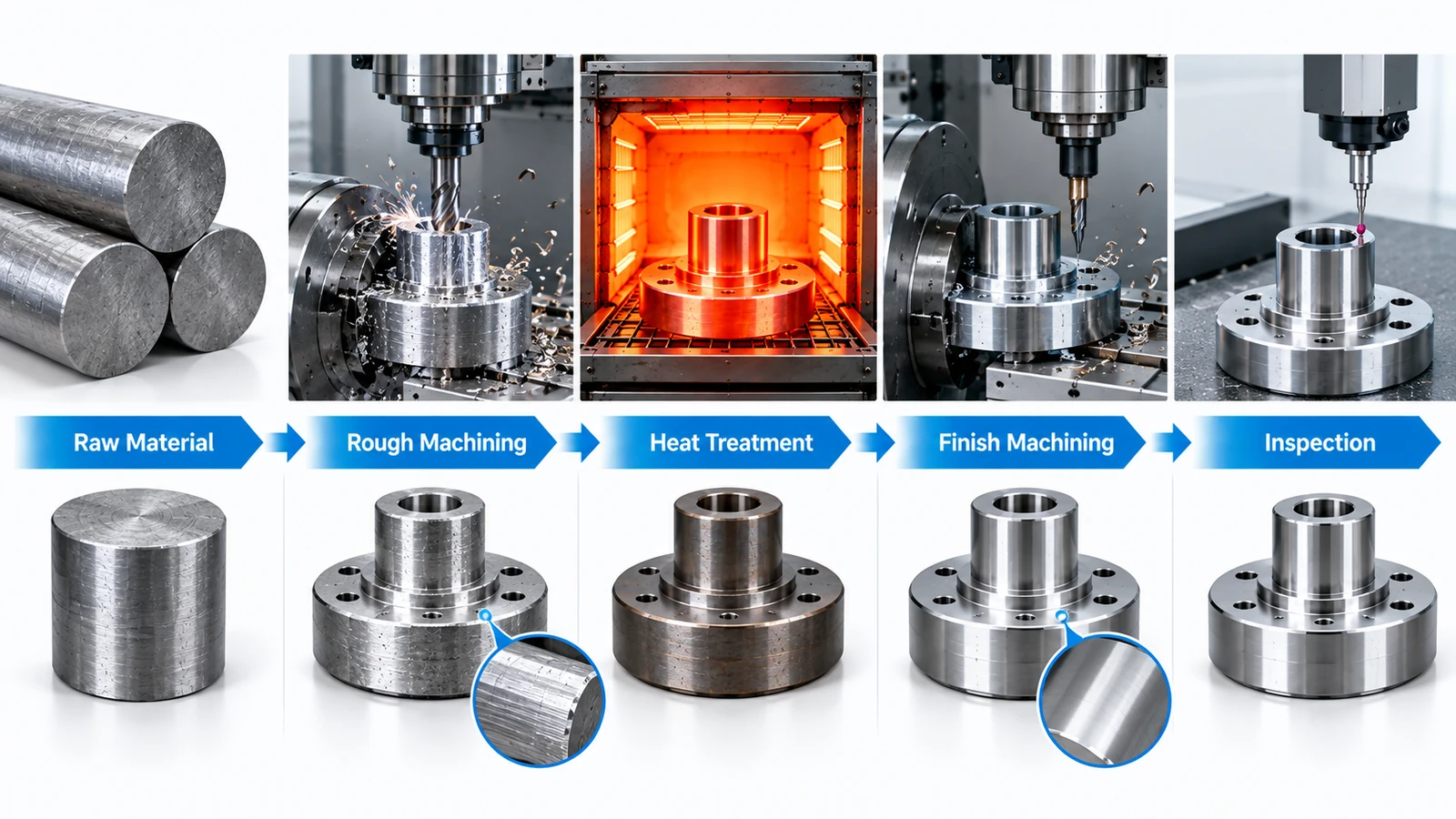
Rough machining removes significant amounts of material and can redistribute internal stresses.
Allowing the component to stabilize before finish machining can reduce the risk of dimensional movement after final dimensions have been produced.
This approach is particularly useful for large, thin-walled, asymmetric, or tight-tolerance components.
Heat Treatment After Machining
Hardening, tempering, case hardening, or nitriding may be performed after most machining operations when the component requires its final mechanical properties near the end of production.
However, dimensional change must be considered.
Critical surfaces may require finish grinding, hard turning, finish machining, honing, or lapping after heat treatment to achieve the required tolerance and surface finish.
Does Heat Treatment Cause Part Distortion?
Yes. Heat treatment can cause dimensional changes or distortion.
During heating and cooling, the material experiences thermal expansion, contraction, microstructural transformation, and changes in residual stress.
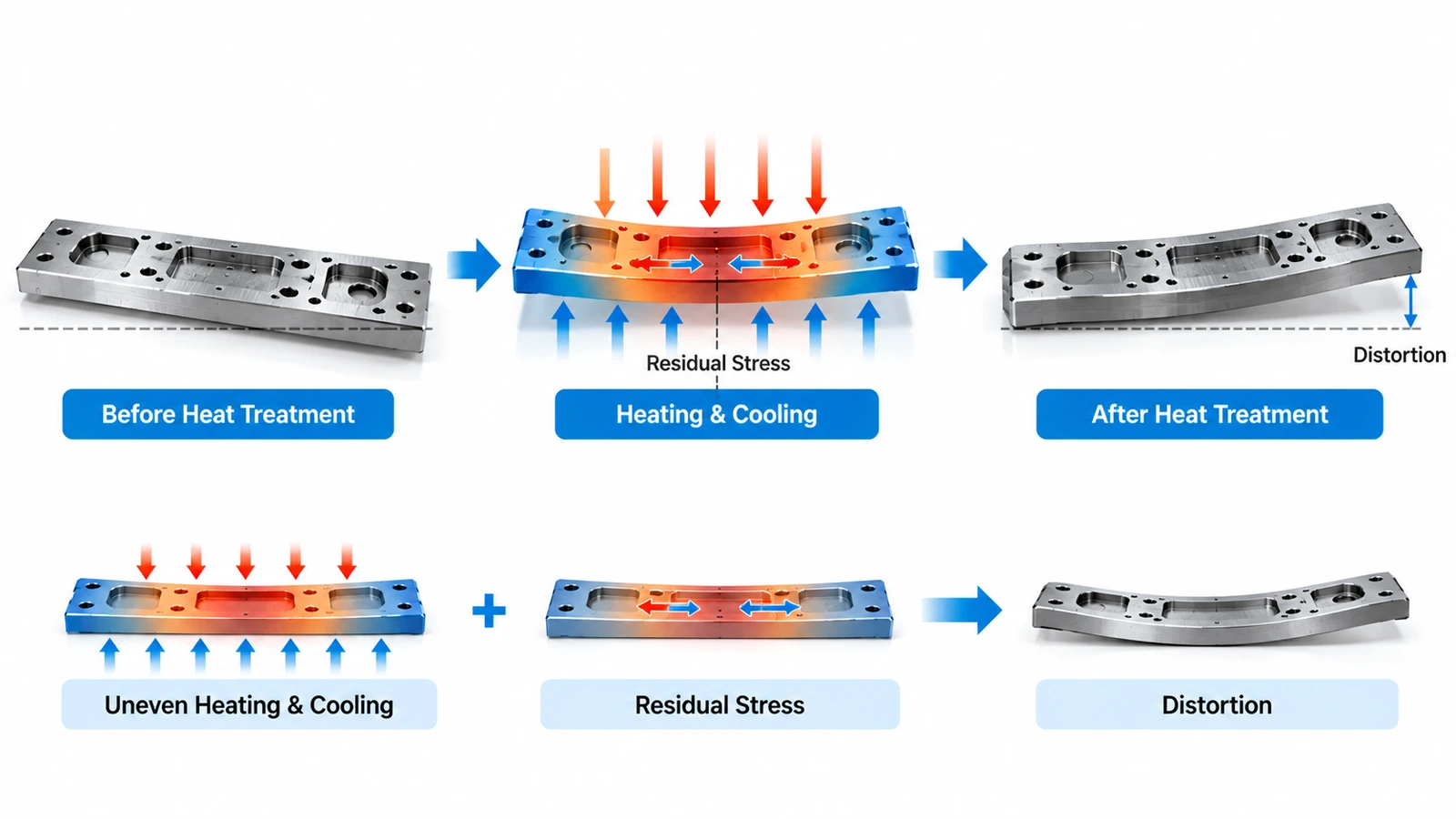
If these effects are not uniform throughout the component, the part may:
- Warp
- Bow
- Twist
- Change diameter
- Lose flatness
- Move outside dimensional tolerance
Parts with thin walls, long shafts, deep pockets, large flat surfaces, or asymmetric material removal are generally more sensitive to dimensional movement.
Rapid quenching can further increase the risk because different areas of the component may heat and cool at different rates.
How Can Heat Treatment Distortion Be Reduced?
Distortion cannot always be eliminated, but it can often be managed through proper manufacturing planning.
Useful strategies include:
- Start with material in an appropriate condition.
- Use balanced rough machining and avoid excessive one-sided material removal.
- Leave machining allowance on critical surfaces.
- Use stress relieving between rough and finish machining when necessary.
- Select an appropriate heat treatment and cooling method for the material and geometry.
- Finish-machine and inspect critical dimensions after major thermal processes.
For tight-tolerance CNC parts, heat treatment should therefore be considered during process planning—not added as an afterthought after machining is complete.
How to Choose the Right Heat Treatment
The correct heat treatment depends primarily on what the finished component needs to do.
| Requirement | Common Heat Treatment |
|---|---|
| Improve machinability | Annealing |
| Refine grain structure | Normalizing |
| Increase hardness | Hardening |
| Reduce brittleness after hardening | Tempering |
| Reduce residual stress | Stress Relieving |
| Hard surface + tough core | Case Hardening |
| High surface wear resistance | Nitriding |
| Increase strength in precipitation-hardenable alloys | Precipitation Hardening |
Material grade must always be considered. Two metals requiring similar mechanical properties may need completely different heat treatment cycles.
For production parts, the required hardness, material condition, heat treatment specification, critical dimensions, and post-treatment machining requirements should be defined on the engineering drawing or manufacturing documentation whenever applicable.
Heat Treatment and Precision CNC Machining
Heat treatment and CNC machining should be planned as parts of the same manufacturing process.
A component may be easy to machine before hardening but difficult to hold within tolerance after quenching. Another part may require stress relief between roughing and finishing to maintain dimensional stability.
A typical precision manufacturing sequence may look like:
Material → Rough CNC Machining → Stress Relief / Heat Treatment → Finish CNC Machining → Surface Treatment → Final Inspection
At YuanYi, heat treatment requirements are considered together with material condition, machining allowance, tolerance, and the sequence of rough and finish machining. This is particularly important for precision parts where post-treatment distortion could affect final dimensions.
By planning machining and thermal processing together, manufacturers can reduce unnecessary machining, control distortion risk, and achieve more consistent final dimensions.
FAQs
Heat treatment modifies the mechanical and physical properties of metals. Depending on the process, it can increase hardness and strength, improve toughness or wear resistance, improve machinability, or reduce residual stress.
Common processes include annealing, normalizing, hardening, tempering, stress relieving, case hardening, nitriding, and precipitation hardening.
No. Some processes increase hardness, while annealing can intentionally soften a material. Stress relieving primarily reduces internal stresses rather than maximizing hardness.
It depends on the material and part requirements. Annealing may be performed before machining, stress relieving can be used between rough and finish machining, while hardening may be performed after rough machining. Tight-tolerance surfaces may require final machining or grinding after heat treatment.
It can. Heating, phase transformations, cooling, and residual stress redistribution may cause dimensional changes or distortion. This is why machining allowance and post-treatment finishing are important for precision components.
Yes, but machining generally becomes more difficult as hardness increases. Depending on the hardness, geometry, and tolerance requirements, manufacturers may use carbide or other suitable cutting tools, hard turning, grinding, or complete most conventional machining before final hardening.
Conclusion
Heat treatment of metals is not simply a method for making parts harder. Different processes can soften a material, refine its structure, relieve stress, improve toughness, increase wear resistance, or produce the final strength required for service.
For CNC-machined components, material condition, rough machining, heat treatment, finish machining, and inspection should be planned together, particularly when tight tolerances or distortion-sensitive geometries are involved.
Choosing the right heat treatment and manufacturing sequence helps achieve the required mechanical properties while maintaining machinability, dimensional stability, and final part accuracy.



