

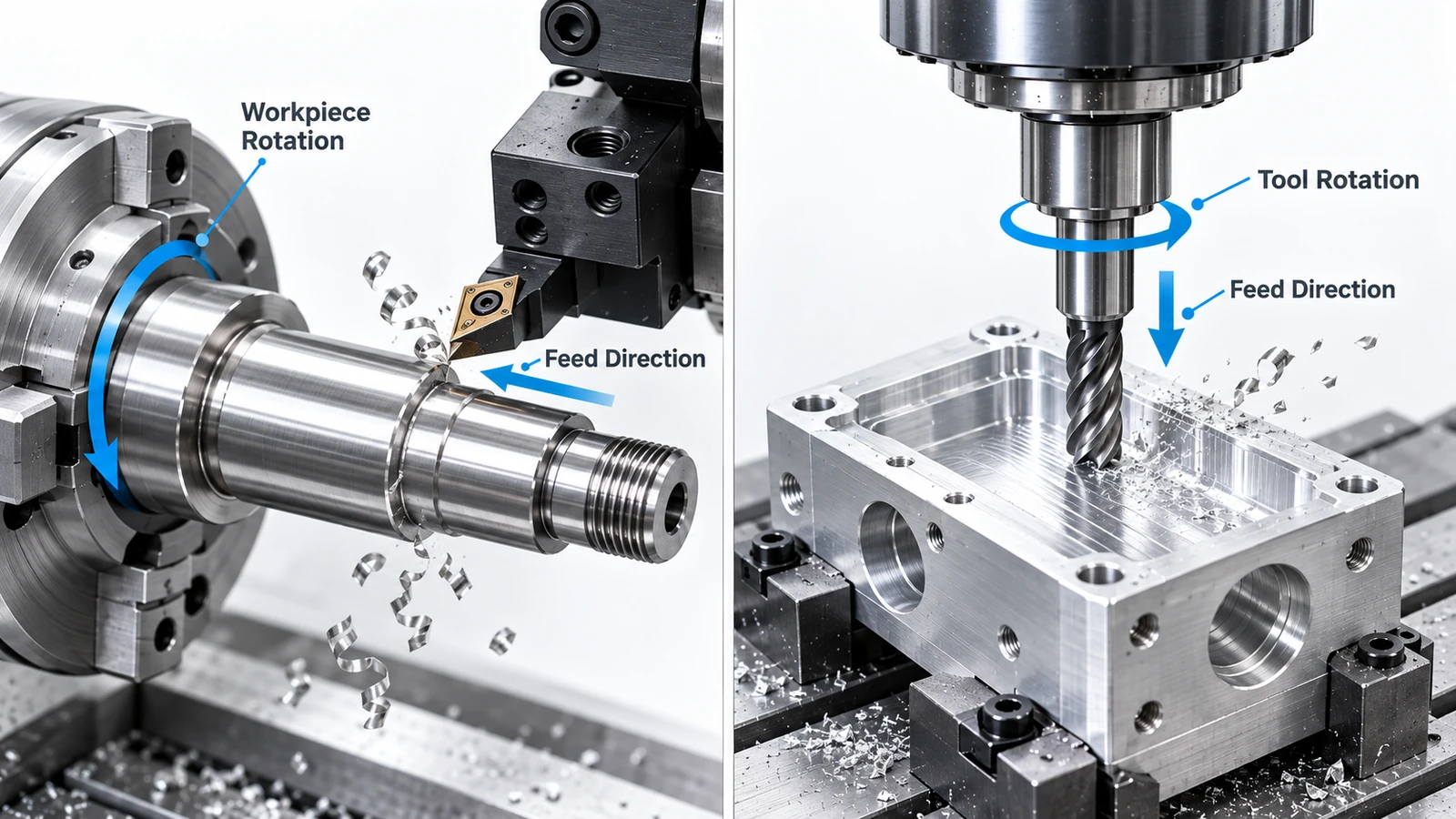
The main difference between a CNC lathe and a CNC mill is what rotates during machining. A CNC lathe rotates the workpiece against a cutting tool, making it ideal for shafts, bushings, and other cylindrical parts. A CNC mill uses rotating cutting tools to machine stationary or repositioned workpieces, making it better for housings, brackets, pockets, and complex features.
Choosing the right process depends on your part geometry, dimensional tolerances, production quantity, and manufacturing cost.
What Is the Difference Between a CNC Lathe and a CNC Mill?
Both machines remove material using computer-controlled cutting operations, but their basic machining principles differ.
How Does a CNC Lathe Work?
A CNC lathe holds and rotates a workpiece in a spindle while a cutting tool moves along programmed axes to remove material.
Typical operations include turning, facing, boring, grooving, and threading.
Because the workpiece rotates about its centerline, a lathe is especially effective for producing rotationally symmetric features, such as cylindrical diameters, shoulders, and concentric bores.
Modern turning centers may also include live tooling and additional axes for certain milling and drilling operations.
How Does a CNC Mill Work?
A CNC mill uses a rotating cutting tool that moves relative to the workpiece along programmed axes.
Common operations include face milling, pocket milling, slotting, contouring, and drilling.
CNC milling is particularly suitable for components with flat surfaces, multiple mounting features, cavities, or complex three-dimensional geometry.
Three-axis machines handle many conventional parts, while four-axis and five-axis configurations provide additional tool access and reduce repositioning for suitable components.
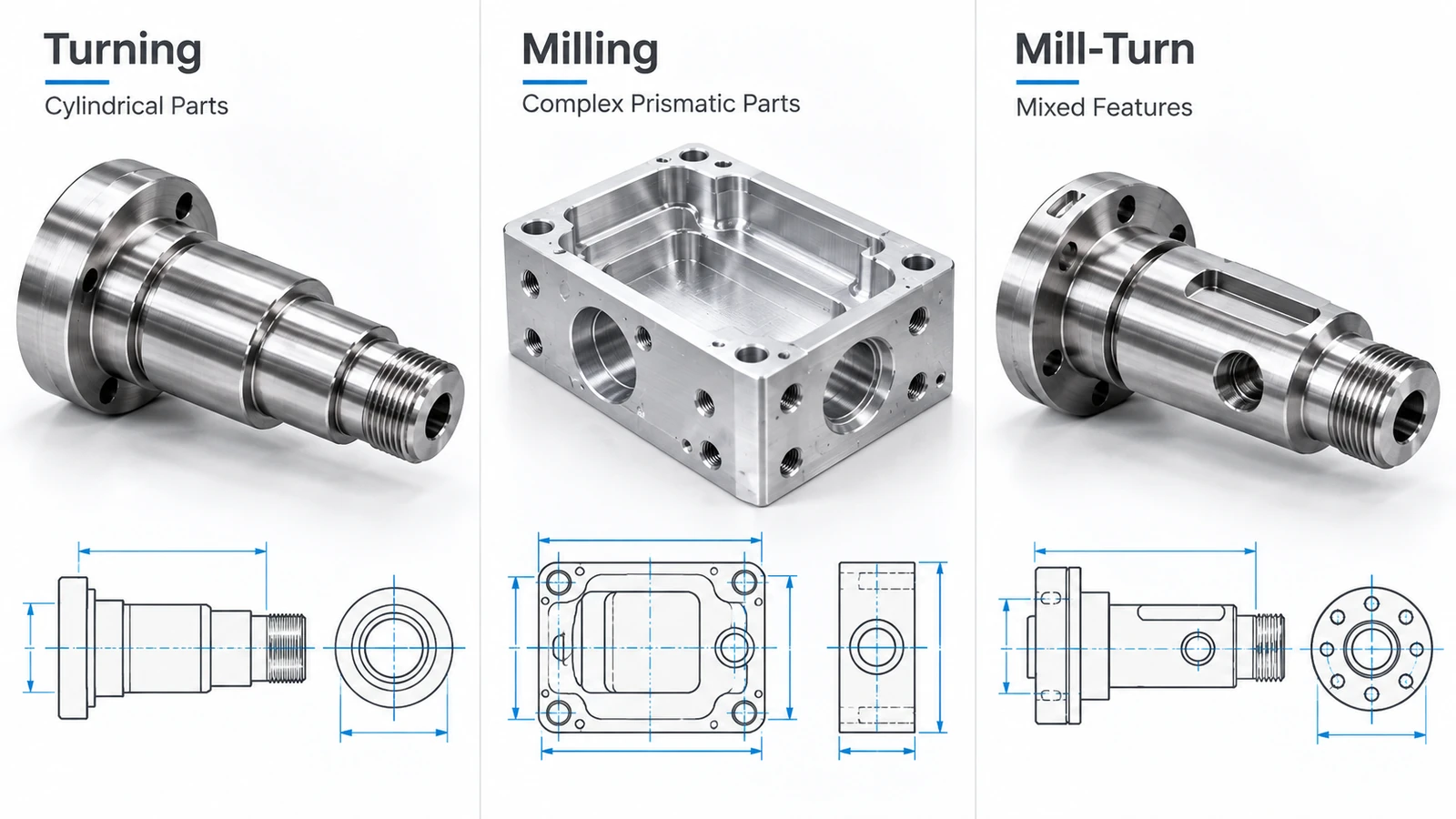
The essential distinction is that turning is generally optimized for rotational geometry, while milling is optimized for prismatic and non-rotational features.
CNC Lathe vs CNC Mill: Key Differences
The following table summarizes the practical differences between CNC turning and milling.
| Feature | CNC Lathe | CNC Mill |
|---|---|---|
| Main cutting motion | Workpiece rotates | Cutting tool rotates |
| Best part geometry | Cylindrical and rotationally symmetric | Flat, prismatic, and complex 3D shapes |
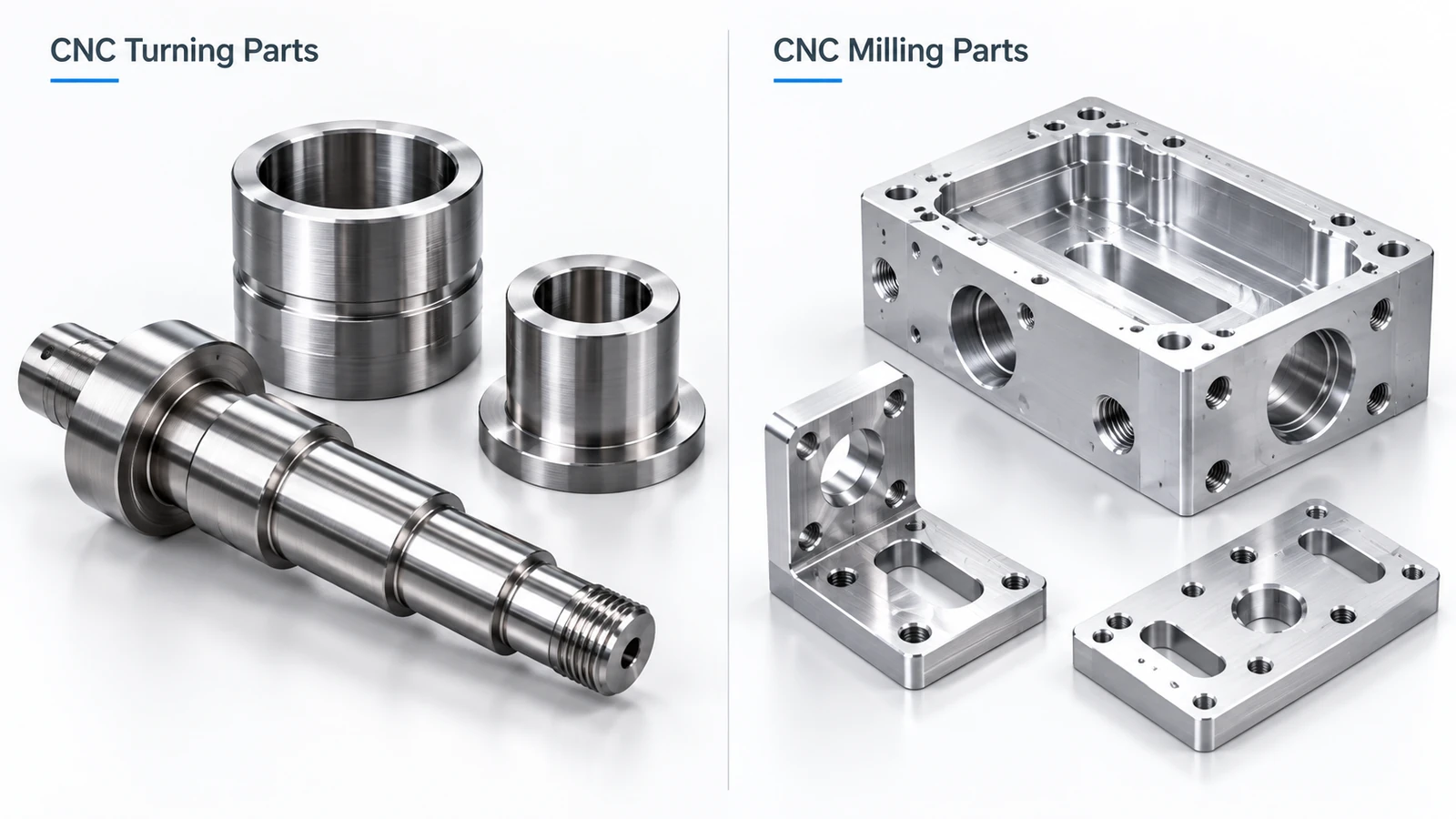
| Typical parts | Shafts, pins, bushings, sleeves | Housings, brackets, plates, manifolds |
| Common operations | Turning, facing, boring, grooving, threading | Face milling, slotting, pocketing, drilling |
| Concentric features | Particularly efficient | Possible with suitable methods and equipment |
| Multiple machined faces | May need live tooling or additional setups | Accessible with suitable setups and axes |
| Complex external shapes | More limited on basic lathes | Generally more flexible |
| Production efficiency | Often advantageous for round parts | Often advantageous for prismatic parts |
| Key cost considerations | Diameter, length, cycle time, bar feeding | Setup count, tool access, material removal |
Neither machine is universally more accurate, faster, or cheaper.
A CNC lathe may be the most economical option for a stepped shaft, while CNC milling may be more efficient for an aluminum housing with multiple pockets and mounting holes.
What Parts Are Best Made on a CNC Lathe?
CNC turning is usually the preferred process when most critical features are arranged around a common rotational axis.
Typical CNC-turned components include:
- Shafts: Stepped diameters, shoulders, and bearing seats.
- Bushings: Cylindrical external surfaces and precision bores.
- Pins: Repeated small-diameter components.
- Sleeves: Hollow cylindrical parts with controlled wall thickness.
- Threaded components: Parts requiring external or internal threads.
Example: Precision Steel Shaft
Consider a steel shaft with three different diameters, two shoulders, and an external thread.
Most features share the same rotational axis.
A CNC lathe can machine these features efficiently, often within a single setup when the geometry and available equipment permit.
This also makes it easier to control relationships between features machined about the same spindle axis, including concentric diameters.
However, the resulting accuracy still depends on machine condition, workholding, material behavior, tooling, and inspection.
For rotational components, our CNC turning services support custom prototypes and production parts in metals and engineering plastics.
What Parts Are Best Made on a CNC Mill?
CNC milling is generally more suitable when a component contains multiple planar surfaces, pockets, slots, or features that cannot be produced efficiently through rotational cutting.
Typical CNC-milled components include:
- Aluminum housings: Pockets, mounting faces, and threaded holes.
- Mechanical brackets: Flat surfaces, slots, and precision mounting features.
- Enclosures: Complex internal cavities and external profiles.
- Manifolds: Multiple drilled passages and machined interfaces.
- Robotic components: Custom profiles and multi-face features.
Example: Aluminum Electronics Housing
Consider an aluminum housing with a rectangular pocket, mounting holes, side openings, and several precision mating surfaces.
A CNC mill can machine these features using end mills, drills, and other suitable cutting tools.
Depending on accessibility, additional setups or four-axis or five-axis machining may be used to reach different faces.
Unlike a predominantly cylindrical shaft, the housing does not benefit from rotating the entire workpiece as the primary cutting motion.
This makes CNC milling the more practical choice.
Our CNC milling services support custom aluminum, stainless steel, titanium, and engineering plastic components with complex machined features.
CNC Lathe vs CNC Mill: Which Is More Accurate?
Neither CNC turning nor CNC milling is inherently more accurate in every application.
Accuracy depends on the specific machine, geometry, cutting conditions, workholding, material, and inspection requirements.
CNC Turning Accuracy
Turning is particularly effective for controlling diameters and features sharing a common rotational axis.
For example, bearing seats and stepped shaft diameters may benefit from machining in a single setup.
However, long, slender shafts can deflect under cutting forces, while thin-walled parts may distort during clamping.
CNC Milling Accuracy
Milling provides strong flexibility for controlling planar surfaces, pockets, holes, and multi-face features.
Accuracy may be affected by cutter deflection, tool runout, thermal conditions, and repositioning errors between setups.
For deep pockets or thin walls, cutting forces and material removal can also influence final dimensions.
At YUANYI Precision Manufacturing, selected precision CNC milling and turning features can be evaluated for tolerances around ±0.005 mm, depending on the material, dimensions, and geometry.
This is not a universal tolerance guarantee for every feature or component. Critical requirements should be confirmed through drawing review and process planning.
What About Surface Finish?
Both machining processes can produce fine surface finishes with suitable tooling and cutting conditions.
Turning often creates feed-related surface patterns on cylindrical features.
Milling creates toolpath-dependent patterns that vary with cutter geometry, stepover, and finishing strategy.
For many projects, Ra 1.6–3.2 μm is a practical general machining range, while finer finishes may be achievable through optimized processes or secondary operations.
The correct surface finish should be selected according to the functional requirement rather than assuming one machining method always produces a smoother surface.
Inspection requirements and dimensional verification should be established through an appropriate quality assurance process.
Which Is More Cost-Effective: CNC Turning or Milling?
The lower-cost process is usually the one that produces the required geometry with fewer unnecessary operations, shorter cycle time, and less setup complexity.
When Is CNC Turning More Economical?
Turning often provides cost advantages for parts dominated by rotational geometry.
For example, producing 100 simple cylindrical bushings on a suitable CNC lathe may involve efficient cycle times and repeatable workholding.
Bar-fed production can further reduce handling effort for compatible components.
When Is CNC Milling More Economical?
Milling is usually more appropriate for parts dominated by flat surfaces, pockets, slots, and complex profiles.
A rectangular mounting bracket may require only a few milling operations but would be impractical to manufacture primarily through conventional turning.
Main Factors Affecting Machining Cost
| Cost Factor | CNC Turning | CNC Milling |
|---|---|---|
| Setup | Often efficient for rotational parts | Depends on faces and accessibility |
| Programming | Relatively straightforward for simple profiles | May increase with 3D geometry |
| Machining time | Efficient for many cylindrical features | Depends on material removal and toolpaths |
| Tooling | Turning inserts, boring tools, threading tools | End mills, drills, specialty cutters |
| Material use | Efficient with suitable bar stock | Depends on stock shape and cavity volume |
| Inspection | Diameters, lengths, concentric relationships | Hole locations, surfaces, complex features |
Total manufacturing cost includes programming, setup, machining, tooling, inspection, and any secondary operations.
For example, a simple shaft generally costs less to manufacture by turning than by milling it from rectangular stock. However, a shaft with extensive off-axis features may require additional operations that change the comparison.
Therefore, accurate cost evaluation should be based on the complete engineering drawing rather than the machine type alone.
When Do You Need Both Turning and Milling?
Some components combine rotational features with slots, flats, cross-holes, or other non-rotational geometry.
These parts may require both turning and milling.
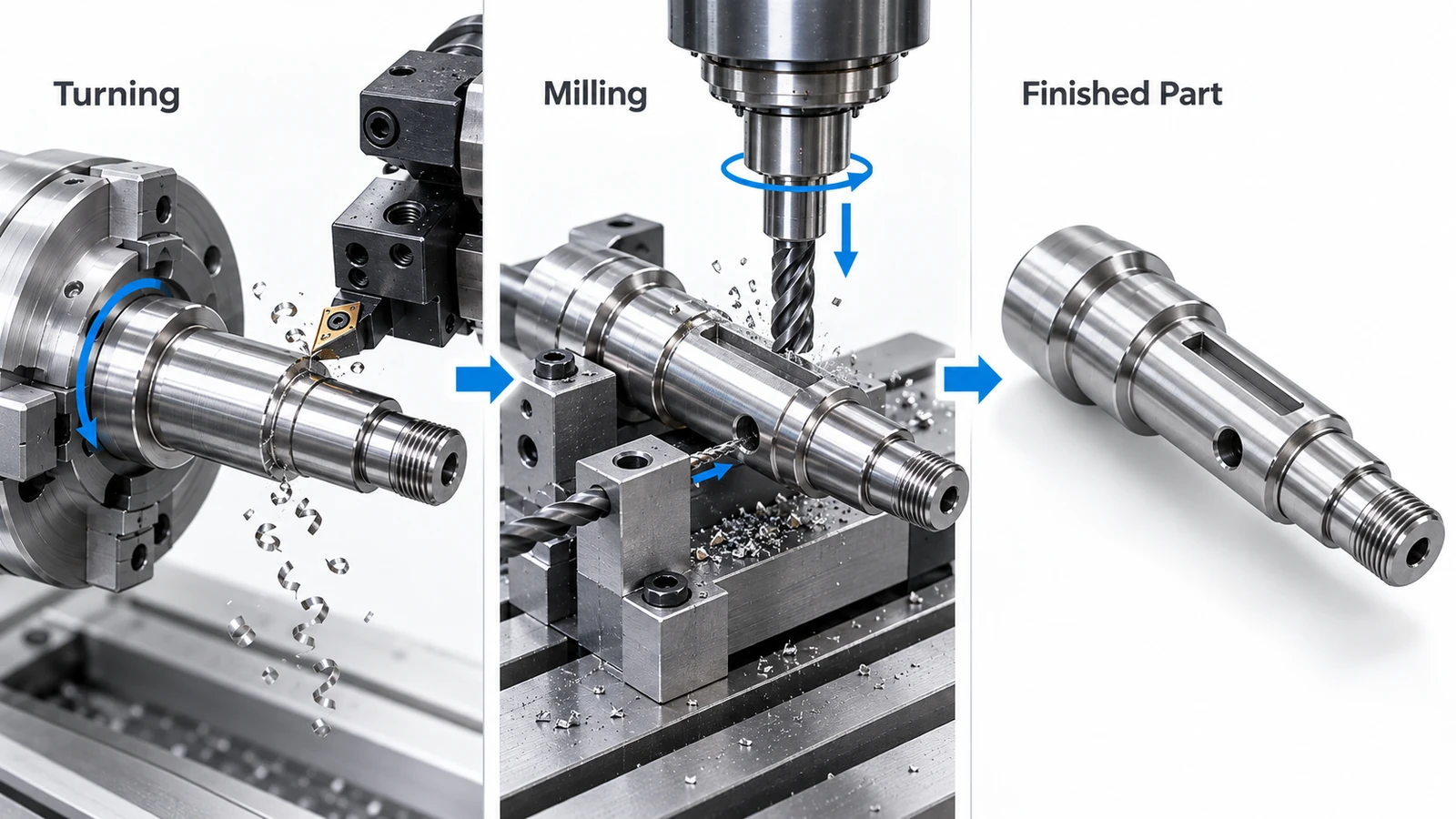
Example: Shaft With a Keyway and Cross-Hole
Consider a steel drive shaft with:
- Multiple precision diameters.
- A shoulder and external thread.
- A milled keyway.
- A cross-drilled hole.
The cylindrical features are naturally suited to CNC turning.
The keyway and cross-hole require additional machining capabilities.
There are two common manufacturing approaches.
Option 1: Separate Turning and Milling
The shaft is first turned on a CNC lathe and then transferred to a milling machine for the keyway and cross-hole.
This approach can be suitable when existing equipment offers an economical setup or when the production requirements do not justify a more complex machine.
For more information about the slot operation, see our keyway cutting guide.
Option 2: Mill-Turn Machining
A mill-turn machine combines turning with milling or drilling capabilities through live tooling and additional controlled axes.
Depending on machine configuration, the shaft may be completed with fewer transfers and setups.
This can reduce handling and help maintain feature relationships, especially when multiple off-axis features must be aligned with turned diameters.
However, mill-turn machining is not automatically cheaper. The equipment rate, programming complexity, production quantity, and total setup time must also be considered.
How to Choose the Right CNC Machining Process
The most practical way to choose between CNC turning and milling is to review the features that dominate the part’s manufacturing requirements.
Quick Process Selection Guide
| Part or Design Requirement | Recommended Starting Process |
|---|---|
| Simple cylindrical shaft | CNC turning |
| Precision bushing with inner and outer diameters | CNC turning |
| Flat aluminum mounting plate | CNC milling |
| Housing with pockets and threaded holes | CNC milling |
| Shaft with a keyway | CNC turning + milling |
| Cylindrical part with several off-axis holes | Turning + milling or mill-turn |
| Complex multi-face bracket | Multi-axis CNC milling |
| Small precision cylindrical parts in volume | CNC turning or Swiss-type machining, depending on geometry |
Four Questions to Ask Before Manufacturing
1. Is the part mainly rotational or prismatic?
If most features are cylindrical and share a common axis, start by considering CNC turning.
If most features are flats, pockets, and complex external profiles, consider CNC milling.
2. Are there features requiring a second process?
Cross-holes, milled flats, and keyways may require milling after turning or a machine equipped with live tooling.
3. Which dimensions and feature relationships are critical?
Identify the tightest tolerances, datum relationships, surface finish requirements, and features that may require additional inspection.
4. What is the production quantity?
The best process for a one-off prototype may differ from the most economical process for hundreds or thousands of identical parts.
For custom CNC parts, a manufacturability review helps determine the appropriate equipment, setups, cutting strategy, and inspection plan.
Conclusion
The choice between a CNC lathe and a CNC mill depends primarily on part geometry and manufacturing requirements.
CNC turning is generally the best starting point for rotational parts such as shafts, bushings, and sleeves. CNC milling is more suitable for housings, brackets, pockets, and complex prismatic components.
When a part combines cylindrical and non-rotational features, turning and milling may be used together or integrated through mill-turn machining.
Selecting the right process helps reduce unnecessary setups, control dimensions, and manage production costs.
Need help choosing the right CNC machining process? Send your engineering drawings to YUANYI Precision Manufacturing for DFM review and a quotation.
Frequently Asked Questions
Yes. CNC turning centers equipped with live tooling and appropriate axes can perform certain milling, drilling, and slotting operations. Basic CNC lathes without live tooling generally cannot perform conventional off-axis milling.
Yes. CNC mills can produce cylindrical features using suitable toolpaths, boring operations, or rotary-axis setups. However, conventional turning is often more efficient for parts dominated by multiple concentric diameters.
Not always. A CNC lathe is often faster for suitable cylindrical components, while a CNC mill can be more efficient for parts with pockets, flat surfaces, and complex contours.
Not necessarily. A five-axis mill provides improved tool access for complex multi-face geometry, but a CNC lathe remains highly effective for rotational components. The appropriate machine depends on the part.
No. Some shafts can be produced using other methods, including grinding or milling in specific circumstances. The best manufacturing route depends on shape, tolerance, material, and production quantity.



