

Thread milling is a CNC machining process used to produce internal and external threads with a rotating cutting tool. Unlike tapping, which uses a tool shaped to the thread size, thread milling creates threads through a controlled helical toolpath. This allows manufacturers to adjust thread dimensions, machine different thread diameters with compatible tools, and maintain greater control when machining challenging materials.
Thread milling is particularly useful for large threads, blind holes, hard materials, and high-value precision components. However, it is not always the fastest or most economical threading method. Understanding how the process works and how it compares with tapping helps engineers select the right approach for their parts.
What Is Thread Milling?
Thread milling is a subtractive machining process that uses a thread milling cutter to produce screw threads on a CNC milling machine or machining center.
The cutter rotates around its own axis while following a circular path around or inside the workpiece. At the same time, it moves along the thread axis to generate the required pitch and thread profile.
The process can produce two main types of threads:
- Internal threads: Threads machined inside holes, such as those used for bolts and threaded inserts.
- External threads: Threads machined on the outside of cylindrical features, such as threaded shafts and studs.
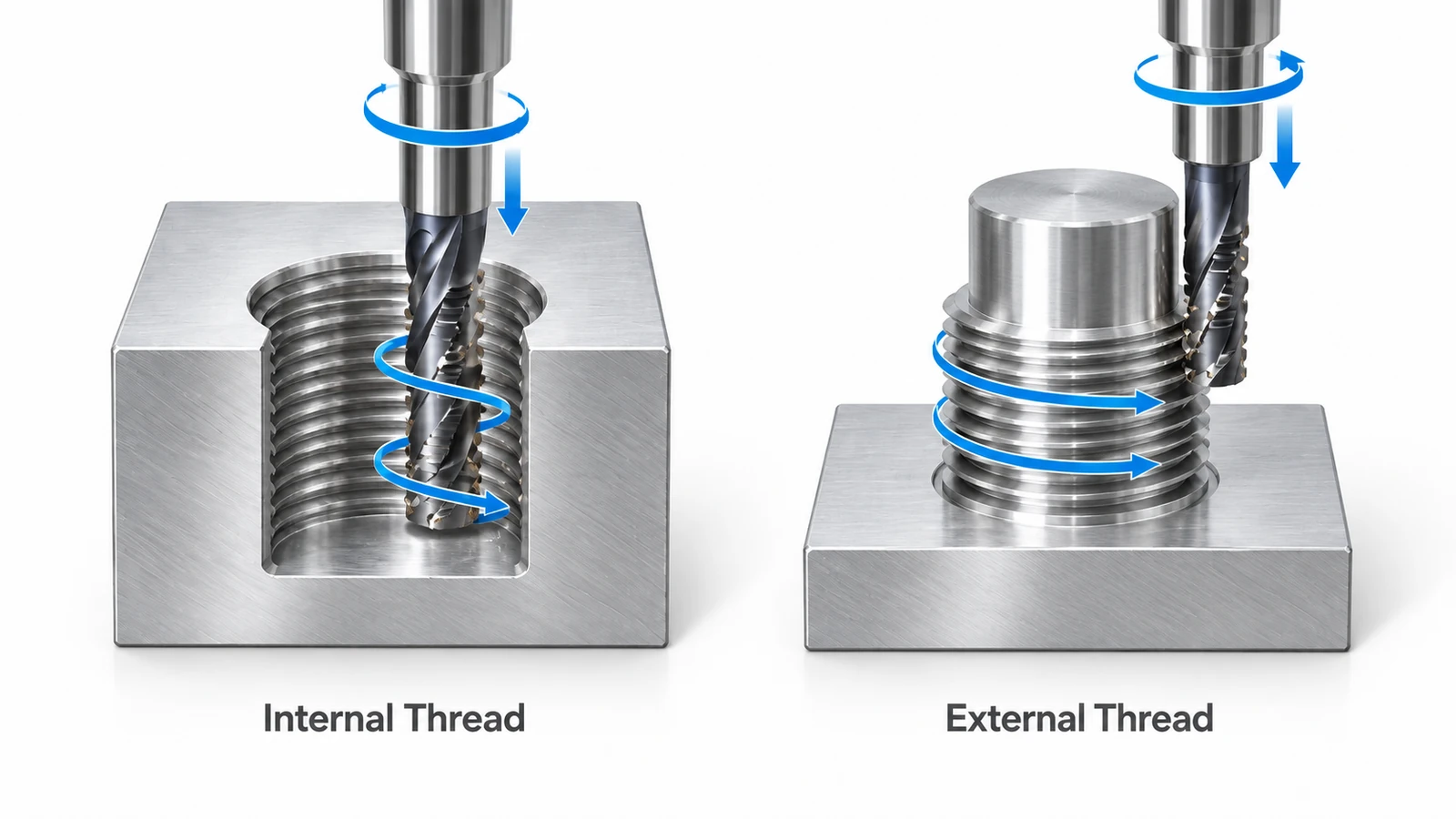
Unlike conventional tapping, thread milling does not require the cutting tool to match the full nominal diameter of the thread. A compatible thread mill can often produce different thread diameters by adjusting the CNC toolpath.
This flexibility makes thread milling valuable in precision CNC machining, especially when a component contains multiple threaded features or requires tight control over thread dimensions.
How Does Thread Milling Work?
Thread milling combines tool rotation with a CNC-controlled helical movement. This movement is known as helical interpolation, and it allows the cutter to generate a continuous thread along the required depth.
The typical thread milling process involves four steps.
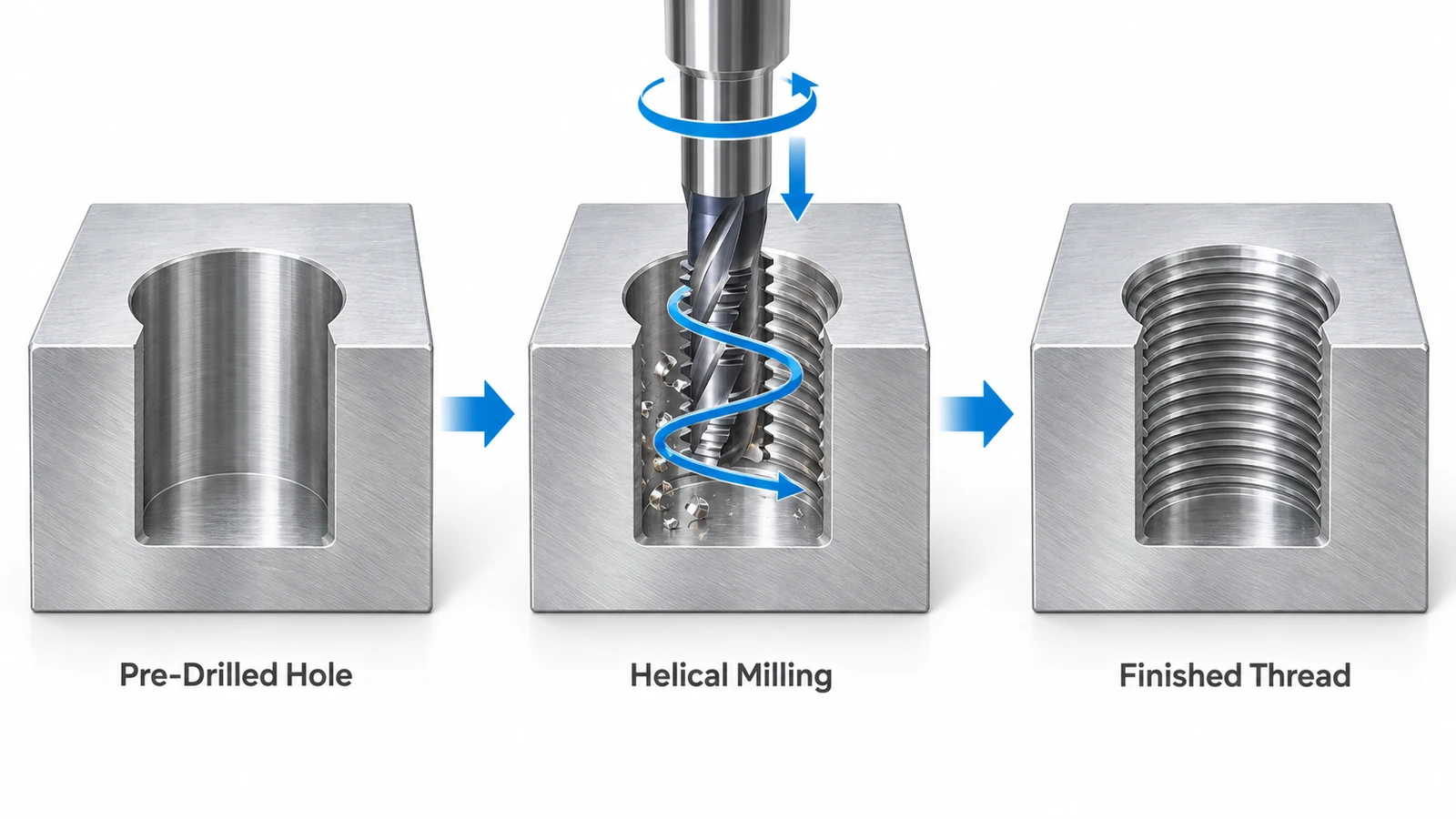
1. Prepare the Workpiece
For internal thread milling, a hole is drilled or bored to the appropriate diameter before threading begins.
The required hole size depends on the thread specification, material, and cutting tool. Proper preparation ensures sufficient material remains for forming the thread without creating excessive cutting forces.
External threads generally require the cylindrical surface to be machined to the appropriate diameter.
2. Select the Thread Mill
The cutter must match the required thread profile and pitch.
Tool selection also depends on the thread diameter, depth, material, and available machining space. A single-form thread mill offers greater flexibility, while a multi-form cutter may reduce machining time for repeated threads of the same pitch.
3. Perform Helical Interpolation
The rotating cutter follows a circular path while moving axially.
For a standard single-start thread, the axial movement over one complete revolution around the thread axis corresponds to one thread pitch.
The CNC program controls the toolpath diameter, axial movement, cutting direction, and entry and exit positions.
By adjusting the toolpath, the machinist can compensate for tool wear or make small corrections to the thread’s pitch diameter.
4. Inspect the Finished Thread
After machining, the thread is checked for dimensional accuracy and functional fit.
Depending on the application, inspection may involve GO/NO-GO thread gauges, thread measurement tools, or coordinate measuring equipment.
Proper inspection helps confirm that the finished thread meets the specified tolerance and assembly requirements.
Types of Thread Mills
Different thread milling cutters are available to accommodate various thread sizes, materials, and production requirements.
The three common categories are single-form, multi-form, and indexable thread mills.
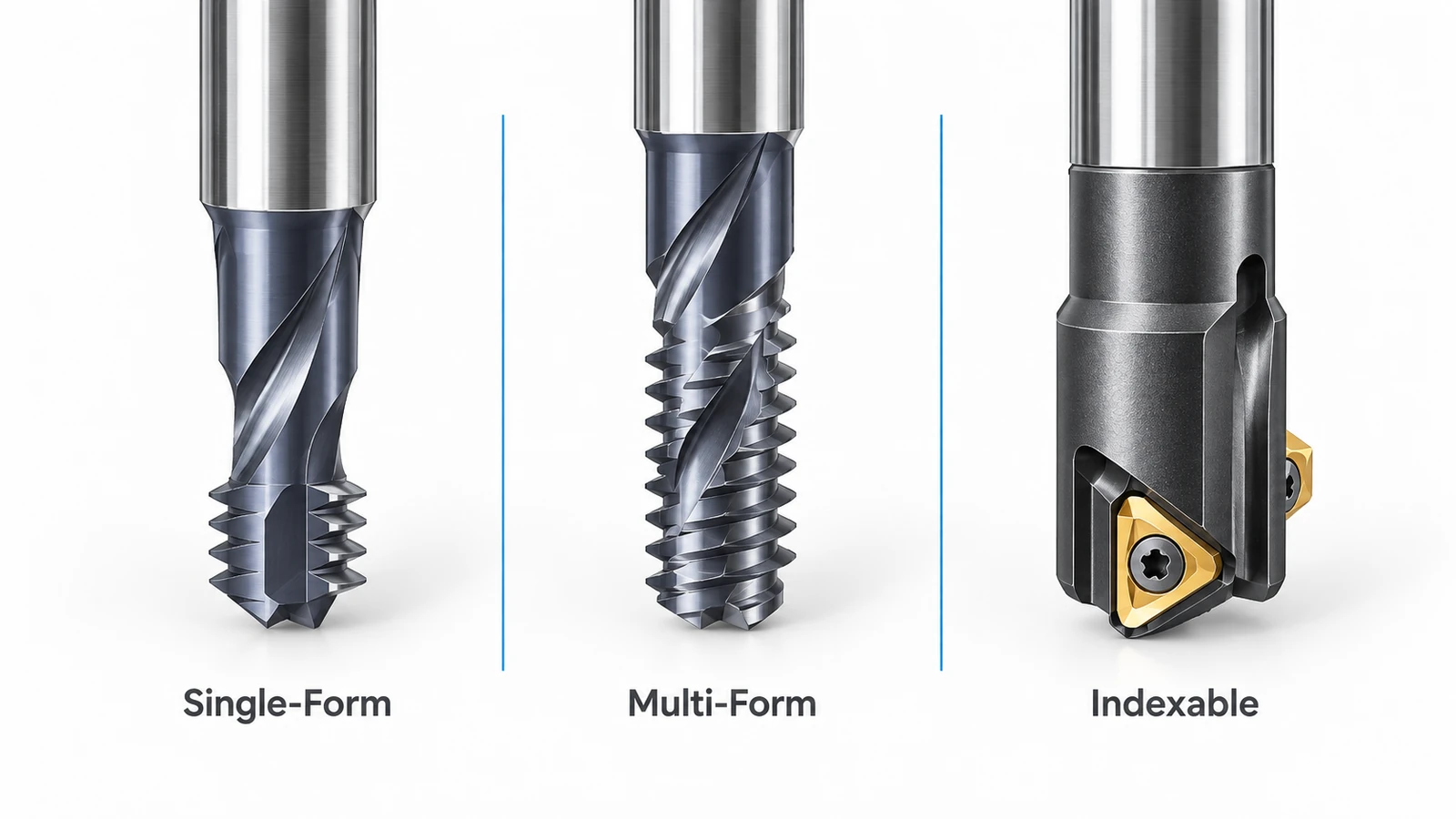
Single-Form Thread Mills
A single-form thread mill has a relatively short cutting profile, typically designed to generate the thread through multiple helical revolutions.
Because the cutter does not need to engage the entire thread length at once, it can be used for different thread depths and, within its compatible range, different thread diameters.
Main advantages:
- Flexible thread diameter and depth capabilities
- Lower simultaneous cutting engagement
- Suitable for deep or challenging threaded features
- Useful for small batches and varied thread sizes
The main drawback is that multiple revolutions are generally required, increasing cycle time.
Multi-Form Thread Mills
Multi-form thread mills have several cutting teeth arranged along the tool’s axis.
For a thread that fits within the cutter’s effective cutting length, multiple thread turns can be produced during one helical revolution.
This reduces machining time compared with a single-form cutter, particularly when producing repeated threads with the same pitch.
However, multi-form tools require closer matching between cutter geometry and the thread specification. Their longer cutting engagement can also increase cutting forces.
Indexable Thread Mills
Indexable thread mills use replaceable cutting inserts mounted on a tool body.
Instead of replacing the entire cutter when an edge wears, the operator can replace the insert.
These tools are particularly useful for larger thread diameters and production environments where replaceable cutting edges offer economic advantages.
The appropriate cutter depends on the thread geometry, production volume, and available tool clearance.
| Thread Mill Type | Main Advantage | Typical Application |
|---|---|---|
| Single-form | High flexibility | Different thread sizes, deep threads |
| Multi-form | Shorter cycle time | Repeated threads with matching pitch |
| Indexable | Replaceable cutting edges | Large-diameter threads |
Advantages of Thread Milling
Thread milling offers several benefits compared with conventional threading methods, particularly for complex or high-value machined components.
Flexible Thread Sizes
A compatible thread milling cutter can machine multiple thread diameters without requiring a dedicated tool for every nominal thread size.
This reduces tool inventory and provides flexibility when machining different part designs.
However, the cutter must still be compatible with the thread pitch, profile, and dimensional requirements.
Better Control Over Thread Dimensions
Thread milling allows small adjustments to the effective thread size through CNC toolpath or cutter compensation.
This is useful when controlling pitch diameter or compensating for gradual tool wear.
It also allows machinists to make dimensional corrections without necessarily changing the cutting tool.
Improved Chip Control
Thread milling generally produces shorter, more manageable chips than conventional cutting taps under comparable conditions.
Because the cutter does not fill the entire hole, there is more room for chip evacuation.
This can be beneficial when machining blind holes or materials that produce difficult chips, although coolant delivery and toolpath design remain important.
Reduced Risk to High-Value Parts
Tapping can generate substantial torque, particularly in large threads or difficult-to-machine materials.
If a tap breaks inside a component, removing it may be difficult and can damage the part.
Thread mills are generally smaller than the hole being threaded, so a broken cutter may be easier to remove.
This makes thread milling attractive for expensive components where scrap costs are significant.
Suitable for Difficult Materials
Thread milling can be effective for stainless steel, titanium alloys, hardened steels, and other challenging materials.
Its cutting engagement and chip formation can be controlled through tool selection and machining parameters.
However, successful machining still depends on cutter geometry, tool coating, machine rigidity, and appropriate cutting conditions.
Limitations of Thread Milling
Although thread milling is versatile, it is not always the preferred threading method.
Longer machining cycles: Thread milling often requires more tool movement than tapping. For high-volume production of standard threads, tapping can be significantly faster.
More complex programming: The process requires helical interpolation and accurate toolpath control. Incorrect programming can produce dimensional errors or damage the tool.
Machine capability: Thread milling requires a CNC machine capable of coordinated circular and axial interpolation, with sufficient positioning accuracy and rigidity.
Tool deflection: Small-diameter or long-reach cutters may deflect under cutting forces, affecting thread accuracy and surface finish.
Higher setup requirements: Programming, cutter selection, and dimensional verification may increase preparation time for simple threaded features.
For standard threads in easily machined materials, tapping is often the simpler and more cost-effective option.
Thread Milling vs Tapping: Key Differences
Thread milling and tapping both produce internal threads, but they differ in cutting motion, tool design, flexibility, and production efficiency.
Tapping uses a rotating tool with a thread profile corresponding to the required thread. The tool advances axially at a rate synchronized with its pitch.
Thread milling uses a smaller rotating cutter following a helical path to create the thread profile.
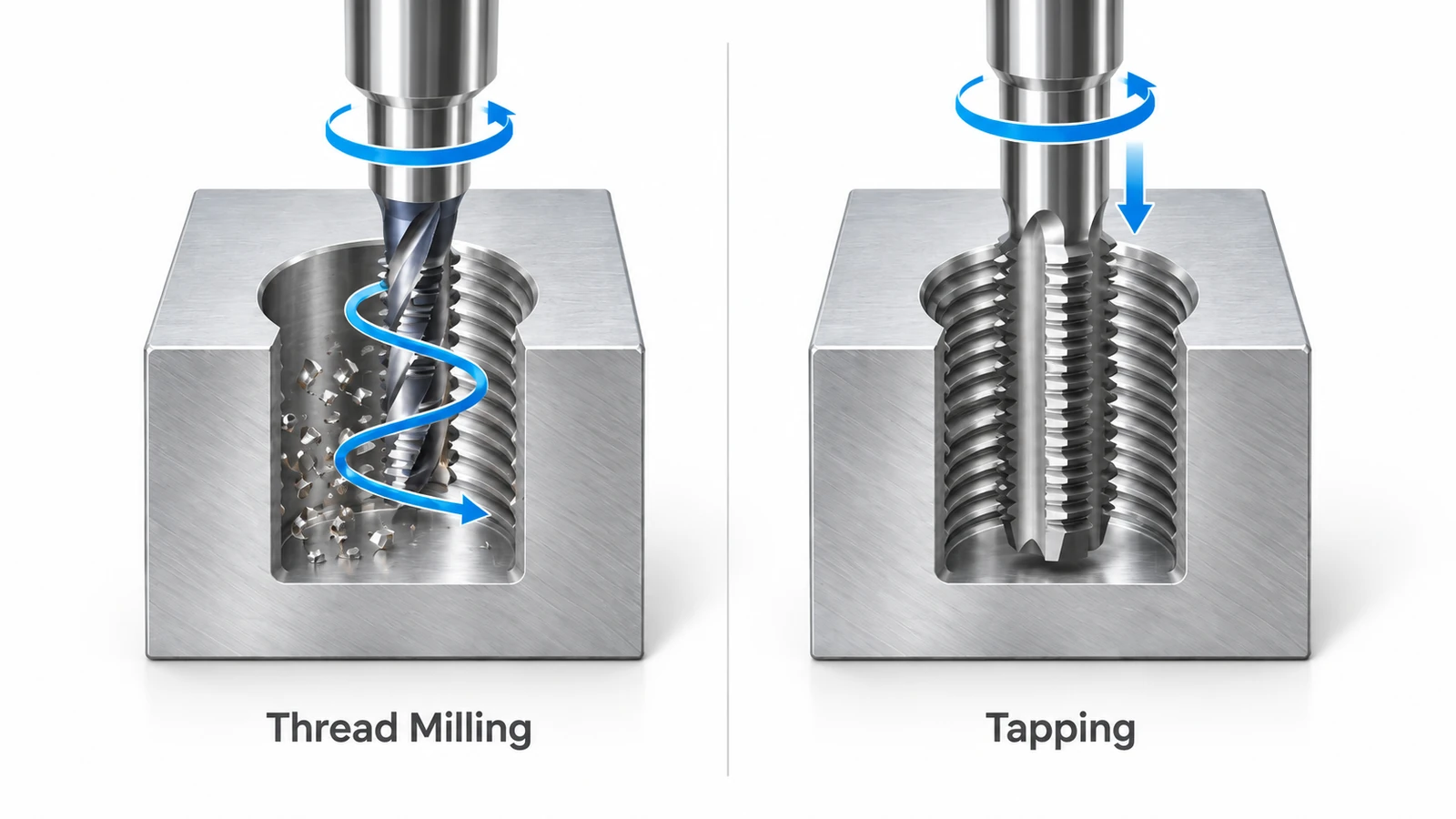
| Factor | Thread Milling | Tapping |
|---|---|---|
| Cutting method | Helical interpolation | Synchronized rotation and axial feed |
| Tool flexibility | Can machine multiple compatible diameters | Usually dedicated to a thread size |
| Cycle time | Generally longer | Generally shorter |
| Thread size adjustment | CNC toolpath compensation | Limited by tap geometry |
| Blind holes | Good control over cutting depth and chips | Requires suitable tap and chip control |
| Large threads | Often advantageous | May require high torque |
| Difficult materials | Flexible cutting engagement | Requires suitable tap geometry and conditions |
| Broken tool removal | Often easier | Broken taps can be difficult to remove |
| Programming | More complex | Relatively simple |
| High-volume standard threads | Less economical in many cases | Often more economical |
The choice depends on more than machining speed alone.
For example, tapping may be ideal for hundreds of standard M6 threaded holes in aluminum components. Thread milling may be preferable for a large threaded hole in a costly stainless steel housing where tool breakage and dimensional control are important.
Neither method is universally superior. The correct choice depends on thread specifications, materials, part value, and production requirements.
When Should You Choose Thread Milling?
Thread milling becomes particularly useful when the application requires flexibility, controlled cutting forces, or reduced manufacturing risk.
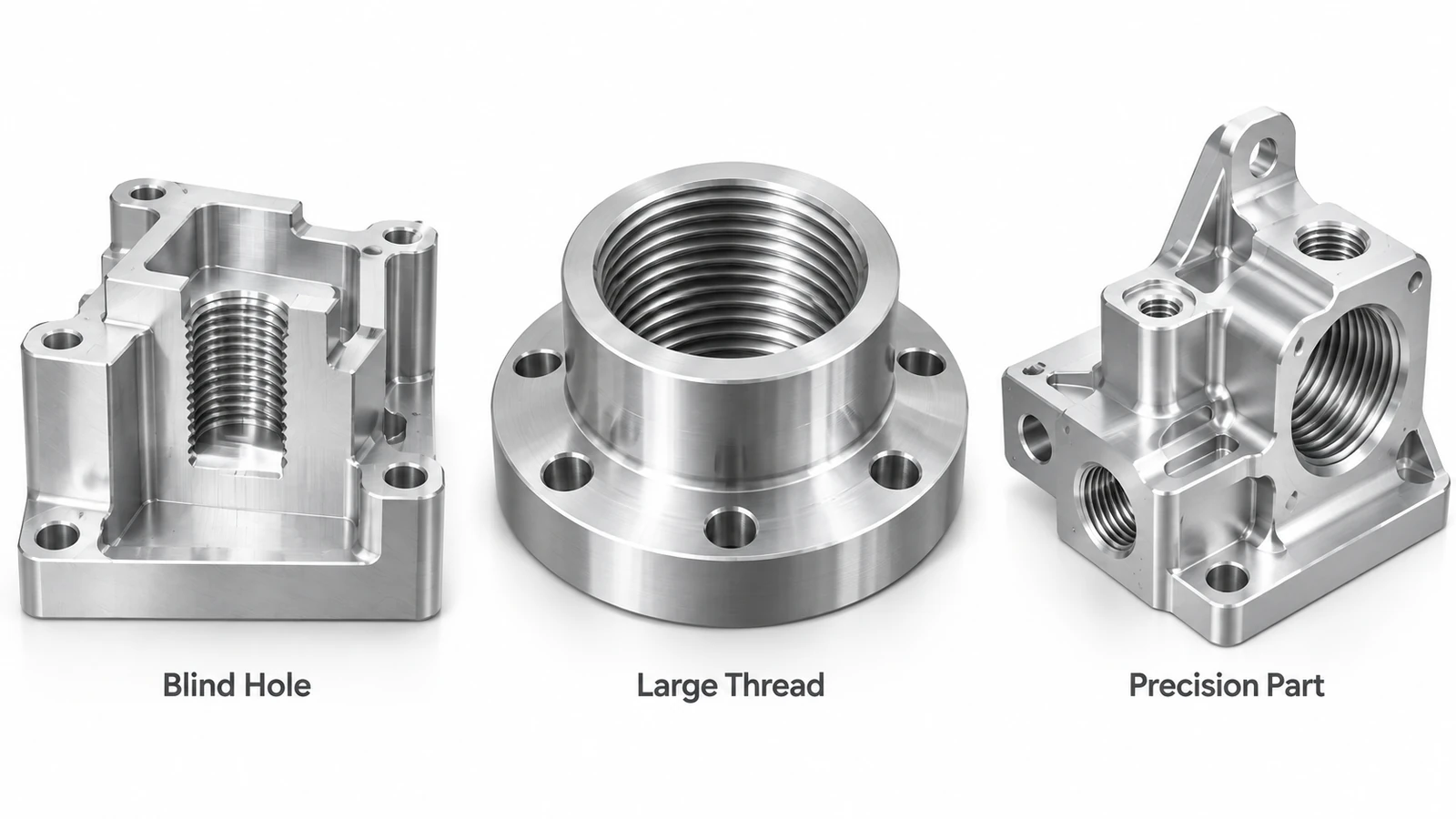
Large-Diameter Threads
Large taps require significant torque and can place substantial loads on the machine and workpiece.
Thread milling removes material progressively, making it attractive for large internal threads where tapping would require excessive torque or specialized tooling.
Blind Holes
Blind holes have a closed bottom, limiting chip evacuation and available tool clearance.
Thread milling can offer better control over the thread depth and reduce problems associated with long chips accumulating in the hole.
However, sufficient bottom clearance and proper chip evacuation are still necessary.
High-Value Precision Components
For expensive aerospace, medical equipment, or industrial components, a broken cutting tool can cause costly damage.
Thread milling may reduce this risk and provides opportunities to adjust thread dimensions through toolpath compensation.
It is especially useful when a finished component contains multiple complex features that would be expensive to remake.
Low-Volume or Customized Parts
Prototype and low-volume manufacturing often involve different thread sizes across multiple components.
Thread milling provides flexibility because compatible cutters can be reused for different nominal diameters, reducing the need for dedicated taps.
Thin-Walled Components
Thread milling can reduce cutting torque and allows progressive material removal compared with conventional tapping.
This can be beneficial for thin-walled housings or delicate features, provided cutting forces and workholding are carefully controlled.
Materials Suitable for Thread Milling
Thread milling can be used on many commonly machined metals. Cutting conditions should be adjusted according to the material’s mechanical properties and machinability.
| Material | Machining Considerations |
|---|---|
| Aluminum | Generally easy to machine; sharp tools and effective chip removal help prevent built-up edge |
| Stainless Steel | Work hardening and heat generation require suitable cutters and controlled engagement |
| Titanium | Low thermal conductivity makes cutting temperature, tool wear, and chip evacuation important |
| Hardened Steel | Requires appropriate carbide grades, coatings, machine rigidity, and cutting conditions |
For aluminum components, thread milling is often selected for flexibility or large thread sizes rather than because conventional tapping is difficult.
For stainless steel and titanium, thread milling may offer greater control over cutting loads and reduce the consequences of tool breakage.
Hardened steel can also be thread milled with suitable tooling, although the achievable hardness range depends on the cutter and application.
Practical Tips for Accurate Thread Milling
Accurate thread milling requires appropriate tool selection, stable machining conditions, and reliable inspection.
Choose the Correct Cutter
Verify the required thread profile, pitch, diameter, and depth before selecting the tool.
Different thread standards, such as metric ISO and Unified threads, may require different cutter geometries.
Minimize Tool Overhang
Long tool overhang increases the risk of vibration and deflection.
Using the shortest practical cutter improves rigidity and helps maintain dimensional accuracy, particularly in deep holes.
Verify the Prepared Hole Diameter
For internal threads, the pre-machined hole diameter affects the amount of material removed during thread milling.
An incorrectly sized hole may produce incomplete threads or excessive cutting loads.
Optimize Cutting Engagement
Choose suitable cutting speeds, feeds, and radial engagement based on material properties and cutter recommendations.
For challenging applications, multiple passes may provide better dimensional control than removing the full thread profile in one pass.
Check Toolpath Compensation
Thread size can be adjusted by modifying the toolpath or tool radius compensation, depending on the CNC control and programming method.
Corrections should be based on measured results rather than estimates.
Inspect Critical Threads
Use appropriate thread gauges or dimensional measurement methods to confirm conformity.
For precision applications, thread pitch diameter, depth, and functional fit may require additional verification.
Common Thread Milling Problems and Solutions
Several common issues can affect thread quality, especially when machining small, deep, or difficult threaded features.
| Problem | Possible Cause | Recommended Solution |
|---|---|---|
| Thread too tight | Incorrect toolpath diameter or tool wear | Measure the thread and adjust compensation |
| Poor surface finish | Vibration or unsuitable cutting conditions | Improve rigidity and optimize cutting parameters |
| Burr formation | Tool wear or unsuitable exit strategy | Check cutting edges and adjust the toolpath |
| Inaccurate thread diameter | Cutter deflection or runout | Reduce engagement and verify tool setup |
| Excessive tool wear | Incorrect cutting speed or inadequate cooling | Review tool grade, coating, and cooling conditions |
In precision machining, thread defects are not always caused by the cutting tool itself. Machine condition, fixture rigidity, workpiece geometry, and programming accuracy can also influence the results.
Identifying the underlying cause is essential before adjusting machining parameters.
Conclusion
Thread milling is a flexible CNC threading process that provides control over thread dimensions, cutting engagement, and tool selection. It is particularly useful for large threads, blind holes, difficult materials, and high-value precision components.
Tapping remains an efficient choice for many standard threads, especially in high-volume production. Selecting between the two processes requires consideration of thread geometry, material, production quantity, and manufacturing risk.
At YuanYi Precision, our CNC milling services support precision components with complex machined features and threaded requirements. Share your drawings and specifications with our team to discuss a suitable manufacturing approach for your project.
FAQs About Thread Milling
Yes. Thread milling can produce internal threads inside holes and external threads on cylindrical surfaces. The cutter geometry, toolpath, and available clearance must match the required thread design.
Yes. A compatible thread mill can often machine multiple nominal thread diameters by changing the CNC toolpath. However, the cutter must match the required thread profile and pitch, and the selected thread diameter must fall within its usable range.
Yes. Thread milling is well suited to many blind-hole applications because it allows control over machining depth and provides space for chip evacuation. The design must still allow adequate bottom clearance for the cutter and its entry and exit movements.
Yes. Hardened steel can be thread milled using suitable cutting tools and machining parameters. Carbide cutter grades, coatings, tool rigidity, and cutting conditions must be selected according to the material hardness and thread requirements.



