

MIG and TIG are two of the most common welding processes used for metal fabrication and precision assemblies.
The main difference is how the electrode and filler metal are supplied. MIG welding uses a continuously fed consumable wire electrode, while TIG welding uses a non-consumable tungsten electrode with a separate filler rod when required.
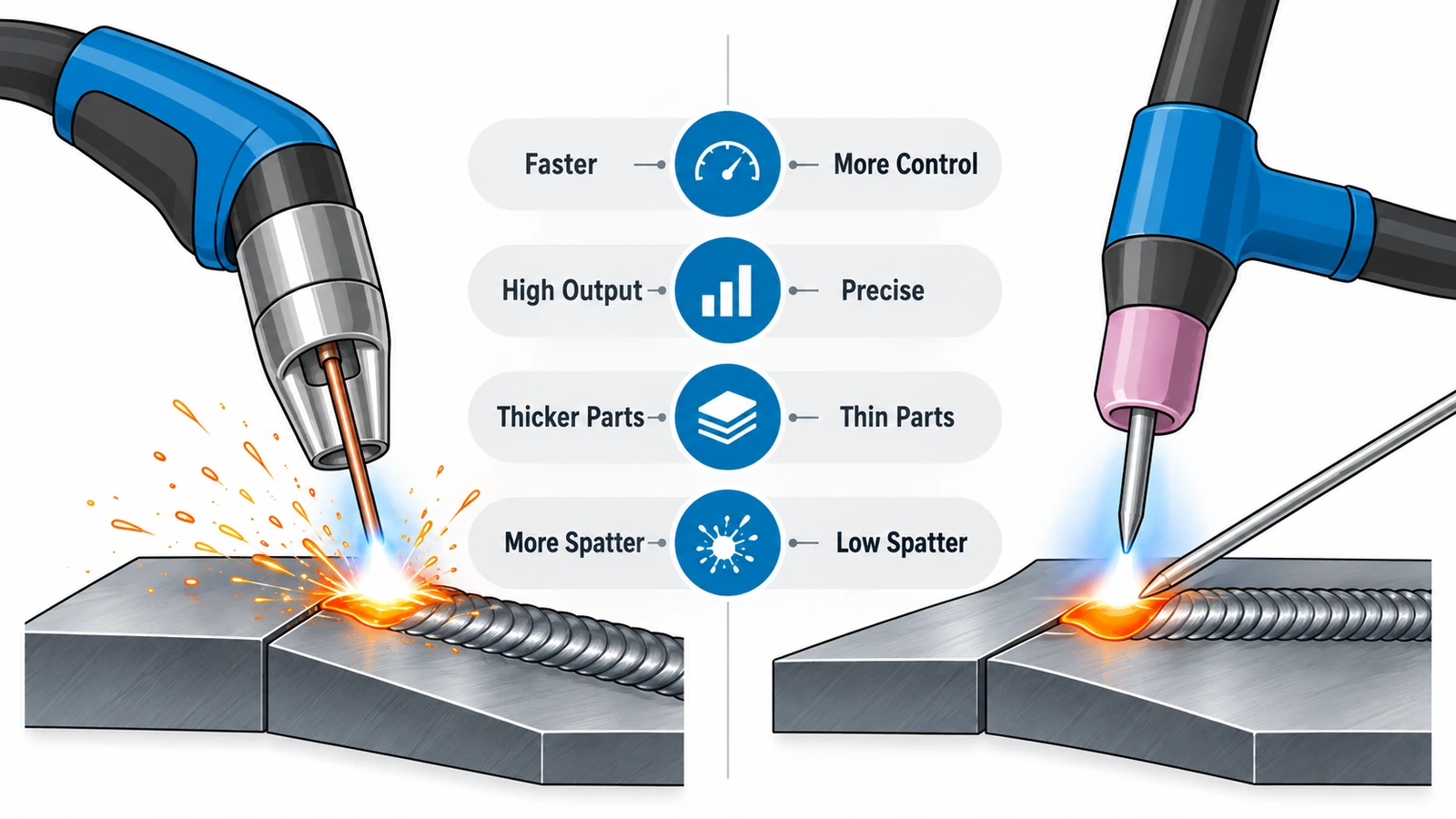
In general, MIG is faster and better suited to production work, larger assemblies, and thicker sections. TIG offers greater control over heat input and the weld pool, making it better suited to thin materials, stainless steel, aluminum, precision parts, and visible welds.
The right process depends on the material, thickness, joint design, production volume, appearance requirements, and dimensional tolerance of the finished part.
MIG vs TIG Welding at a Glance
| Factor | MIG Welding | TIG Welding |
|---|---|---|
| Electrode | Consumable wire | Non-consumable tungsten |
| Filler Metal | Wire normally acts as filler | Separate filler rod when needed |
| Welding Speed | Faster | Slower |
| Heat Control | Good | Excellent |
| Weld Appearance | Good | Clean and precise |
| Thin Materials | Suitable | Especially suitable |
| Thick Materials | Efficient | Possible but slower |
| Spatter | More likely | Very little |
| Skill Requirement | Easier to learn | Requires more operator skill |
| Productivity | High | Lower |
| Typical Applications | Frames, brackets, general fabrication | Precision parts, thin sections, stainless and aluminum |
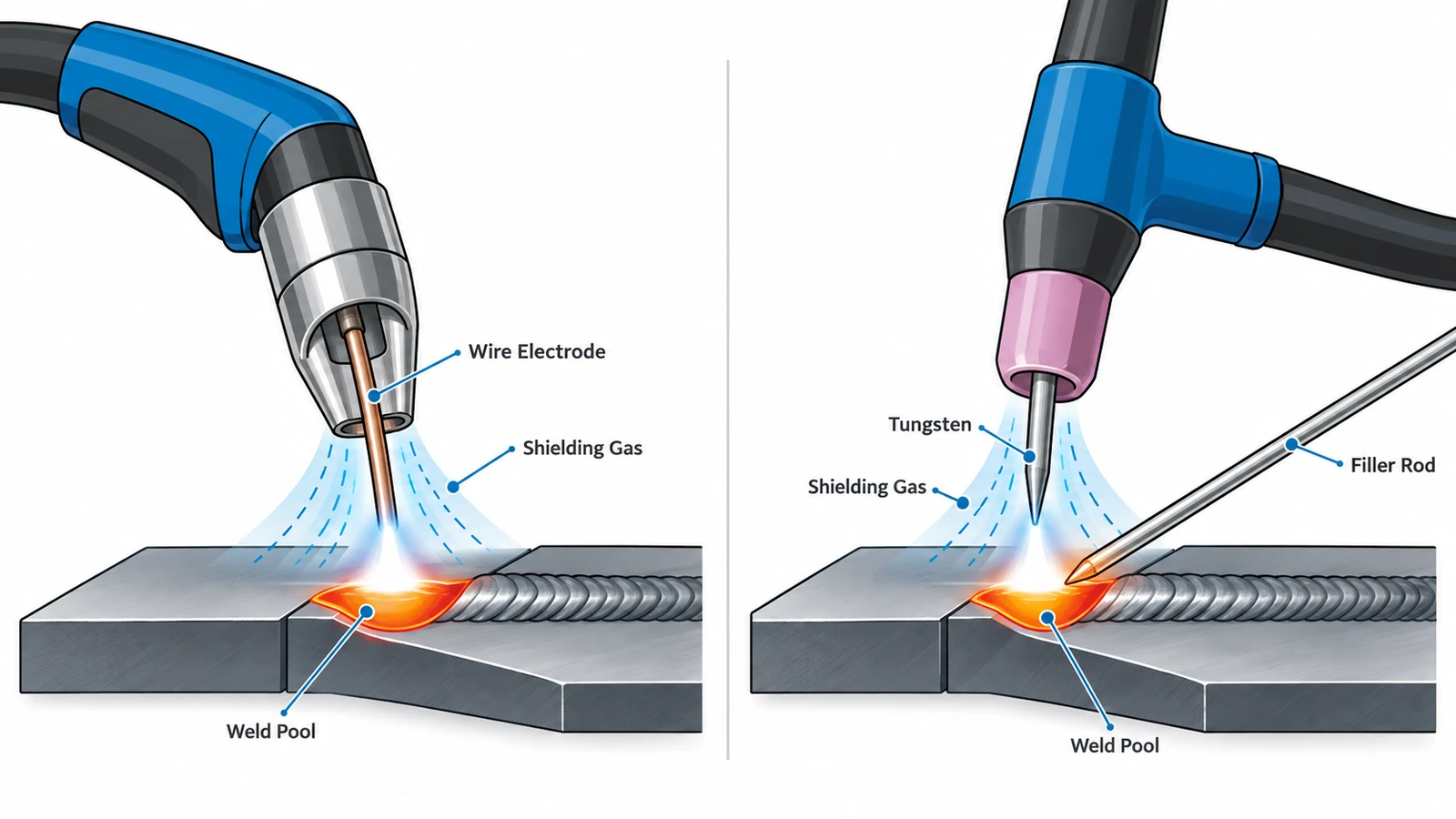
The biggest practical difference is productivity versus control.
MIG favors speed and output, while TIG favors precision, appearance, and heat management.
What Is MIG Welding?
MIG welding, or Metal Inert Gas welding, is commonly known in industrial terminology as Gas Metal Arc Welding (GMAW).
The process continuously feeds a metal wire through the welding torch. This wire carries the electrical current, creates the arc, melts, and becomes part of the weld joint.
A shielding gas protects the molten weld pool from contamination by the surrounding atmosphere.
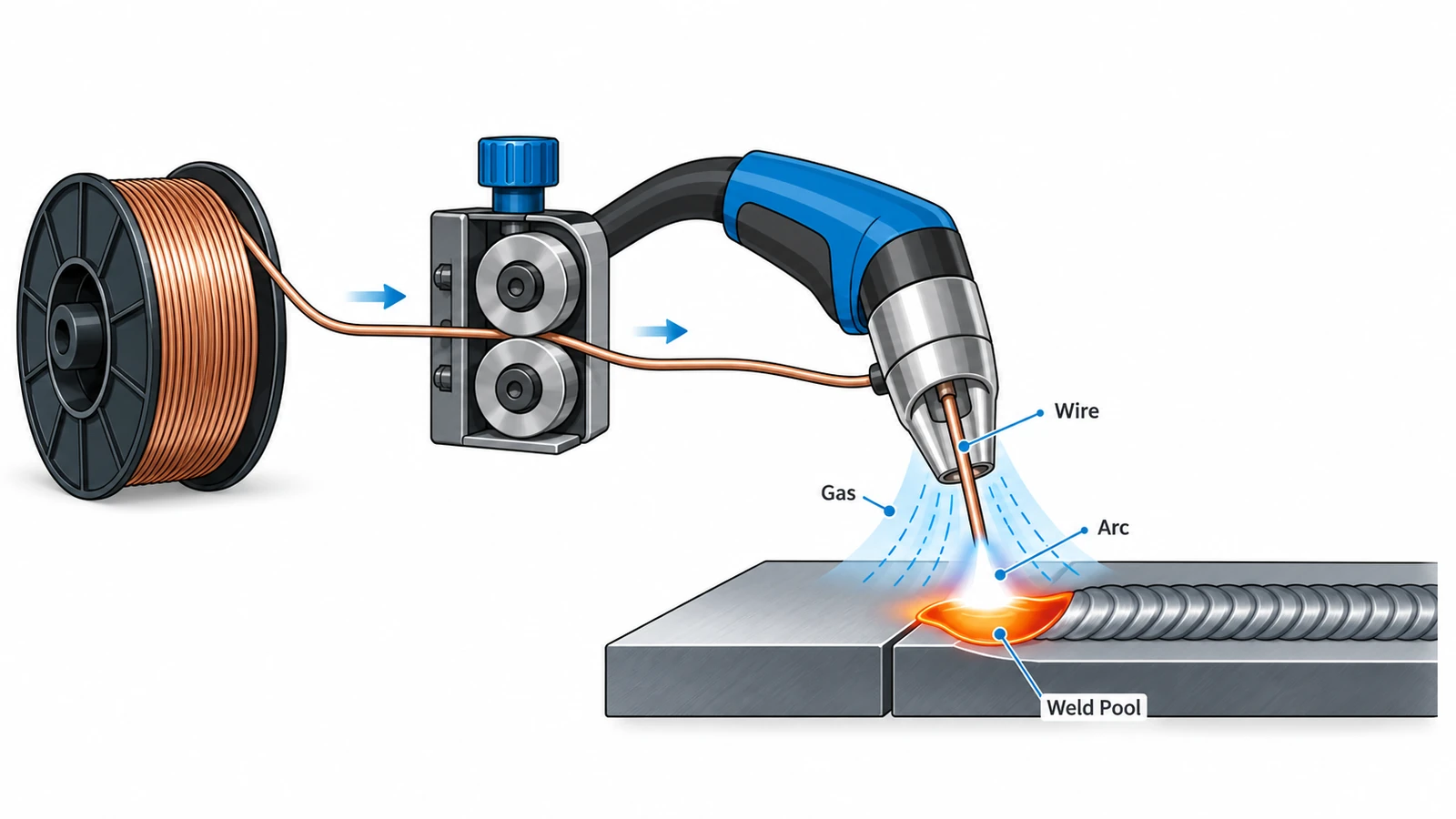
Because the wire is fed automatically, MIG welding is well suited to continuous welding and production work.
Typical applications include:
- Steel frames
- Structural brackets
- Machine bases
- Sheet metal assemblies
- Automotive components
- General fabrication
- Medium- and high-volume production
Advantages of MIG Welding
MIG welding is fast and productive because the wire is continuously fed into the weld. It is relatively easy to learn, works well for long seams and repetitive assemblies, and is widely used in automated or robotic welding systems.
Limitations of MIG Welding
Compared with TIG, MIG offers less precise control over the weld pool and can produce more spatter. On thin or distortion-sensitive parts, incorrect parameters can increase the risk of burn-through, warping, or additional post-weld cleanup.
What Is TIG Welding?
TIG welding stands for Tungsten Inert Gas welding and is also known as Gas Tungsten Arc Welding (GTAW).
Unlike MIG, TIG uses a tungsten electrode that does not normally melt into the weld.
The tungsten creates the arc while the operator controls the weld pool separately. If additional material is required, a filler rod is fed into the joint independently.
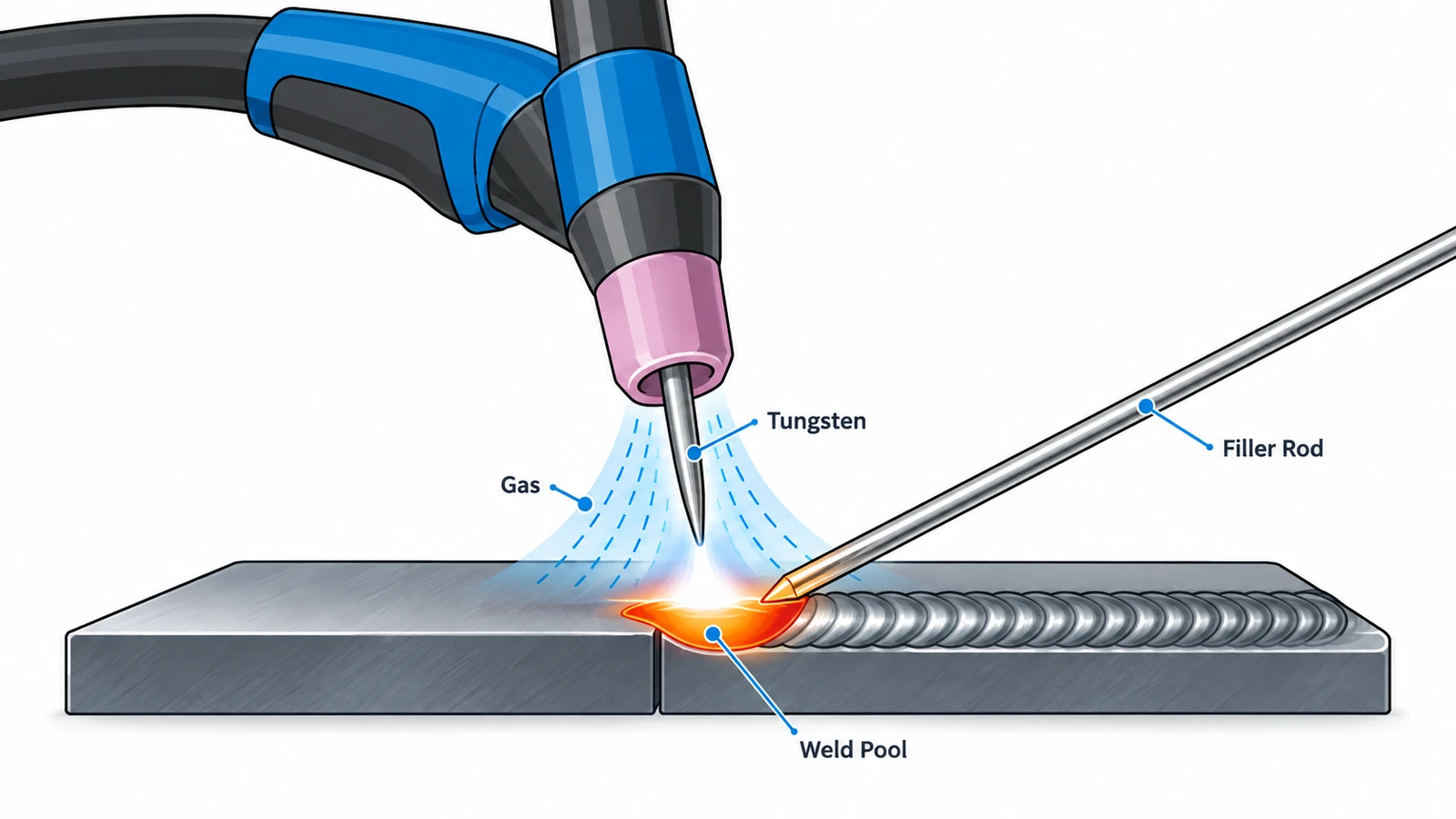
This allows more precise control over:
- Arc position
- Heat input
- Filler addition
- Weld penetration
- Bead shape
TIG welding is commonly used for:
- Stainless steel assemblies
- Aluminum components
- Thin-wall structures
- Aerospace parts
- Medical equipment
- Food-processing equipment
- Visible cosmetic welds
- Precision CNC-machined assemblies
Advantages of TIG Welding
TIG provides excellent control over heat input, arc position, and filler addition. It produces clean welds with very little spatter and is especially useful for thin sections, stainless steel, aluminum, and parts where weld appearance or dimensional control matters.
Limitations of TIG Welding
TIG is slower and requires more operator skill. For long weld seams, large structures, or high-volume production, the additional welding time may increase manufacturing cost without providing a meaningful benefit.
MIG vs TIG Welding: 8 Key Differences
1. Welding Speed
MIG welding is generally faster.
The continuously fed wire allows the operator to maintain a steady process with relatively high deposition rates.
TIG welding requires more precise control and may involve separately feeding filler material, so production rates are usually lower.
For large frames, enclosures, and general fabricated assemblies, MIG normally has the productivity advantage.
2. Weld Quality and Appearance
TIG is usually preferred when weld appearance is important.
The operator has greater control over the arc and filler material, making it easier to produce narrow, consistent weld beads with very little spatter.
MIG can also produce strong, high-quality welds, but the finished bead may require more cleanup when cosmetic appearance matters.
3. Heat Control
TIG provides more precise control over heat input.
This is important when welding thin or precision parts, where excess heat can cause:
- Warping
- Burn-through
- Dimensional movement
- Loss of flatness
- Misalignment of machined features
TIG allows experienced operators to adjust heat more precisely during welding.
4. Material Thickness
MIG is generally more efficient on medium and thicker sections because of its higher deposition rate.
TIG is particularly useful for thin materials where excessive heat could damage the part.
TIG can also weld thicker sections, but the process is usually slower than MIG.
5. Spatter and Cleanup
TIG produces very little spatter, often reducing post-weld grinding and cleanup.
MIG can generate more spatter depending on the transfer mode, material, shielding gas, machine settings, and operator technique.
This difference matters most when the welded surface will remain visible.
6. Skill Requirement
MIG is generally easier to learn.
Because the machine feeds the wire automatically, the operator mainly controls torch position, travel speed, and welding parameters.
TIG requires more coordination between torch movement, heat control, and filler addition, so producing consistent welds usually requires more experience.
7. Productivity
MIG is usually more productive for repetitive welding work.
It is commonly used for:
- Machine frames
- Automotive structures
- Fabricated brackets
- Industrial equipment
- Production assemblies
TIG is normally selected when the additional control justifies the slower welding speed.
8. Cost
MIG generally has a lower welding cost for production work because welding speed is higher.
TIG usually requires more operator time and skill.
However, welding cost should not be considered separately from post-processing. If a MIG-welded part requires extensive grinding, straightening, or rework, the total manufacturing cost can increase.
For some precision assemblies, TIG may reduce downstream finishing or correction.
MIG vs TIG Welding for Different Materials
Material type is one of the most important factors when choosing between MIG and TIG.
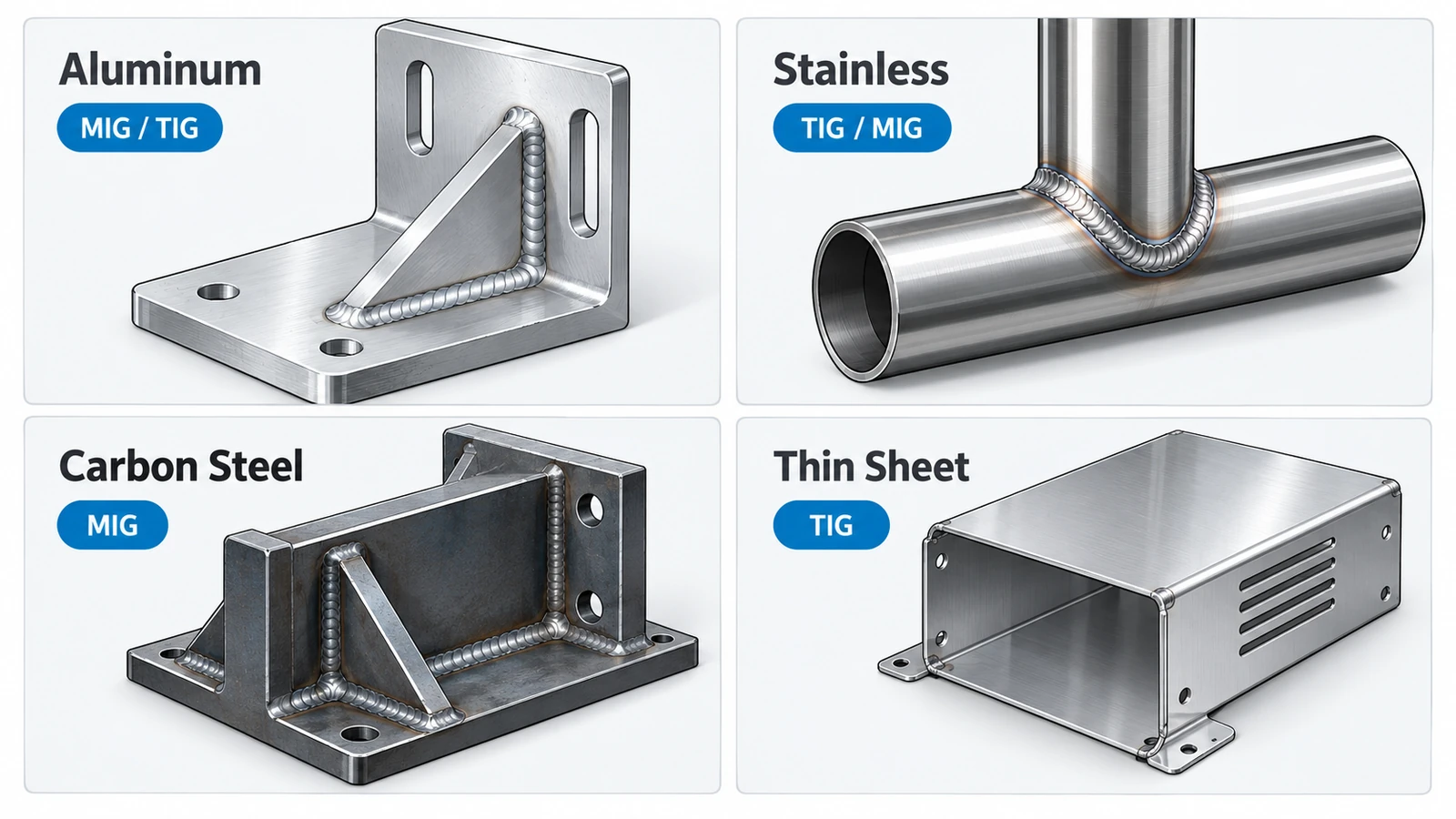
MIG vs TIG for Aluminum
Both MIG and TIG can weld aluminum successfully.
MIG is commonly used for thicker aluminum sections and larger production assemblies because it offers higher welding speed.
TIG is often preferred for:
- Thin aluminum parts
- Precision assemblies
- Visible weld seams
- Small components
- Parts requiring tighter heat control
For CNC-machined aluminum housings or brackets, TIG can be advantageous when dimensional control and weld appearance are important.
MIG vs TIG for Stainless Steel
Both processes can weld stainless steel.
MIG is suitable for production fabrication where efficiency is the main priority.
TIG is frequently chosen when surface appearance, contamination control, thin wall thickness, or precise heat input matters.
Typical applications include:
- Medical equipment
- Food-processing systems
- Laboratory equipment
- Precision enclosures
- Tubing assemblies
MIG vs TIG for Carbon Steel
MIG is widely used for carbon steel frames, brackets, machinery, and general fabrication because it offers high welding speed and good productivity.
TIG can also weld carbon steel effectively, but it is usually chosen when the part requires greater precision, a cleaner weld, or tighter heat control.
MIG vs TIG for Thin Metal
TIG is generally better suited to very thin materials because the operator has finer control over heat input and the weld pool.
Thin sections can distort quickly during welding, so weld sequence, fit-up, fixturing, and heat management become critical.
MIG can still be used successfully on thin sheet with suitable settings and experienced operators, but TIG offers greater control when tolerances are demanding.
When Should You Choose MIG Welding?
Choose MIG when productivity is the priority, especially for long weld seams, medium-to-thick materials, steel frames, machine structures, and repetitive production.
MIG is usually a good choice when:
- Welding speed is important
- Production quantity is relatively high
- The material is medium or thick
- The assembly contains long weld seams
- Large frames or structures are involved
- Some post-weld cleanup is acceptable
- Weld appearance is not the main requirement
For example, a large welded machine frame may contain many meters of weld. Using TIG for the entire structure could add significant production time without providing a meaningful benefit.
In this situation, MIG is usually more practical.
When Should You Choose TIG Welding?
Choose TIG when precision, heat control, appearance, or distortion control matters more than welding speed.
TIG is usually a good choice for:
- Thin materials
- Stainless steel
- Aluminum
- Precision assemblies
- Visible weld seams
- Small components
- Parts sensitive to distortion
- High-value machined components
For example, an aluminum CNC-machined enclosure may already contain precision holes, pockets, sealing surfaces, and mounting features.
Excessive welding distortion could affect those dimensions, so a carefully controlled TIG process may be preferable.
MIG vs TIG Welding for CNC Machined Parts
Welding CNC-machined components requires more consideration than welding basic fabricated structures.
Machining can produce very tight dimensions, while welding introduces concentrated heat into the assembly.
As the material heats and cools, expansion and contraction can affect:
- Hole alignment
- Flatness
- Angular accuracy
- Parallelism
- Position tolerance
- Bearing surfaces
- Sealing surfaces
For this reason, the manufacturing sequence can be just as important as the welding process itself.
A precision welded assembly may follow a sequence such as:
Rough Machining → Fit-Up → Tack Welding → Final Welding → Stress Relief if Required → Finish Machining → Inspection
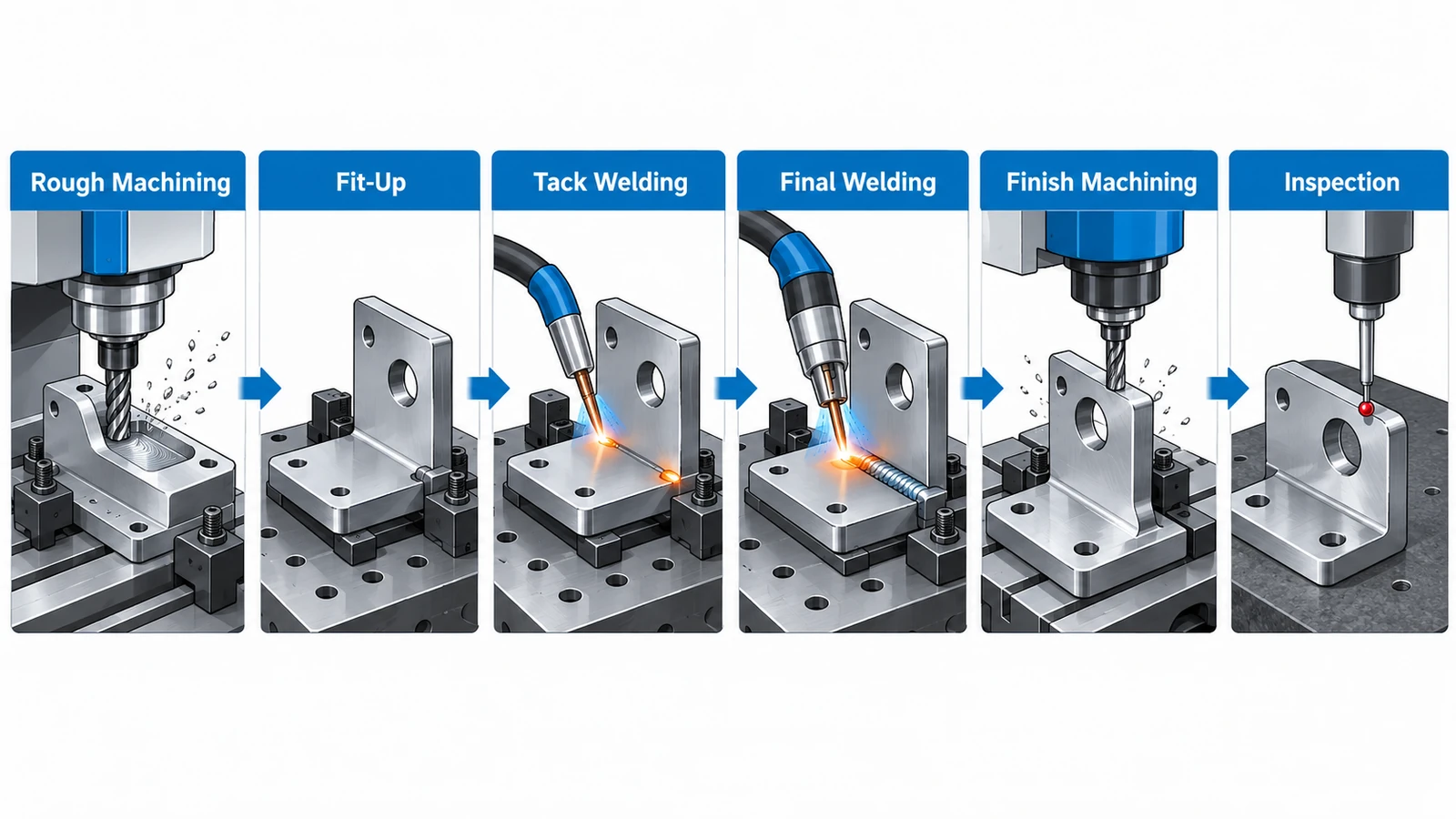
This allows critical dimensions to be finished after most welding distortion has already occurred.
Why Tack Welding Matters
Before final MIG or TIG welding, components are often tack welded in position.
Tack welds help maintain:
- Joint alignment
- Gap position
- Component orientation
- Assembly dimensions
However, tack welds also introduce heat.
Large or poorly positioned tack welds can affect alignment before final welding begins.
For precision assemblies, welding fixtures, tack sequence, final weld sequence, and heat management should therefore be considered together.
MIG vs TIG: How to Choose
The easiest way to choose between MIG and TIG is to identify what matters most for the part.
Choose MIG Welding If:
- You need faster welding
- Production volume is higher
- The material is medium or thick
- The assembly is large
- Long weld seams are involved
- Cosmetic appearance is secondary
- Manufacturing efficiency is the priority
Choose TIG Welding If:
- The material is thin
- Heat input must be controlled carefully
- The weld is highly visible
- The part contains precision features
- Stainless steel or aluminum is involved
- Spatter must be minimized
- Dimensional control is important
In many manufacturing facilities, both processes are used.
MIG may be used for structural sections while TIG is used for smaller precision areas or visible weld seams.
The best process depends on the part rather than simply choosing one welding method for every project.
Final Thoughts
MIG and TIG welding serve different manufacturing needs.
MIG welding is generally better for speed, production efficiency, thicker materials, and larger fabricated structures. TIG welding is usually preferred when precision, thin materials, weld appearance, and heat control are more important.
For CNC-machined assemblies, the choice should also consider what happens after welding.
Proper fixturing, tack welding, weld sequencing, stress relief where necessary, finish machining, and inspection can all help control distortion and protect critical dimensions.
The right choice between MIG and TIG therefore depends on the material, part geometry, tolerance requirements, production volume, and final function of the assembly.
Frequently Asked Questions
Not necessarily.
Both MIG and TIG can produce strong welds when the joint is properly designed and the welding parameters are correct.
Weld strength depends on factors such as base material, filler metal, penetration, joint design, welding parameters, and overall weld quality.
TIG should not automatically be considered stronger simply because it offers more precise control.
Neither process is universally better.
TIG is better suited to precision welding, thin materials, clean welds, and applications where heat control is important.
MIG is better suited to faster production, longer weld seams, thicker sections, and general fabrication.
Yes.
MIG is commonly used for aluminum, particularly for thicker sections and production applications.
Proper wire feeding equipment, shielding gas, filler wire, and welding parameters are important because aluminum behaves differently from steel during welding.
TIG is commonly preferred for stainless steel when appearance, thin wall thickness, and heat control are important.
MIG can also weld stainless steel efficiently and may be better suited to larger or higher-volume fabricated assemblies.
TIG is usually preferred for very thin material because it provides better control over heat input and the weld pool.
This can help reduce burn-through and distortion.
MIG is generally cheaper for production welding because the process is faster.
However, total cost also depends on grinding, finishing, straightening, inspection, and potential rework.
For precision parts, TIG may sometimes reduce downstream finishing requirements.
Yes.
Some TIG joints can be fusion welded without adding separate filler metal.
Whether this is suitable depends on material type, thickness, joint design, and engineering requirements.
TIG can provide better control over heat input, but distortion depends on more than the welding process.
Material thickness, joint design, fixtures, welding sequence, travel speed, heat input, and part geometry all affect distortion.
For precision components, welding strategy should be considered together with machining and inspection requirements.



