

Fasteners are mechanical components used to join, secure, locate, or retain two or more parts. Common types of fasteners include bolts, screws, nuts, washers, studs, rivets, pins, dowel pins, threaded inserts, retaining rings, clips, and specialty fasteners.
Different types of fasteners are designed for different joining requirements. Some create removable joints for maintenance, while others are intended for permanent or semi-permanent assembly. Choosing the right type depends on the joint design, load, material, environment, installation space, and maintenance needs.
For CNC machined parts, fastener selection also affects threaded-hole design, counterbores, countersinks, tolerances, and assembly reliability.
What Is a Fastener?
Mechanical fasteners are components used to join, secure, locate, or retain parts. Unlike welding or adhesive bonding, many fasteners allow assemblies to be taken apart without damaging the main components.
Fasteners can broadly be divided into two groups:
Threaded fasteners use mating threads to create clamping force. Examples include bolts, screws, nuts, and studs.
Non-threaded fasteners rely on interference, deformation, spring force, or geometry. Examples include rivets, pins, retaining rings, and clips.
The right choice depends on whether the joint must carry load, align parts, resist vibration, allow maintenance, or remain permanent.
Types of Fasteners and Their Uses at a Glance
| Fastener Type | Main Function | Removable? | Typical Applications |
|---|---|---|---|
| Bolts | Clamp parts together | Yes | Machinery, structures, equipment |
| Screws | Fasten directly into threaded material | Yes | Housings, brackets, assemblies |
| Nuts | Mate with bolts or studs | Yes | Mechanical assemblies |
| Washers | Distribute load and protect surfaces | Yes | Bolted and screwed joints |
| Studs | Provide fixed external threads | Yes | Engines, flanges, machinery |
| Rivets | Permanent joining | Usually no | Sheet metal, aerospace, enclosures |
| Pins | Retain, pivot, or position parts | Usually | Linkages, machinery, tooling |
| Dowel Pins | Precision alignment | Yes | Fixtures, molds, gearboxes |
| Threaded Inserts | Reinforce threaded holes | Yes | Aluminum and plastic parts |
| Retaining Rings | Axial retention | Yes | Shafts, bearings, bores |
| Clips | Quick retention | Yes | Panels, covers, light assemblies |
| Specialty Fasteners | Application-specific connection | Depends | Custom machinery and equipment |
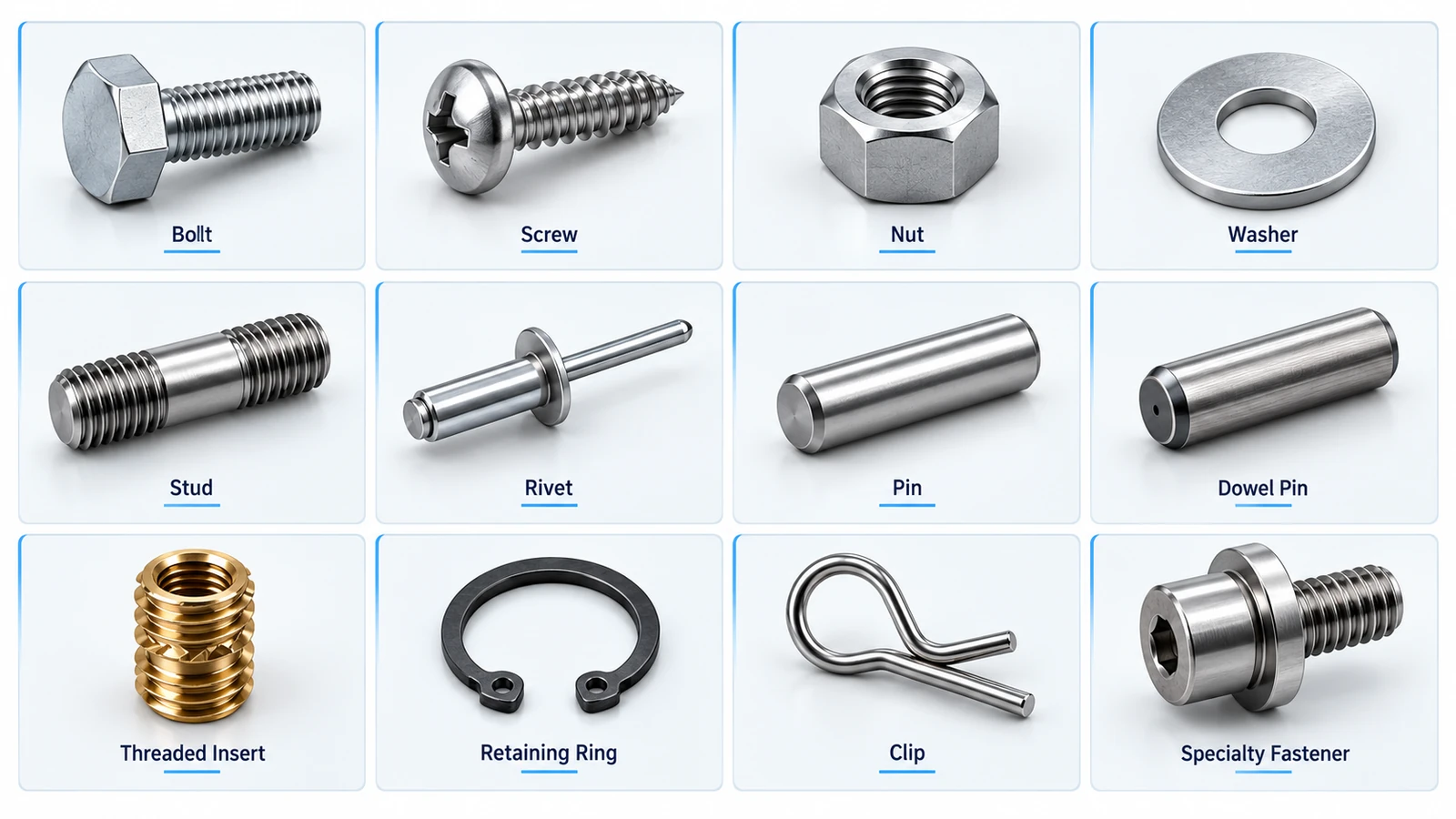
12 Common Types of Fasteners
1. Bolts
Bolts are threaded fasteners normally inserted through clearance holes and secured with a nut. Tightening the nut creates clamping force between the assembled parts.
Common bolt styles include:
- Hex bolts
- Socket head bolts
- Carriage bolts
- Flange bolts
Bolts are widely used in machinery, equipment, automotive assemblies, and structures where a strong removable joint is required.
2. Screws
Screws usually engage directly with an internally threaded hole rather than requiring a separate nut. In CNC machined parts, machine screws and socket head cap screws are especially common.
Typical types include:
- Machine screws
- Socket head cap screws
- Flat-head screws
- Self-tapping screws
Socket head screws work well in compact assemblies because they require less surrounding tool clearance. Flat-head screws are commonly used with countersunk holes when the head must sit flush with the surface.
3. Nuts
Nuts contain internal threads and are normally used with bolts or studs.
Common types include:
- Hex nuts
- Lock nuts
- Flange nuts
Hex nuts suit general-purpose assemblies, while lock nuts help reduce loosening in vibrating equipment. Flange nuts provide a larger bearing surface and can distribute clamping force over a wider area.
Nut size, thread pitch, material, and strength class should match the mating fastener.
4. Washers
Washers are thin components placed beneath a bolt head, screw head, or nut.
They are mainly used to:
- Distribute clamping force
- Protect component surfaces
- Reduce local deformation
- Support locking systems
Flat washers are the most common. Spring or locking washers may also be used, although high-vibration joints often require more robust locking methods.
Washers are particularly useful when fastening softer materials such as aluminum or engineering plastics.
5. Studs
Studs are threaded rods or shafts without a conventional bolt head. They may be threaded along their full length or only at the ends.
One end is often installed into a component while the exposed end accepts a nut.
Typical applications include:
- Engines
- Flanges
- Pumps
- Valves
- Heavy machinery
Studs are useful for assemblies that are removed repeatedly because the internal thread in the main component does not need to be engaged and disengaged each time.
6. Rivets
Rivets create permanent or semi-permanent mechanical joints. During installation, the rivet passes through aligned holes and one end is deformed or expanded.
Common examples include:
- Solid rivets
- Blind rivets
- Structural rivets
Rivets are widely used in sheet metal, aircraft structures, enclosures, and automotive assemblies. Unlike bolts and screws, they are not normally intended for repeated disassembly.
7. Pins
Pins are non-threaded fasteners used for positioning, pivoting, securing, or retaining parts.
Common examples include:
- Clevis pins
- Spring pins
- Cotter pins
Clevis pins are often used in pivoting joints, while spring pins rely on elastic interference to remain inside a hole.
Pins are common in machinery, linkages, hinges, and fixtures where positioning or movement is more important than clamping force.
8. Dowel Pins
Dowel pins are precision cylindrical pins mainly used to align components accurately.
They are common in:
- Machining fixtures
- Mold assemblies
- Gearboxes
- Machine housings
- Precision equipment
Unlike bolts, which mainly provide clamping force, dowel pins provide repeatable positioning.
A typical precision assembly may use:
dowel pins for alignment + screws or bolts for clamping.
Hole tolerance and fit are critical when accurate location is required.
9. Threaded Inserts
Threaded inserts provide durable internal threads in materials that may not perform well with repeated direct threading.
They are commonly used in:
Common designs include wire-thread inserts, press-fit inserts, and heat-set inserts.
They are useful when a part must be assembled and removed repeatedly or when the base material is too soft to provide durable threads. Inserts can also repair damaged threaded holes.
10. Retaining Rings
Retaining rings, also called snap rings or circlips, fit into grooves on shafts or inside bores to prevent axial movement.
Typical applications include:
- Bearings
- Shaft assemblies
- Gear assemblies
- Motors
- Gearboxes
External retaining rings fit onto shafts, while internal rings fit inside bores.
They provide a compact alternative to locknuts or threaded shaft ends when axial retention is the main requirement.
11. Clips
Clips use spring force or geometric engagement to hold parts in place.
Typical examples include:
- Spring clips
- Panel clips
- Wire clips
- Retaining clips
They are useful where fast installation and removal matter more than maximum joint strength.
Clips are common in enclosures, panels, automotive interiors, and light mechanical assemblies.
12. Specialty and Custom Fasteners
Standard fasteners cover most assemblies, but some applications require unusual geometry, materials, or tolerances.
Examples include:
- Custom threaded studs
- Precision locating pins
- Shoulder screws
- Special spacers
- Custom threaded shafts
Custom fasteners may be required when standard hardware cannot meet requirements for size, temperature, corrosion resistance, weight, geometry, or positioning accuracy.
They can often be produced by CNC turning, Swiss machining, or mill-turn machining.
Threaded vs Non-Threaded Fasteners
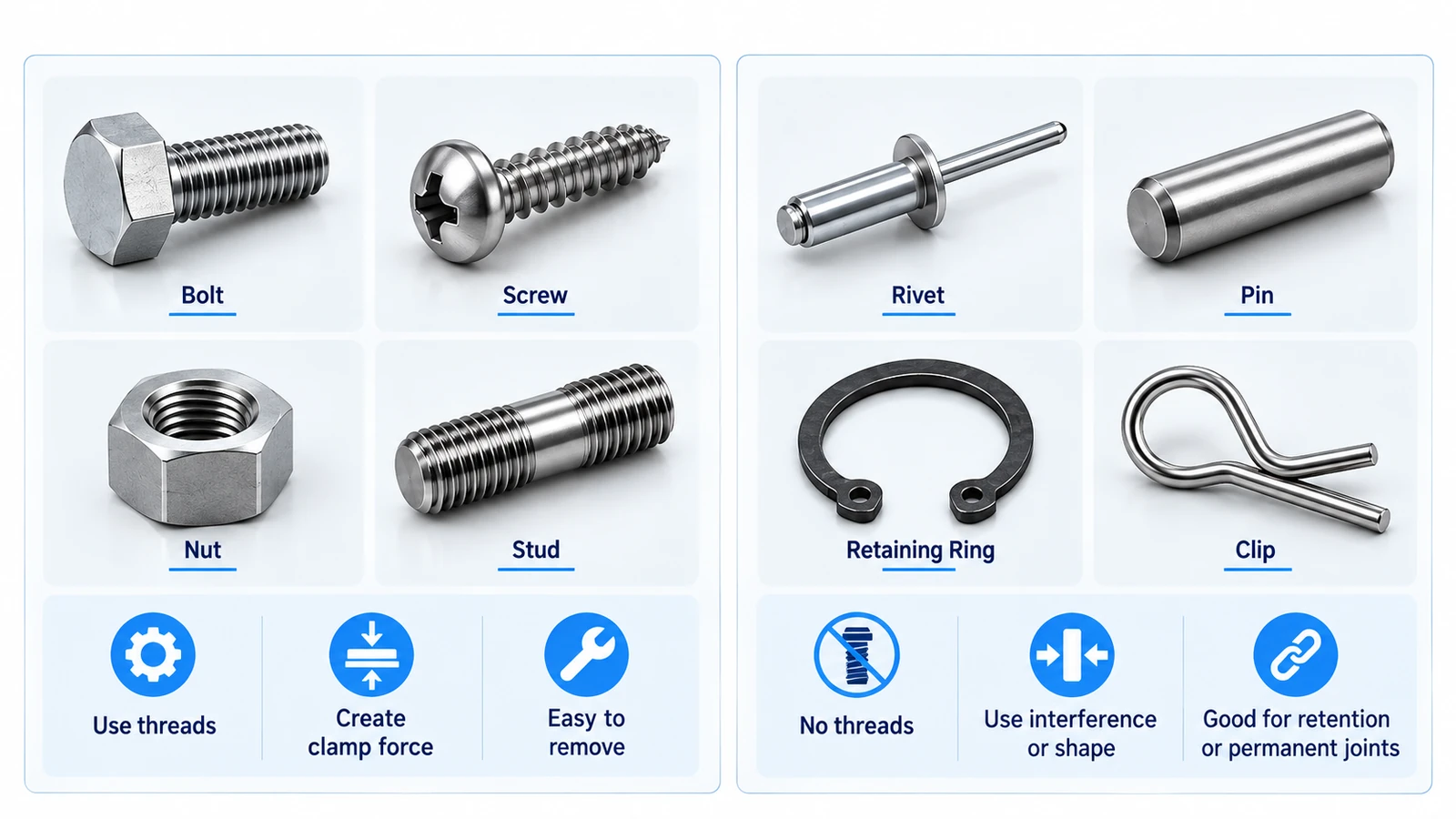
One of the simplest ways to compare fastener types is by whether they use threads.
| Feature | Threaded Fasteners | Non-Threaded Fasteners |
|---|---|---|
| Examples | Bolts, screws, nuts, studs | Rivets, pins, retaining rings |
| Typical removal | Easy | Depends on design |
| Adjustment | Good | Limited |
| Assembly method | Thread engagement | Pressing, deformation, or retention |
| Main purpose | Clamping and removable joints | Alignment, retention, permanent joining |
Threaded fasteners are generally preferred when maintenance or repeated disassembly is required.
Non-threaded fasteners are often better for alignment, compact retention, rapid installation, or permanent joining.
Permanent vs Removable Fasteners
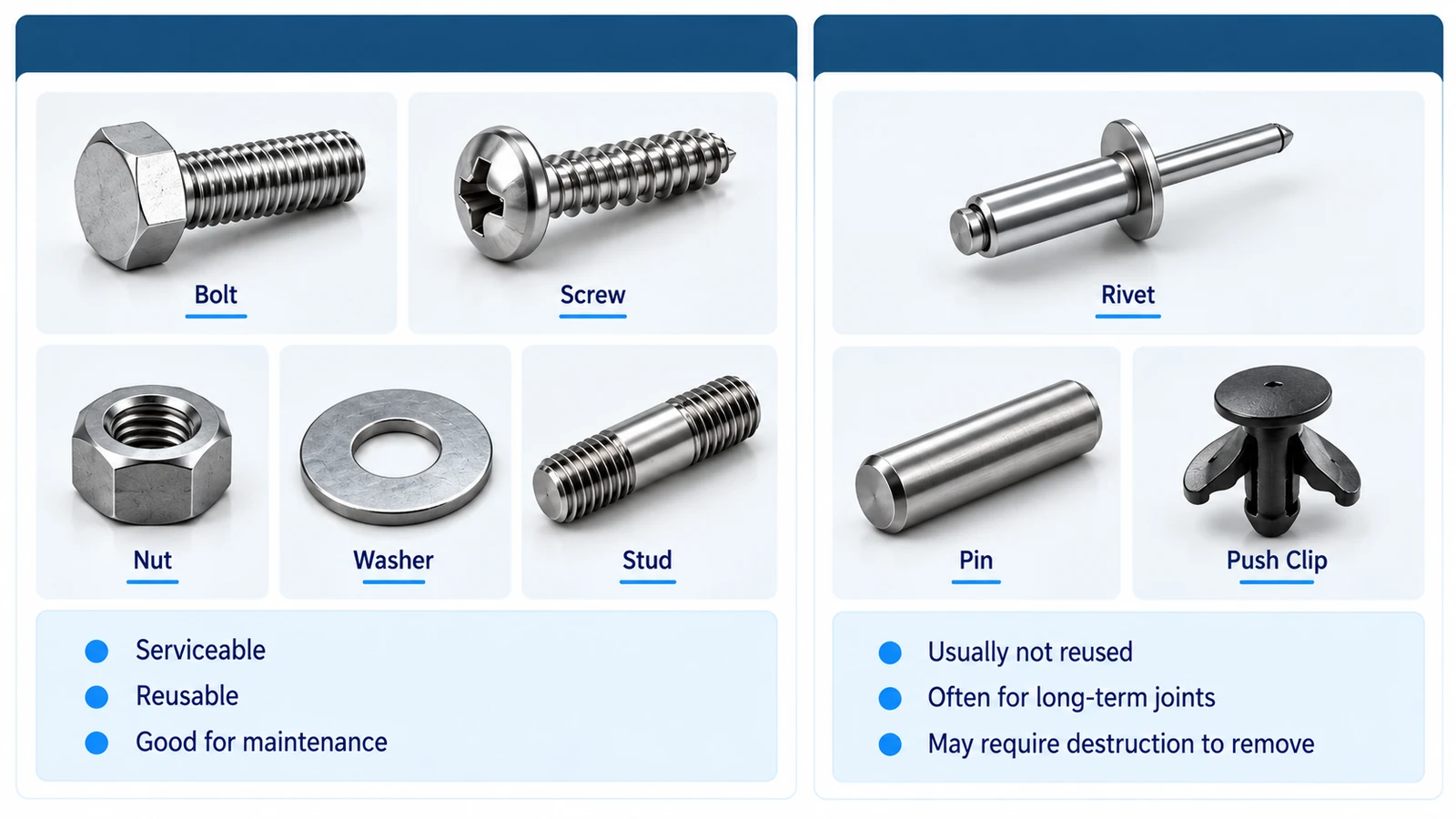
Removable fasteners include bolts, screws, nuts, studs, and many retaining rings. They are suitable for equipment that requires maintenance, adjustment, or inspection.
Permanent or semi-permanent fasteners include rivets and some press-fit pins. These can often be removed, but removal may damage the fastener or require additional work.
The choice depends on how often the assembly must be serviced during its life.
Common Fastener Materials
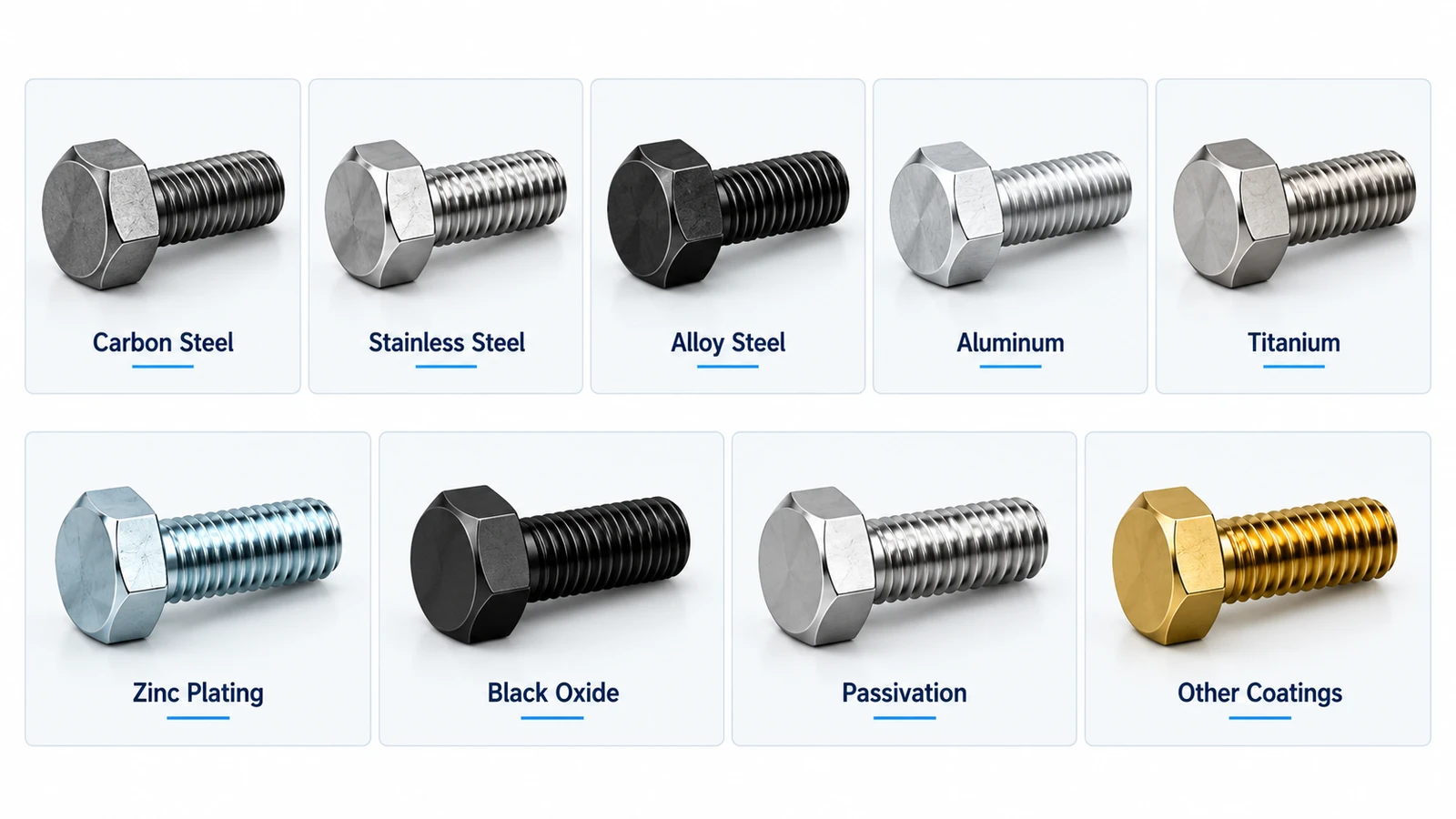
Fastener material affects strength, corrosion resistance, weight, temperature capability, and cost.
Carbon Steel
Carbon steel is widely used because it provides good strength at relatively low cost. Zinc plating or other coatings are often added for corrosion protection.
Stainless Steel
Stainless steel is commonly used in wet, outdoor, food-processing, medical, and chemically exposed environments.
304 and 316 stainless steel are frequent choices where corrosion resistance is important.
Alloy Steel
Alloy steel is commonly used for high-strength bolts, screws, and studs. Heat treatment can significantly improve strength and hardness.
Aluminum
Aluminum fasteners are lightweight and corrosion resistant but generally weaker than steel fasteners. They are useful where weight reduction is important.
Titanium
Titanium combines high specific strength with excellent corrosion resistance and is commonly used in aerospace, medical, marine, and other demanding applications.
Fastener material is only part of the selection. Surface finishes such as zinc plating, black oxide, passivation, or other protective coatings may also be used to improve corrosion resistance or surface performance.
How to Choose the Right Fastener
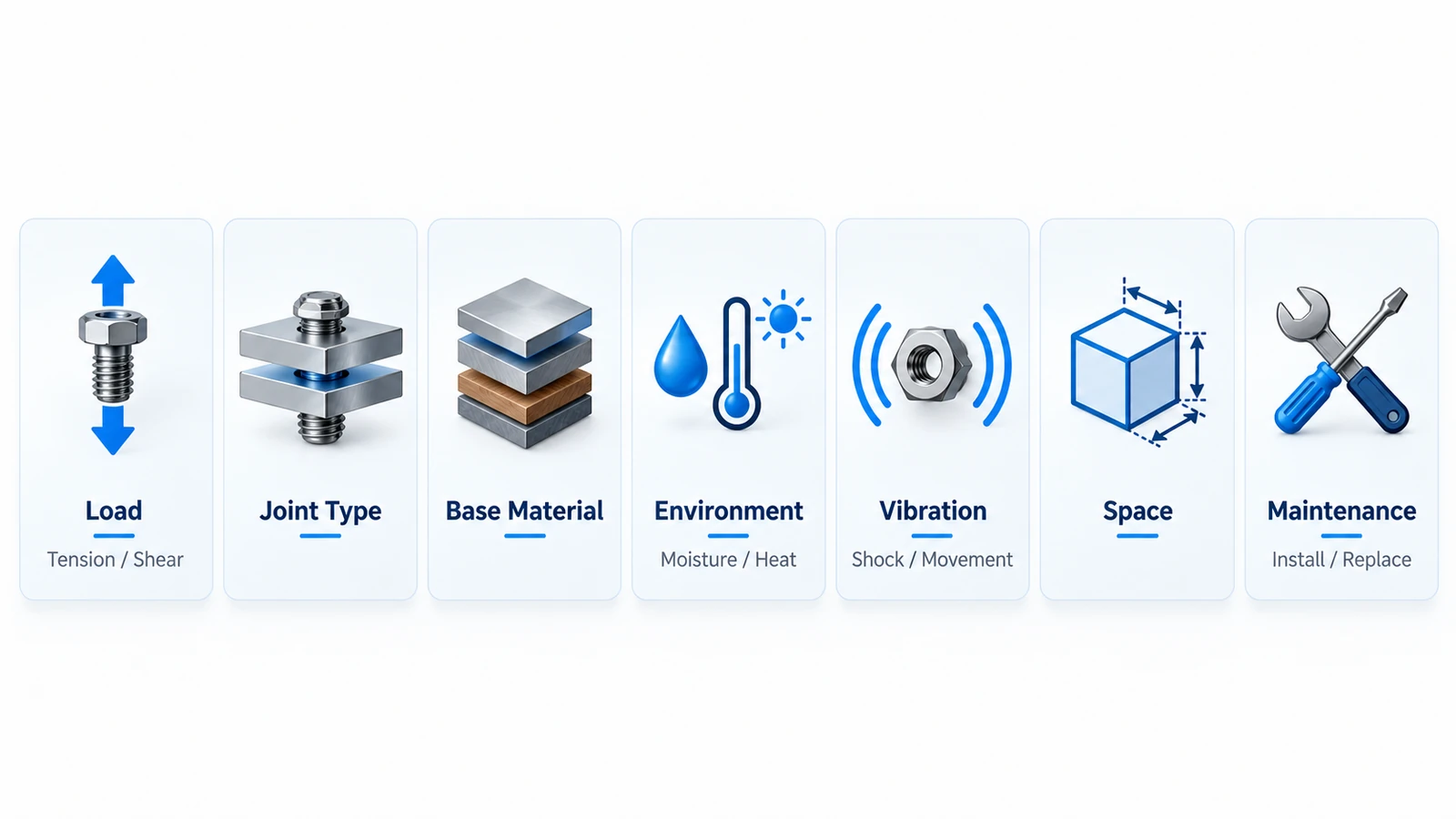
Proper fastener selection requires more than matching thread diameter.
1. Consider the Load
Determine how the joint will be loaded.
Tensile load pulls along the fastener axis, while shear load acts across it. Some joints experience both.
Fastener diameter, material, strength class, thread engagement, and quantity should reflect the expected load.
2. Decide Whether the Joint Must Be Removable
Bolts and screws are usually better for serviceable assemblies.
For permanent sheet-metal joints, rivets may be more suitable.
3. Consider the Base Material
Repeatedly tightening a screw directly into soft aluminum or plastic can damage the threads.
Threaded inserts may provide better durability in these materials.
4. Check the Operating Environment
Consider exposure to:
- Moisture
- Salt
- Chemicals
- Heat
- Temperature cycling
Material and coating choices should limit corrosion or strength loss during service.
5. Account for Vibration
Machine tools, motors, vehicles, pumps, and automation equipment can experience repeated vibration.
Where loosening is a concern, locking nuts, locking compounds, or mechanical locking systems may be required.
6. Check Installation Space
Head style affects tool access.
A hex bolt requires wrench clearance, while a socket head screw works better in tighter spaces.
A countersunk screw is useful when the top surface must remain flush.
7. Consider Maintenance Frequency
Assemblies that require regular access should use fasteners that tolerate repeated installation and removal.
This can affect thread material, insert selection, screw head style, and tool access.
Fasteners in CNC Machined Parts
Fastener selection directly affects the geometry of CNC machined components.
The drawing should define the fastener size together with hole type, thread depth, head clearance, and positional requirements.
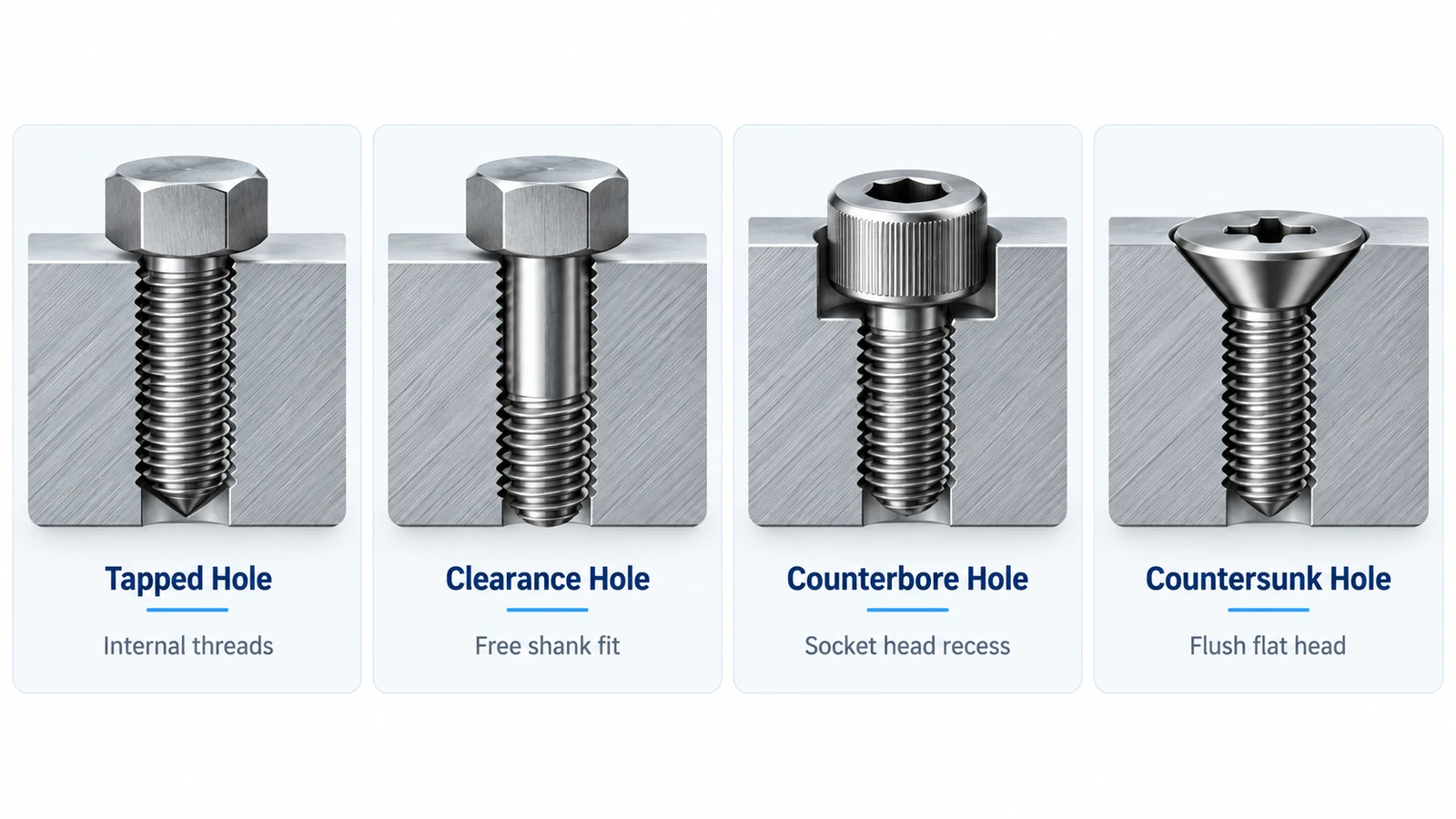
Tapped Holes
Tapped holes contain internal threads so screws can fasten directly into the machined part.
Common metric sizes include M3, M4, M5, M6, and M8.
Blind tapped holes require extra depth below the usable thread because the drill point and tap geometry cannot produce full threads all the way to the bottom.
Clearance Holes
A clearance hole is slightly larger than the fastener shank, allowing a bolt or screw to pass through freely.
The fastener then clamps the parts together using a nut or threaded feature in another component.
Counterbore Holes
A counterbore is a cylindrical recess that allows the fastener head to sit below or near the surrounding surface.
Socket head cap screws are commonly used with counterbores.
They are useful where a protruding screw head could interfere with another component or mechanism.
Countersunk Holes
Countersunk holes use a conical recess designed for flat-head screws.
When properly sized, the screw head sits flush with the surrounding surface.
This is useful for panels, housings, sliding surfaces, and other designs where protruding hardware is undesirable.
Threaded Inserts
Threaded inserts are often used in machined aluminum and plastic parts when repeated assembly is expected.
They improve thread durability and reduce the risk of damaging the parent material during servicing.
Quick Fastener Selection Guide
| If You Need… | Consider |
|---|---|
| Strong removable joint | Bolt and nut |
| Fastener directly into a tapped hole | Machine screw |
| Permanent sheet-metal joint | Rivet |
| Accurate component alignment | Dowel pin |
| Strong reusable threads in soft material | Threaded insert |
| Axial shaft retention | Retaining ring |
| Better resistance to loosening | Locking fastener system |
| Flush external surface | Countersunk screw |
| Compact fastener access | Socket head screw |
| Repeated assembly and maintenance | Bolt, screw, or stud |
There is rarely one fastener that is best for every application. The right choice depends on how the parts are loaded, assembled, serviced, and manufactured.
Frequently Asked Questions
The most common mechanical fasteners include bolts, screws, nuts, washers, studs, rivets, pins, dowel pins, threaded inserts, retaining rings, and clips.
A bolt typically passes through clearance holes and is secured with a nut. A screw usually engages directly with an internally threaded hole or material.
Threaded fasteners use mating threads to create or maintain a joint. Non-threaded fasteners such as rivets, pins, and retaining rings rely on deformation, interference, or geometry.
Bolts and screws are generally preferred for removable joints because they can be loosened and reused. The exact choice depends on load, access, material, and maintenance requirements.
CNC machined assemblies commonly use machine screws, socket head cap screws, bolts, dowel pins, studs, threaded inserts, and retaining rings.
Threaded inserts are useful when the base material is relatively soft or when a component will be assembled and disassembled repeatedly. Aluminum and engineering plastics are common applications.



