

Non-ferrous metals are metals and alloys in which iron is not the primary base metal. Common examples include aluminum, copper, brass, bronze, titanium, magnesium, and nickel-based alloys.
These materials are widely used in aerospace, automotive, electronics, medical, and industrial applications because they can provide low weight, corrosion resistance, conductivity, wear resistance, or a high strength-to-weight ratio.
However, non-ferrous metals behave very differently in manufacturing. Aluminum and brass are generally easy to machine, while titanium and nickel-based alloys require much more careful control of heat, cutting conditions, and tool wear.
Understanding these differences helps engineers and buyers select a material that meets both part performance and manufacturing requirements.
What Are Non-Ferrous Metals?
A non-ferrous metal is a metal or alloy in which iron is not the primary constituent.
This distinguishes non-ferrous materials from ferrous metals such as carbon steel, alloy steel, stainless steel, and cast iron, where iron forms the main metallic base.
Common non-ferrous metal examples include:
- Aluminum
- Copper
- Brass
- Bronze
- Titanium
- Magnesium
- Nickel-based alloys
The term does not necessarily mean that a material contains absolutely no iron. Some non-ferrous alloys may contain small amounts of iron as an alloying element or impurity while still being classified as non-ferrous.
Common Properties of Non-Ferrous Metals
The properties of non-ferrous metals vary widely, but several characteristics are commonly associated with this group.
Corrosion Resistance
Many non-ferrous metals offer good corrosion resistance because they do not form iron oxide rust like ordinary carbon steel.
Aluminum, titanium, copper alloys, and nickel-based alloys can all perform well in corrosive environments, depending on the specific grade and service conditions.
Low Weight
Aluminum, magnesium, and titanium are widely used where weight reduction matters.
However, not all non-ferrous metals are lightweight. Copper and nickel, for example, are considerably denser than aluminum.
Electrical and Thermal Conductivity
Copper is widely used for electrical and thermal applications because of its excellent conductivity.
Aluminum also provides good conductivity at a much lower weight, making it useful for electrical systems, heat sinks, and thermal components.
Non-Magnetic Properties
Many non-ferrous metals are non-magnetic or only weakly magnetic.
This makes materials such as aluminum, copper, brass, and titanium useful in electronics, instrumentation, and applications where magnetic interference must be minimized.
Strength-to-Weight Ratio
Titanium and high-strength aluminum alloys such as 7075 are often selected where high strength is required without excessive weight.
This is one reason they are widely used in aerospace, robotics, motorsport, and high-performance equipment.
Common Types of Non-Ferrous Metals
The following are among the most common types of non-ferrous metals used in CNC machining and precision manufacturing.
| Metal | Typical Grades or Alloys | Main Advantages | Typical Parts |
|---|---|---|---|
| Aluminum | 6061, 7075, 2024, 5052 | Lightweight, machinable, corrosion resistant | Housings, brackets, frames |
| Copper | C101, C110 | Excellent electrical and thermal conductivity | Busbars, electrodes, thermal parts |
| Brass | C360 | Excellent machinability, good appearance | Fittings, connectors, turned parts |
| Bronze | Bearing bronze, aluminum bronze | Wear resistance, low friction | Bushings, bearings, gears |
| Titanium | Grade 2, Grade 5 | High strength-to-weight ratio, corrosion resistance | Aerospace and medical parts |
| Magnesium | AZ31, AZ91 | Very low weight, good machinability | Lightweight housings |
| Nickel-Based Alloys | Inconel families | High-temperature and corrosion resistance | Aerospace and high-temperature parts |
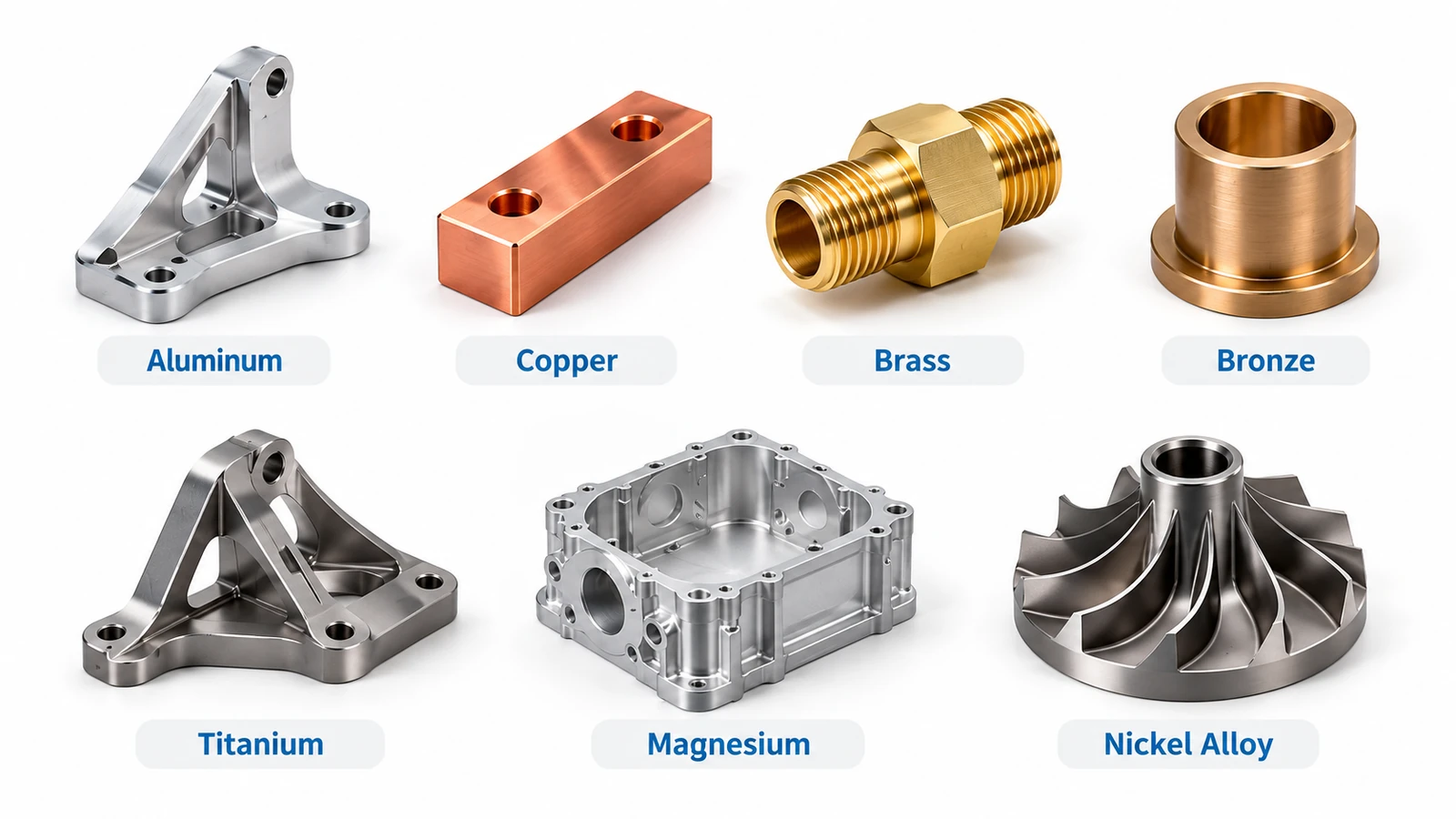
Aluminum
Aluminum is one of the most widely used non-ferrous metals in CNC machining.
Common machining grades include 6061, 7075, 2024, 5052, and MIC-6. Aluminum combines low density, good machinability, corrosion resistance, and a wide range of finishing options.
6061 is commonly used for general-purpose parts, while 7075 is preferred when higher strength is required.
Typical applications include housings, brackets, machine components, robotics parts, aerospace structures, and fixtures.
Aluminum also works well with anodizing, hard anodizing, bead blasting, and powder coating.
Copper
Copper is mainly selected for its excellent electrical and thermal conductivity.
Common grades such as C101 and C110 are used in:
- Electrical contacts
- Busbars
- Electrodes
- Heat transfer components
- Power distribution parts
Pure copper can be relatively soft and ductile, which may increase burr formation, tool adhesion, and chip-control problems during machining.
Sharp tools and suitable cutting conditions are important for maintaining surface quality and dimensional accuracy.
Brass
Brass is a copper-zinc alloy known for excellent machinability.
Free-machining grades such as C360 are well suited to CNC turning, Swiss machining, drilling, and threading.
Typical applications include:
- Fittings
- Connectors
- Valves
- Bushings
- Electrical components
- Precision turned parts
Brass machines cleanly, supports relatively high cutting speeds, and is one of the easiest common non-ferrous metals to machine for small precision parts.
Bronze
Bronze refers to a family of copper-based alloys commonly containing tin, aluminum, silicon, or other alloying elements.
Compared with brass, bronze is more often selected for wear resistance, friction performance, and durability in sliding applications.
Typical uses include bushings, bearings, gears, wear plates, and marine components.
Machinability varies by alloy, but many engineering bronzes machine well with appropriate tooling.
Titanium
Titanium is valued for its high strength-to-weight ratio, corrosion resistance, and biocompatibility.
Common machining grades include:
- Grade 2 commercially pure titanium
- Grade 5 Ti-6Al-4V
Titanium is widely used in aerospace, medical, marine, and high-performance industrial applications.
Unlike aluminum or brass, titanium is relatively difficult to machine because its low thermal conductivity keeps more heat near the cutting edge, accelerating tool wear.
Rigid setups, suitable cutting tools, controlled feeds and speeds, and effective cooling are important when machining titanium parts.
Magnesium
Magnesium is one of the lightest structural metals available.
It offers very low density, good machinability, and useful vibration-damping characteristics.
Common alloys include AZ31 and AZ91, which are used in lightweight housings, electronics, automotive parts, and aerospace components.
Magnesium is generally easy to machine, but chip handling requires extra care because fine magnesium chips can present a fire risk.
Nickel-Based Alloys
Nickel-based alloys are used where high-temperature strength and corrosion resistance are more important than machining speed.
Common examples include Inconel families used in aerospace engines, turbine components, chemical processing equipment, and other severe environments.
These alloys are difficult to machine because they can work harden rapidly and generate significant cutting heat.
Tool selection, machine rigidity, coolant control, and stable cutting conditions are especially important.
Ferrous vs Non-Ferrous Metals
The main difference is whether iron is the primary metallic base.
| Property | Ferrous Metals | Non-Ferrous Metals |
|---|---|---|
| Primary base | Iron | Aluminum, copper, titanium, etc. |
| Typical weight | Often heavier | Many options are lightweight |
| Corrosion resistance | Varies by alloy | Often good |
| Magnetism | Many are magnetic | Many are non-magnetic |
| Conductivity | Usually lower | Copper and aluminum are excellent |
| Strength | Often high | Varies widely |
| Cost | Often lower | Can be higher |
| Common examples | Carbon steel, alloy steel, stainless steel, cast iron | Aluminum, copper, brass, bronze, titanium |
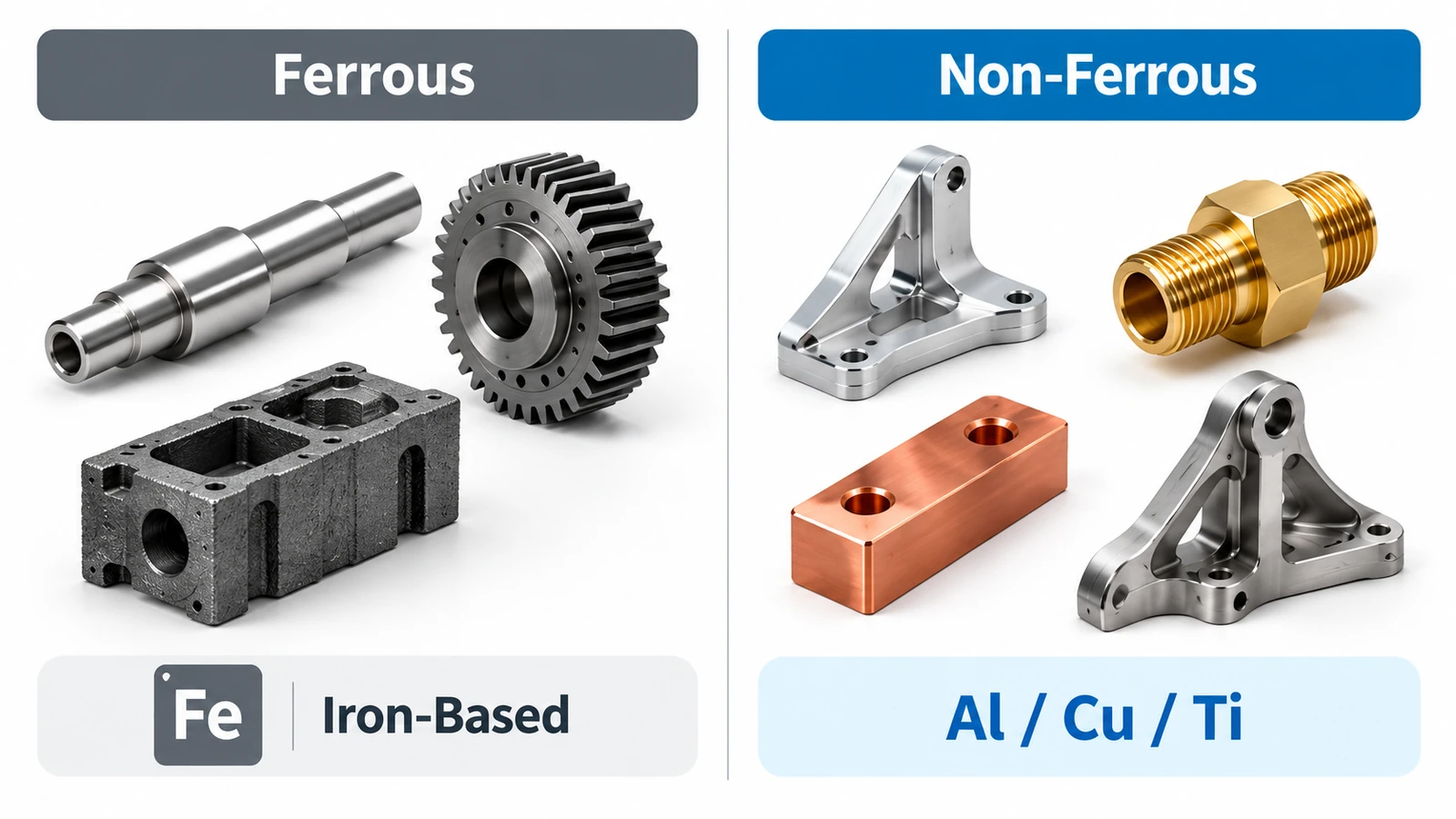
These are general tendencies rather than strict rules.
Stainless steel, for example, is ferrous but can provide excellent corrosion resistance. Titanium is non-ferrous but can provide very high strength. Some stainless steels also have very low magnetic response.
For engineering applications, the specific alloy grade is usually more important than the broad ferrous or non-ferrous classification.
CNC Machining Non-Ferrous Metals
Non-ferrous metals vary greatly in machinability.
Some support high cutting speeds and produce clean chips, while others require slower machining, stronger heat control, and closer tool monitoring.
| Material | Machinability | Typical Machining Concern |
|---|---|---|
| Aluminum | Excellent | Built-up edge on softer grades |
| Brass | Excellent | Usually few major issues |
| Bronze | Good | Tool wear varies by alloy |
| Copper | Moderate | Burrs, tool adhesion, heat |
| Magnesium | Excellent | Chip and fire management |
| Titanium | Difficult | Heat concentration and tool wear |
| Nickel-based alloys | Difficult | Work hardening and cutting heat |
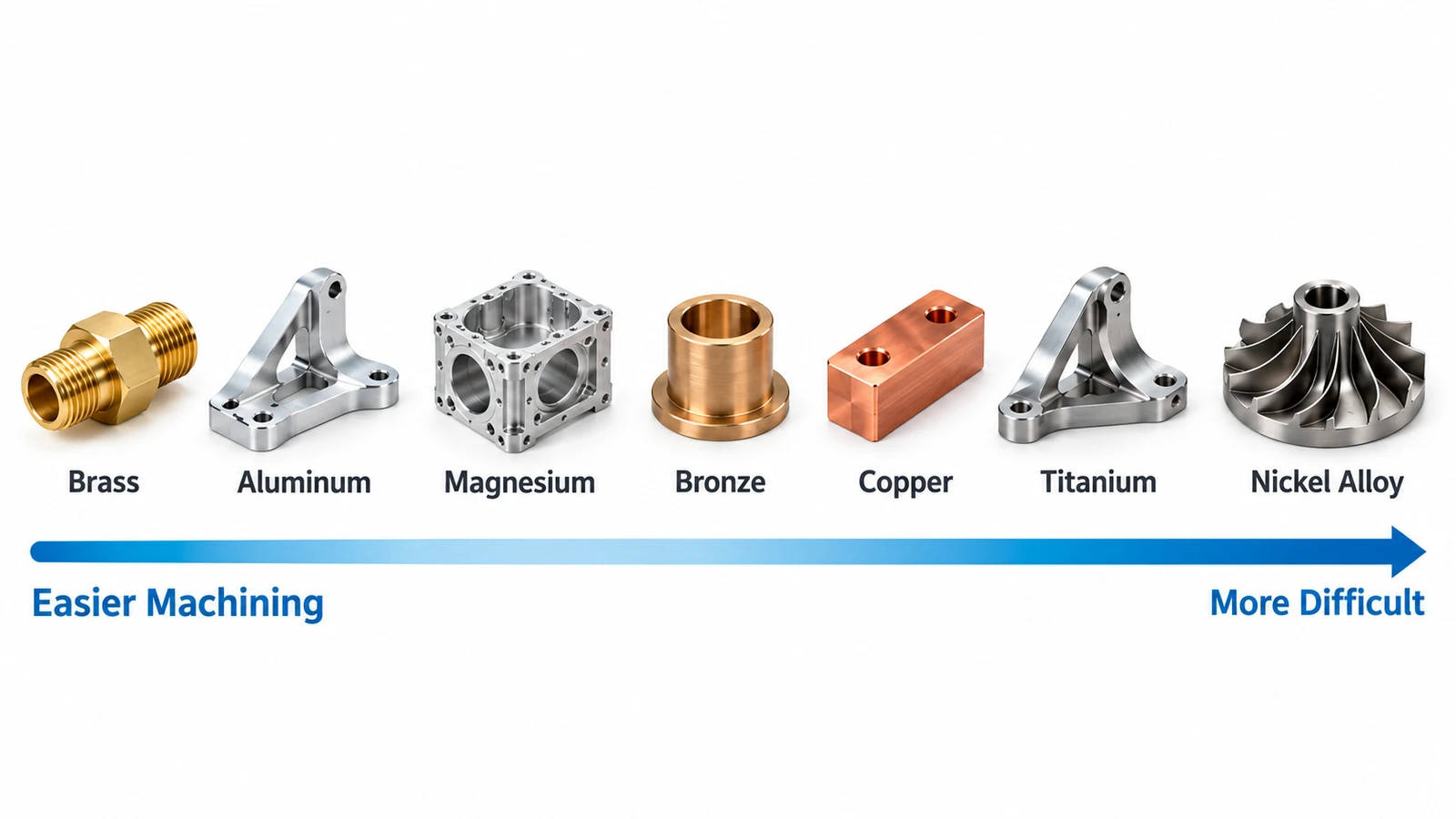
Aluminum and brass are generally well suited to high-productivity CNC milling and turning.
Copper may require sharper tooling and better chip control, while titanium and nickel-based alloys usually need lower cutting speeds, rigid workholding, and stronger thermal management.
These differences directly affect cycle time, tool life, surface finish, and total machining cost.
How to Choose a Non-Ferrous Metal
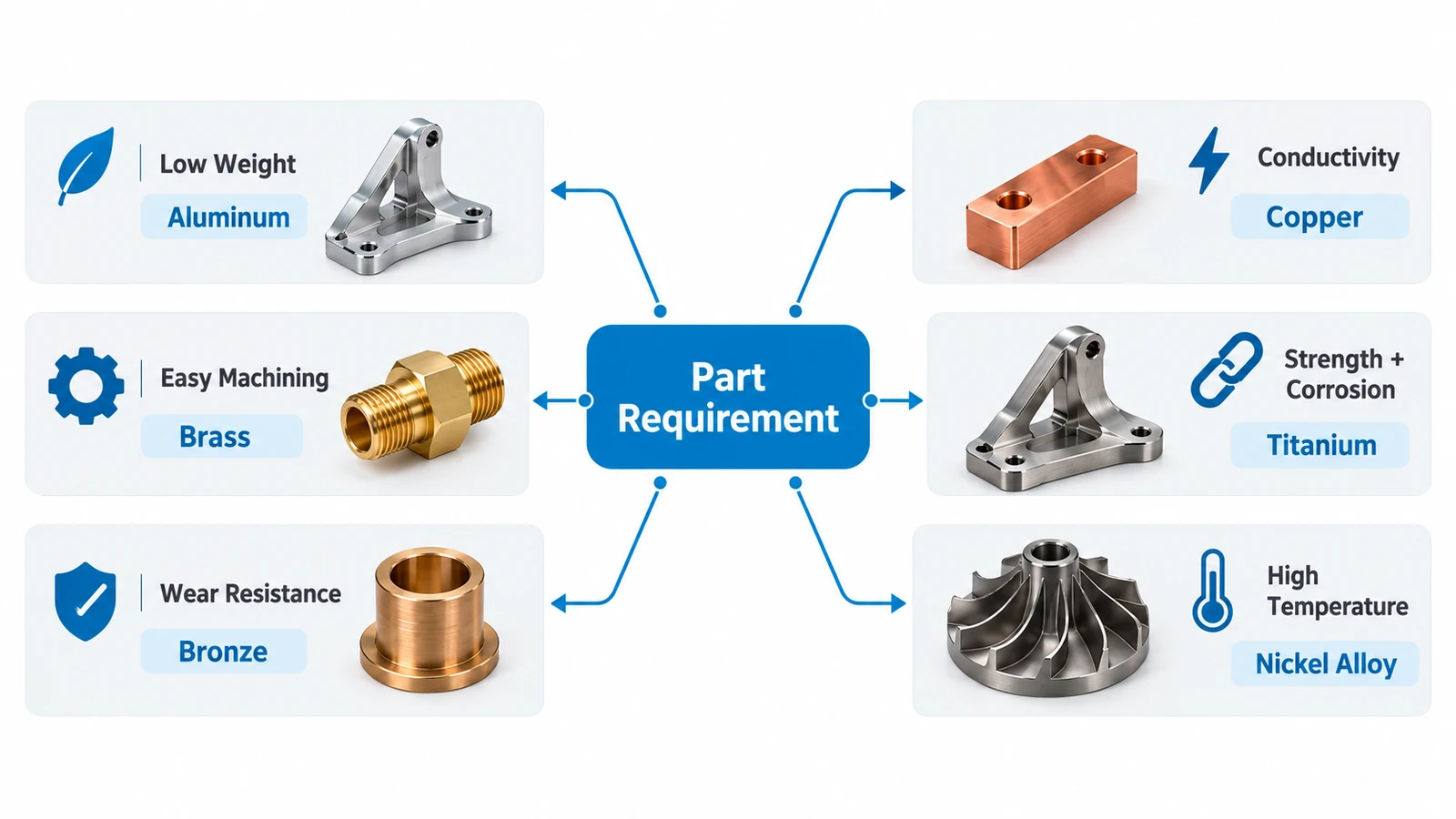
The right material depends on what the part needs to do and how it will be manufactured.
Choose Aluminum When You Need
- Low weight
- Good machinability
- Moderate material cost
- Corrosion resistance
- Anodizing or cosmetic finishing
Aluminum is a practical choice for housings, brackets, frames, robotic parts, and prototypes.
Choose Brass When You Need
- Excellent machinability
- Precision turning
- Threads and small features
- Good surface appearance
- Corrosion resistance
Brass is especially suitable for fittings, connectors, valves, and precision turned parts.
Choose Copper When You Need
- High electrical conductivity
- High thermal conductivity
- Electrical contact performance
- Heat transfer capability
Copper is usually selected because conductivity is critical rather than because it is easy to machine.
Choose Bronze When You Need
- Wear resistance
- Low-friction sliding performance
- Bearing surfaces
- Bushings
- Gears
Bronze is especially useful in parts exposed to repeated contact and wear.
Choose Titanium When You Need
- High strength at relatively low weight
- Excellent corrosion resistance
- Biocompatibility
- Aerospace or medical performance
Titanium is more expensive to machine than aluminum, so it is usually selected when its performance advantages justify the higher manufacturing cost.
Choose Nickel-Based Alloys When You Need
- High-temperature strength
- Oxidation resistance
- Severe corrosion resistance
- Performance in demanding industrial environments
These alloys are rarely chosen for low-cost machining but can outperform many alternatives under extreme service conditions.
Applications of Non-Ferrous Metals
Non-ferrous metals are used across many manufacturing industries.
| Industry | Common Materials | Typical Applications |
|---|---|---|
| Aerospace | Aluminum, titanium, nickel-based alloys | Brackets, housings, structural parts |
| Medical | Titanium, aluminum | Instruments, implants, equipment components |
| Electronics | Copper, aluminum, brass | Connectors, heat sinks, electrical parts |
| Automotive | Aluminum, magnesium, copper | Housings, thermal parts, lightweight components |
| Robotics | Aluminum, brass, bronze | Frames, joints, bushings |
| Industrial Equipment | Aluminum, bronze, brass | Fixtures, housings, wear components |
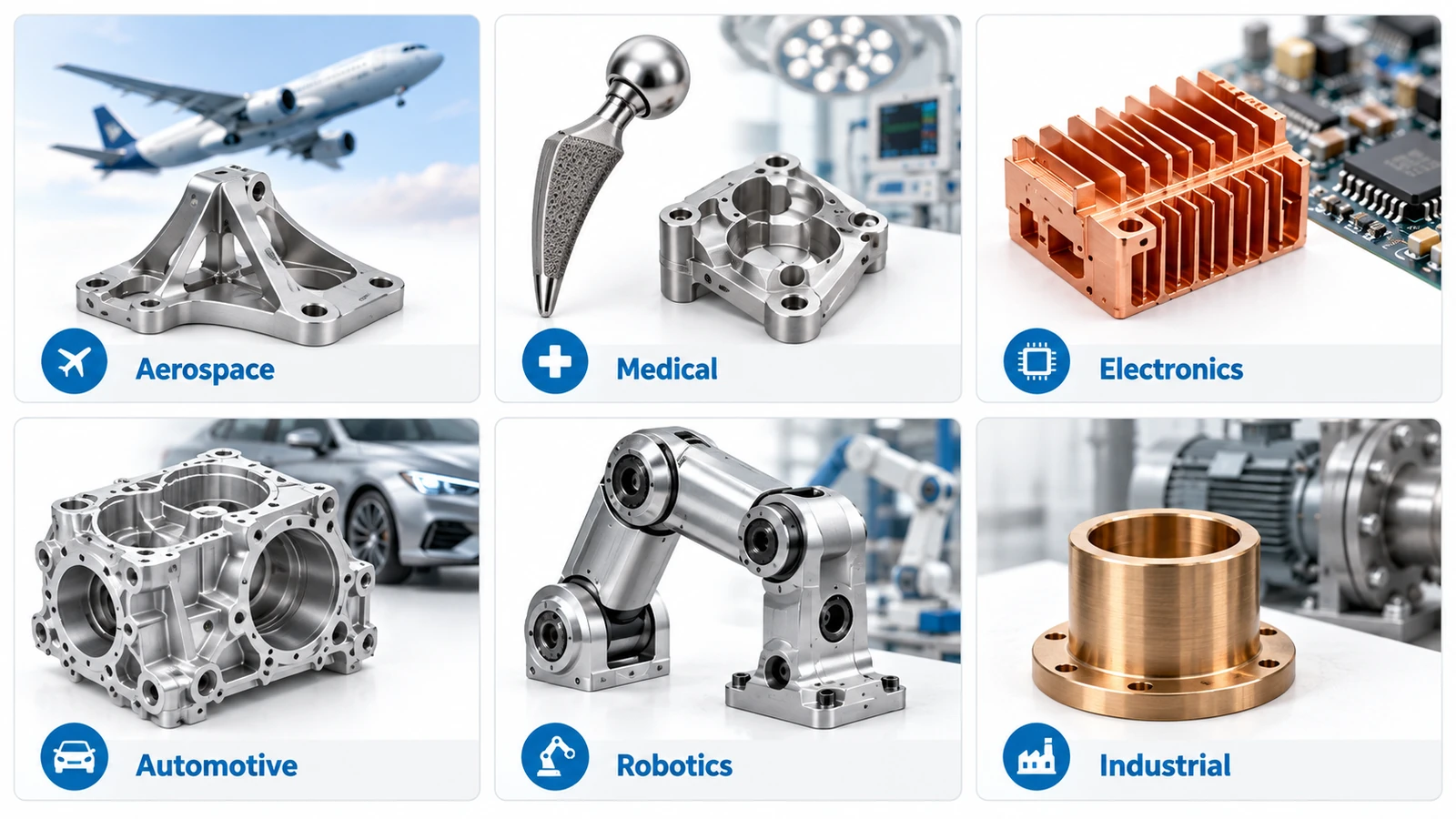
The right material depends on weight, strength, corrosion resistance, conductivity, wear, operating temperature, and manufacturing cost.
Advantages and Limitations of Non-Ferrous Metals
| Advantages | Limitations |
|---|---|
| Lightweight material options | Some alloys are expensive |
| Good corrosion resistance | Properties vary widely between alloys |
| Excellent conductivity options | Some grades are difficult to machine |
| Non-magnetic options | Some lightweight metals have lower stiffness |
| Good finishing possibilities | Material choice can increase machining cost |
Non-ferrous metals are not automatically better than ferrous metals. The best choice depends on part function, environment, tolerance requirements, production volume, and manufacturing process.
Conclusion
Non-ferrous metals include aluminum, copper, brass, bronze, titanium, magnesium, and nickel-based alloys. Depending on the alloy, they can provide low weight, corrosion resistance, conductivity, wear resistance, or high strength-to-weight performance.
For CNC parts, material selection should consider not only mechanical properties but also machinability, tolerance, finishing, production volume, and total cost. Choosing the right alloy early can improve part performance while reducing machining difficulty and unnecessary expense.
Frequently Asked Questions
Non-ferrous metals are metals and alloys in which iron is not the primary base material. Common examples include aluminum, copper, brass, bronze, titanium, magnesium, and nickel-based alloys.
Common non-ferrous metal examples include aluminum, copper, brass, bronze, titanium, magnesium, nickel, tin, zinc, and lead.
For CNC machining, aluminum, brass, copper, bronze, and titanium are among the most commonly used.
Yes. Aluminum is a non-ferrous metal because iron is not its primary metallic base.
It is widely used because of its low weight, good machinability, corrosion resistance, and broad range of available alloys.
Stainless steel is a ferrous metal because iron is its primary base material.
Its chromium content provides corrosion resistance, but it is still classified as a ferrous alloy.
Yes. Titanium is a non-ferrous metal.
It is widely used in aerospace, medical, marine, and industrial applications because of its high strength-to-weight ratio and corrosion resistance.
Free-machining brass and many aluminum alloys are among the easiest common non-ferrous metals to CNC machine.
Actual machinability still depends on the specific alloy, temper, part geometry, tolerance, and machining process.



