

Milling operations are different ways a rotating cutting tool removes material to create specific features on a workpiece. Depending on the cutter, toolpath, and part geometry, milling can produce flat surfaces, shoulders, slots, pockets, contours, threads, gears, and other complex features.
Common types of milling operations include face milling, peripheral milling, end milling, shoulder milling, slot milling, pocket milling, profile milling, angular milling, form milling, thread milling, gear milling, and plunge milling.
The right operation depends mainly on the feature being machined, the required accuracy and surface finish, the material, and the available CNC machine.
What Is a Milling Operation?
A milling operation describes how material is removed and what type of geometry is being produced.
For example, face milling creates flat surfaces, while slot milling produces narrow channels and pocket milling removes material inside a defined area.
It is also important not to confuse milling operations with machine configurations.
- Face milling and slot milling are machining operations.
- 3-axis milling and 5-axis milling describe machine motion and capability.
- Vertical milling and horizontal milling describe machine configuration.
These CNC milling operations can often be combined within the same setup to produce multiple part features efficiently.
12 Common Types of Milling Operations
| Milling Operation | Main Feature Produced | Typical Applications |
|---|---|---|
| Face Milling | Flat surface | Datum faces, plates, housings |
| Peripheral Milling | Flat or side surface | Side faces, large flat areas |
| End Milling | General features | Slots, profiles, pockets |
| Shoulder Milling | 90° wall and floor | Steps, ledges, housing walls |
| Slot Milling | Narrow channel | Keyways, grooves, slots |
| Pocket Milling | Internal cavity | Housings, molds, brackets |
| Profile Milling | External or 3D contour | Curved parts, molds, aerospace components |
| Angular Milling | Angled surface | V-grooves, dovetails, bevels |
| Form Milling | Predefined profile | Radii, special grooves, formed surfaces |
| Thread Milling | Internal or external thread | Precision threaded holes |
| Gear Milling | Gear teeth | Spur gears and similar components |
| Plunge Milling | Deep material removal | Deep cavities, long-reach machining |
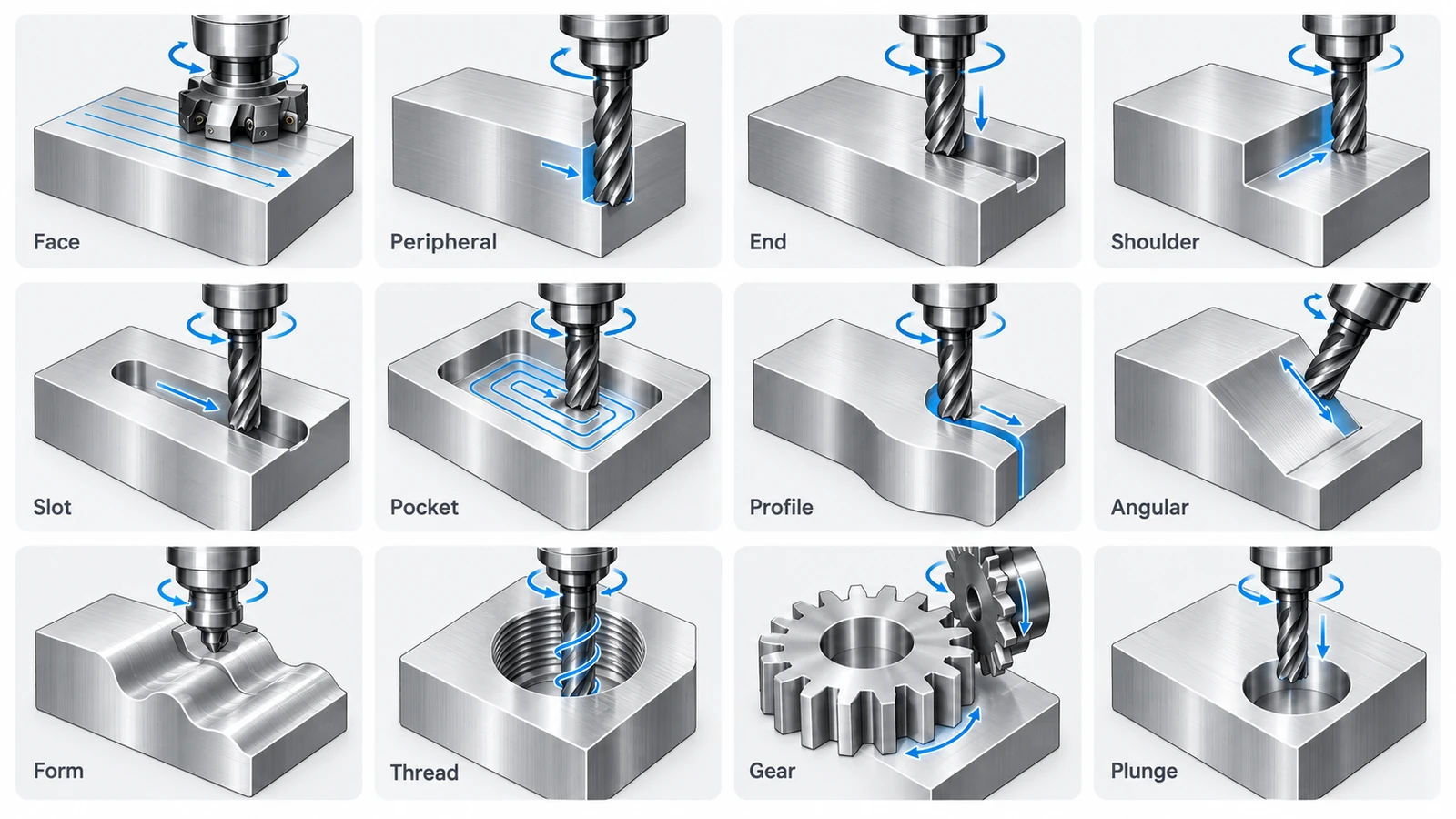
1. Face Milling
Face milling is used to machine a flat surface, usually with the cutter axis positioned perpendicular to the workpiece.
The cutting edges on the face and outer diameter of the cutter remove material as the tool travels across the surface.
Face milling is commonly used for:
- Creating datum surfaces
- Flattening plates and blocks
- Machining housing surfaces
- Preparing a part for later operations
- Finishing large flat areas
Face mills usually have several replaceable inserts, making them efficient for removing material over relatively large surfaces.
For precision CNC parts, face milling is often one of the first operations because a flat reference surface makes later machining and inspection easier.
2. Peripheral Milling
Peripheral milling removes material primarily with the cutting edges around the circumference of the cutter, with the cutter axis generally parallel to the machined surface.
It is a traditional milling classification commonly associated with machining long flat surfaces and side faces. In modern CNC machining, many similar cuts are performed with end mills rather than dedicated slab milling cutters.
Typical applications include:
- Long flat surfaces
- Straight side walls
- Wide side faces
- Parallel surfaces
Compared with face milling, peripheral milling relies more heavily on the cutter’s outer cutting edges rather than its face.
3. End Milling
End milling is one of the most widely used CNC milling operations.
An end mill has cutting edges on both its end and sides, allowing the tool to machine in several directions.
Typical end milling applications include:
- Pockets
- Slots
- Profiles
- Shoulders
- Contours
- Steps
- General material removal
Different end mill geometries are available depending on the part.
Flat end mills are commonly used for flat-bottom features, while ball nose tools are better suited for curved surfaces and 3D contours. Corner-radius end mills can provide additional tool strength while still producing detailed geometry.
Because of its versatility, end milling is widely used for aluminum, steel, stainless steel, titanium, engineering plastics, and many other materials.
4. Shoulder Milling
Shoulder milling produces a horizontal floor and a vertical wall, usually forming a 90-degree shoulder.
It is frequently used for:
- Steps
- Ledges
- Housing walls
- Locating surfaces
- Raised or recessed features
The tool must machine both surfaces accurately while maintaining the required corner geometry.
Shoulder milling is common in brackets, machine components, housings, fixtures, and other precision parts.
For deep shoulders, tool rigidity and cutter reach become important because excessive overhang can increase vibration and wall deflection.
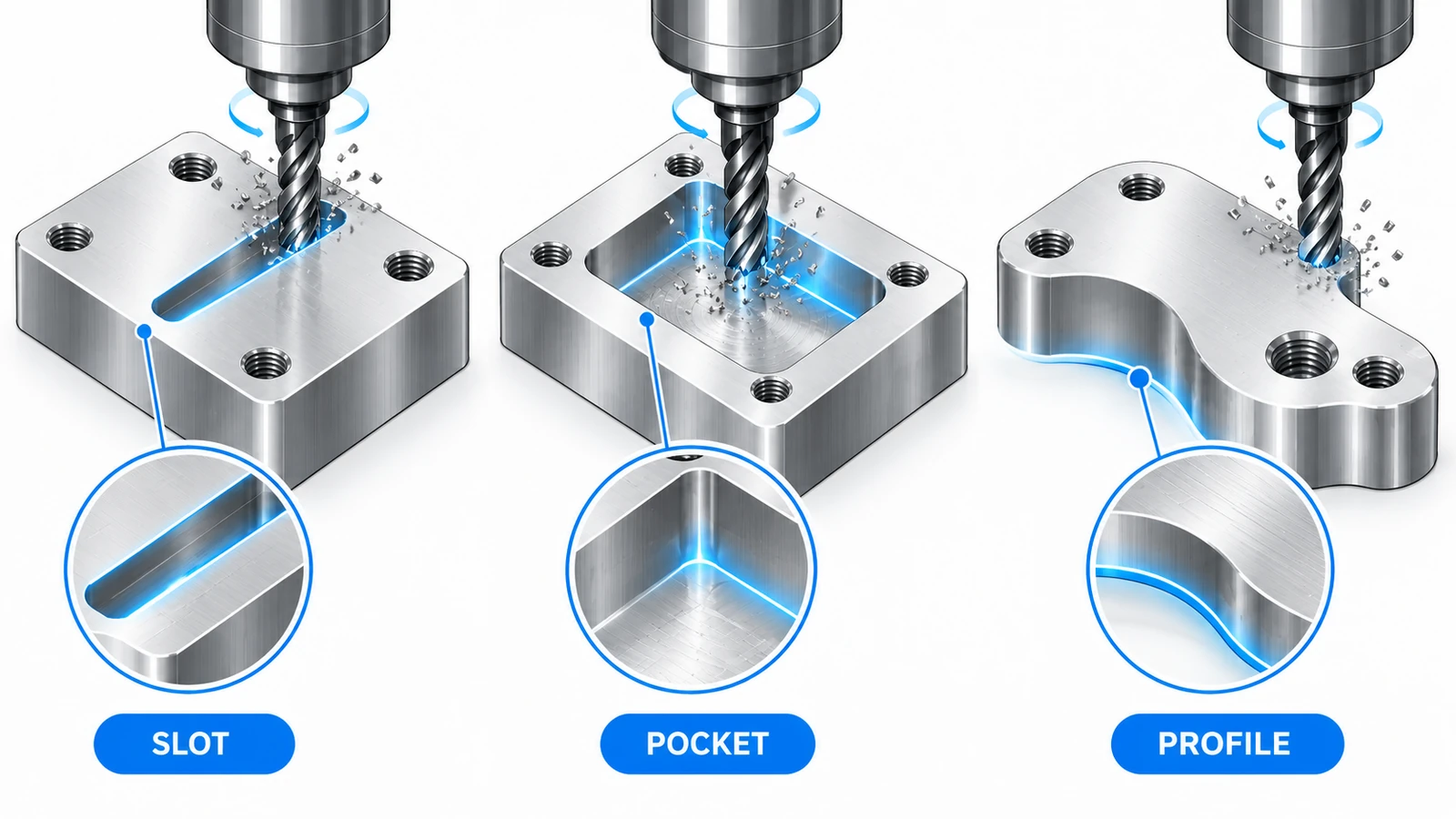
5. Slot Milling
Slot milling is used to create narrow channels in a workpiece.
Common slot features include:
- Straight slots
- Keyways
- Guide channels
- T-slots
- Open-ended slots
- Closed slots
An end mill or dedicated slot cutter may be used depending on slot width and depth.
Full-width slotting generally places more cutting load on the tool than light side milling because the cutter is engaged on both sides.
For deep or narrow slots, chip evacuation is especially important. Poor chip removal can cause recutting, heat buildup, poor surface finish, or premature tool wear.
6. Pocket Milling
Pocket milling removes material from inside a defined area while leaving surrounding walls intact.
Pockets may be:
- Open
- Closed
- Shallow
- Deep
- Rectangular
- Circular
- Irregularly shaped
This operation is commonly used for CNC-machined housings, aerospace brackets, molds, fixtures, electronic enclosures, and structural components.
A typical pocket machining strategy may include roughing first to remove most of the material, followed by finishing passes on the floor and walls.
Deep pockets often require additional consideration for tool reach, chip evacuation, corner radii, and vibration.
7. Profile Milling
Profile milling follows the external or internal contour of a part.
It can be used for simple 2D shapes or more complex 3D surfaces.
Common applications include:
- Outer part profiles
- Curved walls
- Mold surfaces
- Aerospace components
- Sculptured surfaces
- Complex brackets
Profile milling is often performed with flat, ball nose, or corner-radius end mills.
For complex 3D surfaces, several finishing passes may be required to achieve the required surface quality.
When a profile includes multiple angled surfaces or difficult-to-reach features, 5-axis CNC machining can reduce repositioning and allow the cutter to maintain a more favorable cutting angle.
8. Angular Milling
Angular milling creates surfaces that are not perpendicular or parallel to the main axis of the workpiece.
Typical features include:
- Angled faces
- V-grooves
- Dovetails
- Bevels
- Sloped surfaces
Angular features can be machined using angle cutters, end mills, chamfer mills, or multi-axis CNC toolpaths.
The best method depends on the angle, feature depth, cutter access, and production quantity.
Simple angled surfaces can often be produced on a 3-axis machine, while more complex orientations may be easier to machine using 4-axis or 5-axis equipment.
9. Form Milling
Form milling uses a cutter with a specific shape to create a matching profile in the workpiece.
Examples include:
- Concave surfaces
- Convex radii
- Special grooves
- Rounded profiles
- Custom edge forms
The main difference between form milling and profile milling is how the shape is produced.
In form milling, the cutter geometry itself creates the profile.
In profile milling, the CNC toolpath moves a standard cutter along the required geometry.
Form milling can be efficient for repeated production when the same feature must be machined on many parts, but custom form cutters may increase tooling cost.
10. Thread Milling
Thread milling uses a rotating cutter and helical CNC toolpath to create internal or external threads.
Unlike a conventional tap, a thread mill does not have to match the full thread diameter.
This provides several advantages in certain applications.
| Thread Milling | Tapping |
|---|---|
| Uses helical interpolation | Tap follows the thread directly |
| One tool can often machine multiple thread diameters with the same pitch | Usually requires a specific tap size |
| Good chip control | Chips can be harder to manage in deep holes |
| Can machine internal and external threads | Mainly used for internal threads |
| Lower risk of losing the part if the tool breaks | Broken taps can be difficult to remove |
| Usually slower | Usually faster for common small threads |
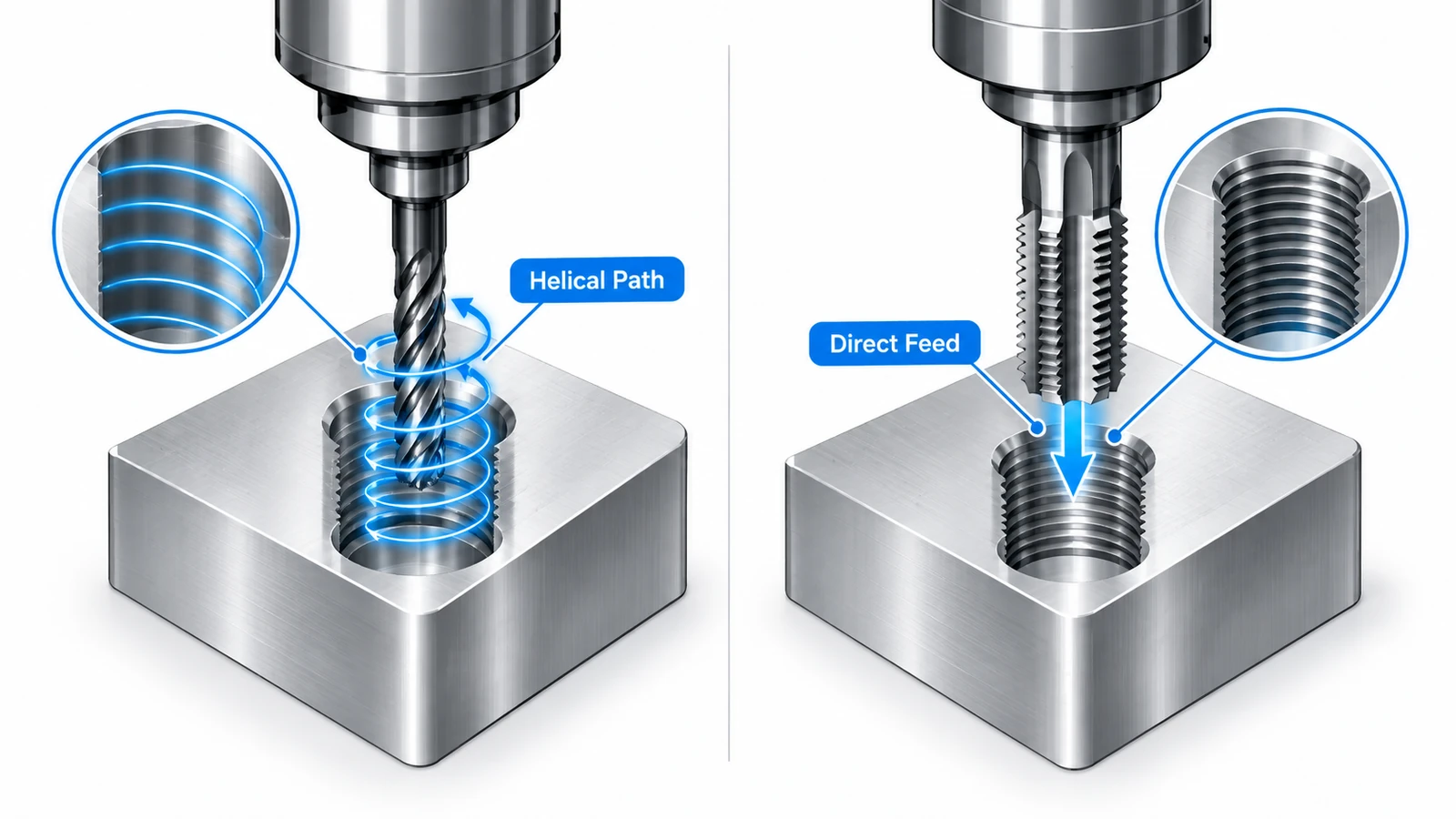
Thread milling is particularly useful for larger threads, expensive parts, difficult materials, and applications where thread quality and process control are important.
11. Gear Milling
Gear milling is used to machine the tooth profiles of gears using dedicated cutters or controlled CNC toolpaths.
It may be used for:
- Spur gears
- Small production runs
- Prototypes
- Custom gear profiles
- Repair components
The cutter geometry and indexing method must match the required tooth form, module or pitch, and number of teeth.
For high-volume gear production, dedicated processes such as hobbing may be faster.
However, CNC gear milling can be useful for prototypes, low-volume production, and parts where gear features must be combined with other machined geometry in the same setup.
12. Plunge Milling
Plunge milling is a milling strategy in which the cutter removes material mainly by feeding along the machine’s Z-axis rather than relying heavily on lateral cutting forces.
Although it is often described alongside other milling operations, plunge milling is better understood as a machining technique used for difficult roughing conditions.
It is particularly useful for:
- Deep cavities
- Long tool overhangs
- Difficult-to-reach areas
- Low-rigidity setups
- Heavy roughing
- Difficult-to-machine materials
Because more of the cutting force is directed along the tool axis, plunge milling can improve stability when conventional side milling causes excessive vibration or tool deflection.
It is commonly followed by pocket, shoulder, or profile finishing operations.
Face Milling vs Peripheral Milling vs End Milling vs Shoulder Milling
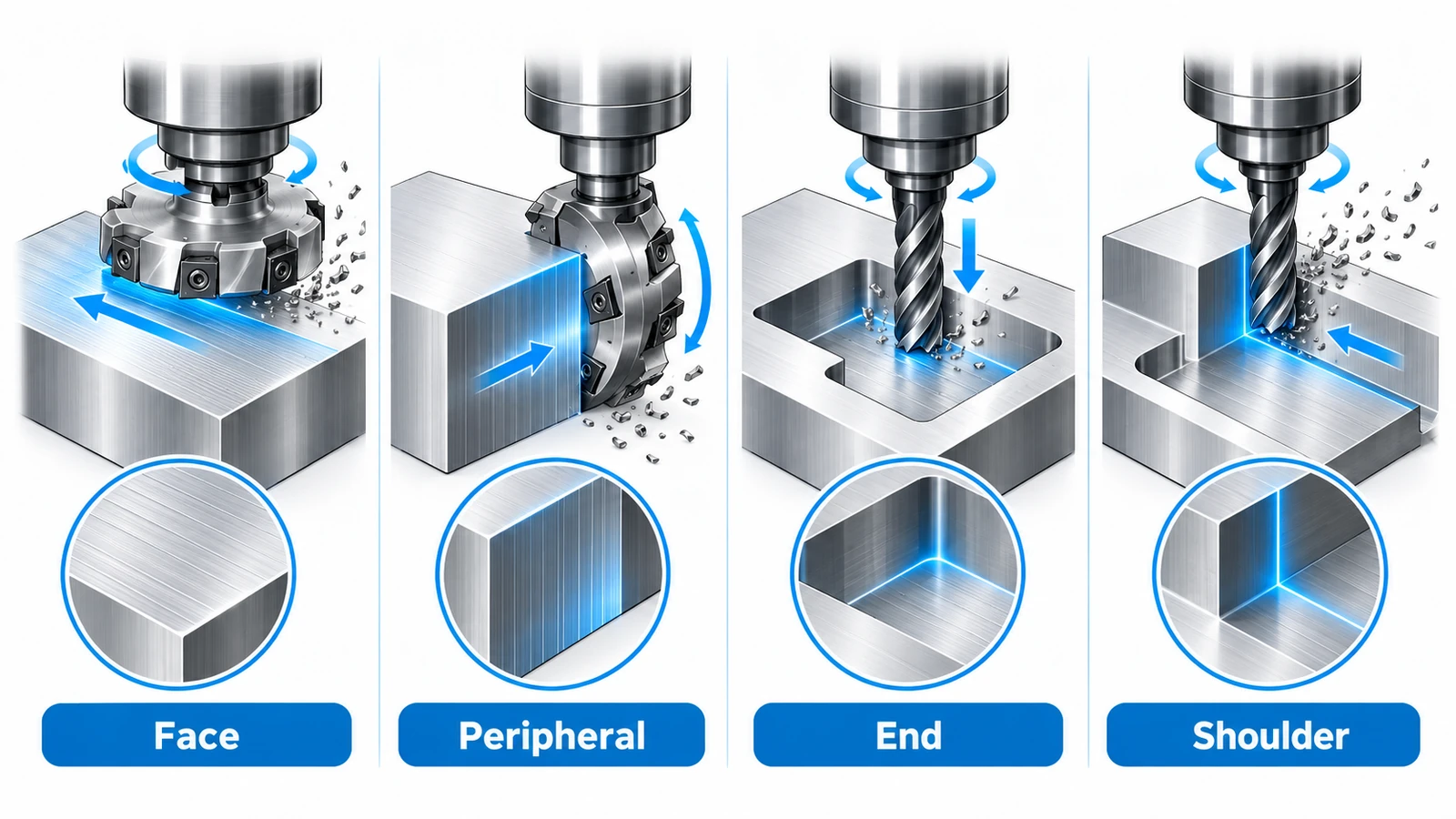
These operations are often confused because the same cutter may sometimes perform more than one of them.
| Operation | Main Purpose | Typical Feature | Cutting Area |
|---|---|---|---|
| Face Milling | Produce flat faces | Datum surface | Mainly cutter face |
| Peripheral Milling | Machine long flat or side surfaces | Side face | Cutter circumference |
| End Milling | General-purpose machining | Slot, pocket, profile | End and sides |
| Shoulder Milling | Create wall and floor | 90° step | End and sides |
The difference is therefore less about the machine itself and more about which part of the cutter is engaged and what geometry is being produced.
Conventional Milling vs Climb Milling
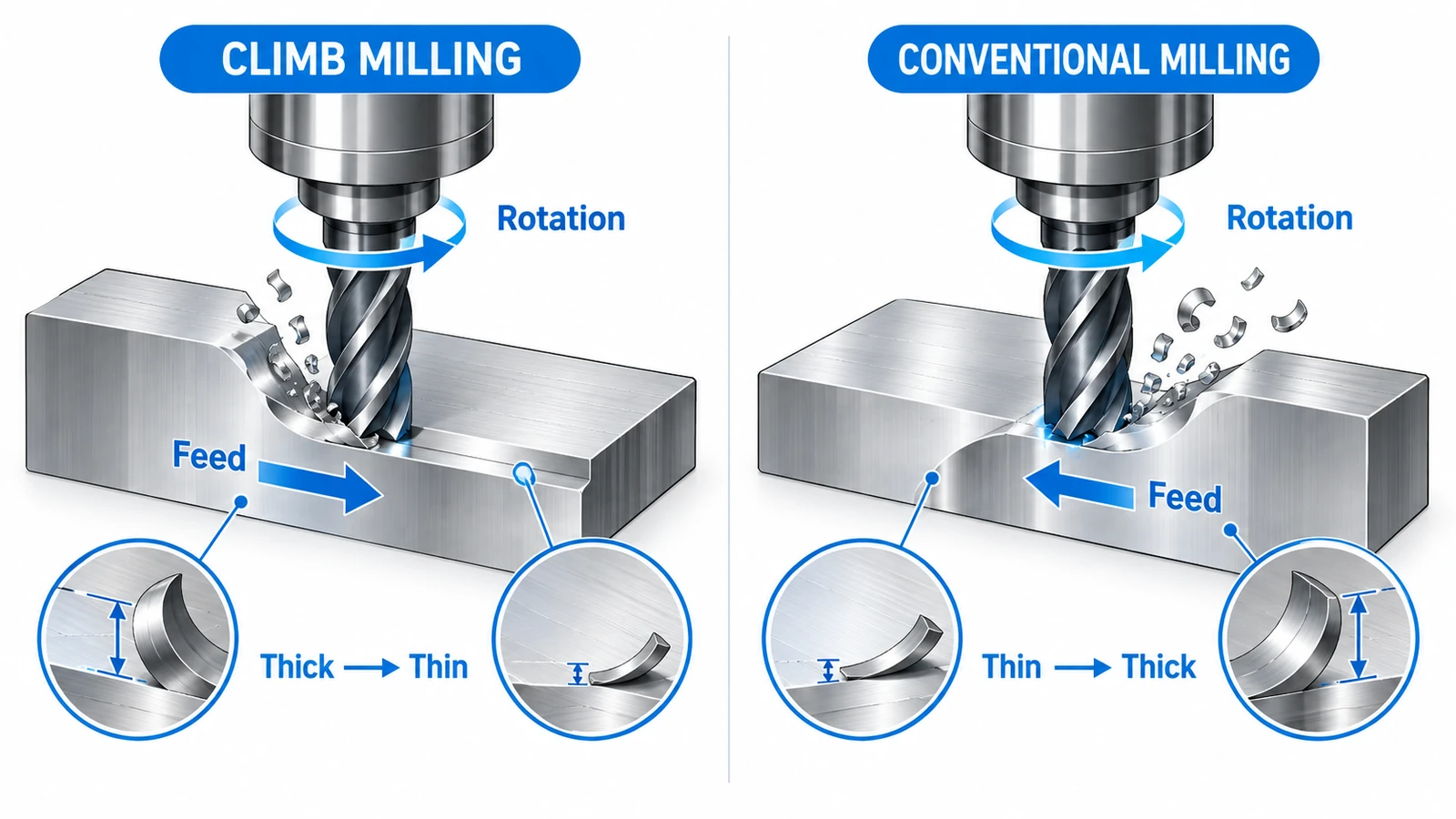
Conventional and climb milling are not separate feature types like slot or pocket milling.
Instead, they describe the relationship between cutter rotation and feed direction.
Climb Milling
In climb milling, cutter rotation moves in the same direction as the feed at the point of contact.
It is widely used on modern CNC machines because it can provide:
- Better surface finish
- Reduced rubbing
- Lower heat generation
- Longer tool life in many applications
Conventional Milling
In conventional milling, the cutter moves against the feed direction at the point of contact.
It may still be useful in certain conditions, such as machining some rough or scaled surfaces or when machine backlash is a concern.
Modern CNC machining generally favors climb milling when the machine, toolholding, setup, and workpiece allow it.
How to Choose the Right Milling Operation
The easiest way to select a milling operation is to start with the feature shown on the engineering drawing.
| Feature to Machine | Recommended Milling Operation |
|---|---|
| Large flat surface | Face milling |
| Flat side surface | Peripheral milling |
| General feature | End milling |
| 90° step or ledge | Shoulder milling |
| Narrow channel | Slot milling |
| Internal cavity | Pocket milling |
| External or curved contour | Profile milling |
| Angled surface | Angular milling |
| Special formed geometry | Form milling |
| Internal or external thread | Thread milling |
| Gear teeth | Gear milling |
| Deep cavity with poor tool rigidity | Plunge milling |
However, geometry is only one factor.
You should also consider:
- Part material
- Required tolerance
- Surface finish
- Cutting tool access
- Feature depth
- Wall thickness
- Machine rigidity
- Tool reach
- Production quantity
In many CNC parts, several milling operations are combined in the same setup.
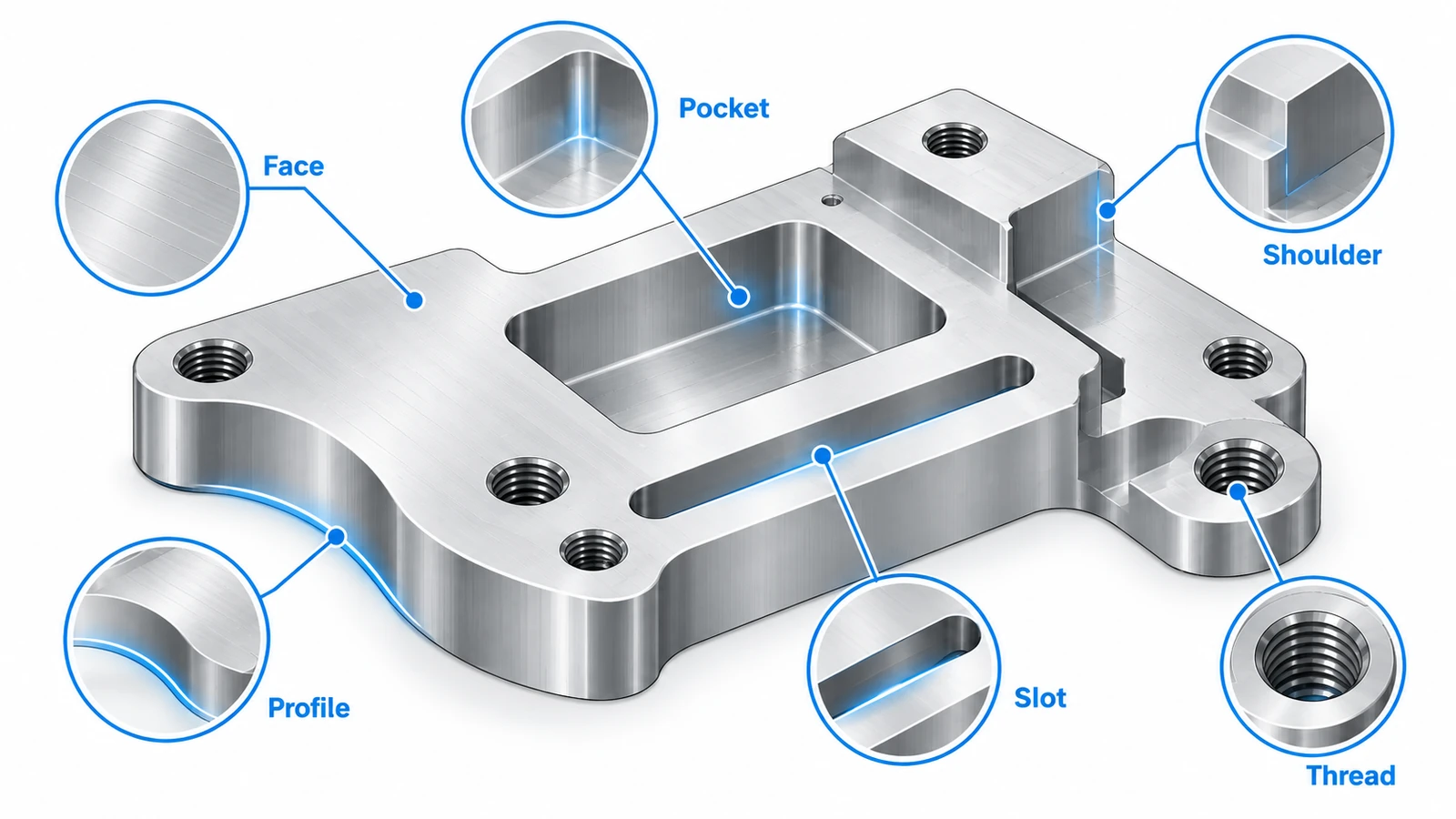
A housing, for example, may require face milling for the datum surface, pocket milling for the internal cavity, shoulder milling for locating steps, slot milling for channels, and thread milling for mounting holes.
How CNC Machine Capability Affects Milling Operations
The same milling operation may be performed differently depending on machine capability.
3-axis CNC milling handles most face, slot, pocket, shoulder, and basic profile operations efficiently.
4-axis milling adds rotary positioning, making it useful for machining multiple sides or features around cylindrical parts with fewer setups.
5-axis CNC milling is better suited to complex contours, angled surfaces, deep features, and parts requiring access from several directions.
Using additional axes does not create a different milling operation by itself. Instead, it improves tool access and can reduce repositioning, setups, and alignment errors.
Final Thoughts
Different milling operations are designed for different part features. Face milling creates broad flat surfaces, slot milling produces channels, pocket milling removes material from cavities, and profile milling follows complex contours.
In practice, most CNC parts require several milling operations in the same setup. The best combination depends on part geometry, material, tolerance, surface finish, tool access, and machine capability.
Frequently Asked Questions
Common milling operations include face milling, end milling, shoulder milling, slot milling, pocket milling, profile milling, peripheral milling, thread milling, angular milling, form milling, gear milling, and plunge milling.
Face milling is mainly used to create broad flat surfaces, while end milling is more versatile and is commonly used for slots, pockets, profiles, shoulders, and other detailed features.
Slot milling is normally used to machine straight slots, channels, and keyways. End mills and dedicated slot cutters are common tools for this operation.
Pocket milling is typically used for internal cavities. Roughing removes most of the material first, followed by finishing passes on the walls and floor when tighter tolerances or better surface finish are required.
Yes. A CNC milling machine can normally perform several operations in one setup. A single part may require face milling, pocket milling, slot milling, shoulder milling, drilling, and thread milling before machining is complete.



